
Noncontextuality inequalities for prepare-transform-measure scenarios
1International Centre for Theory of Quantum Technologies, University of Gdańsk, 80-309 Gdańsk, Poland
2Perimeter Institute for Theoretical Physics, Waterloo, Ontario, Canada, N2L 2Y5
3Basic Research Community for Physics e.V., Germany
| Published: | 2026-10-27, volume 10, page 2250 |
| Editor: | Leon Loveridge |
| Eprint: | arXiv:2407.09624v3 |
| Doi: | https://doi.org/10.22331/q-2026-10-27-2250 |
| Citation: | Quantum 10, 2250 (2026). |
Find this paper interesting or want to discuss? Scite or leave a comment on SciRate.
Abstract
We provide the first systematic technique for deriving witnesses of contextuality in prepare-transform-measure scenarios. More specifically, we show how linear quantifier elimination can be used to compute a polytope of correlations consistent with generalized noncontextuality in such scenarios. This polytope is specified as a set of noncontextuality inequalities that are necessary and sufficient conditions for observed data in the scenario to admit of a classical explanation relative to any linear operational identities, if one ignores some constraints from diagram preservation. While including these latter constraints generally leads to tighter inequalities, it seems that nonlinear quantifier elimination would be required to systematically include them. We also provide a linear program which can certify the nonclassicality of a set of numerical data arising in a prepare-transform-measure experiment. We apply our results to get a robust noncontextuality inequality for transformations that can be violated within the stabilizer subtheory. Finally, we give a simple algorithm for computing all the linear operational identities holding among a given set of states, of transformations, or of measurements.
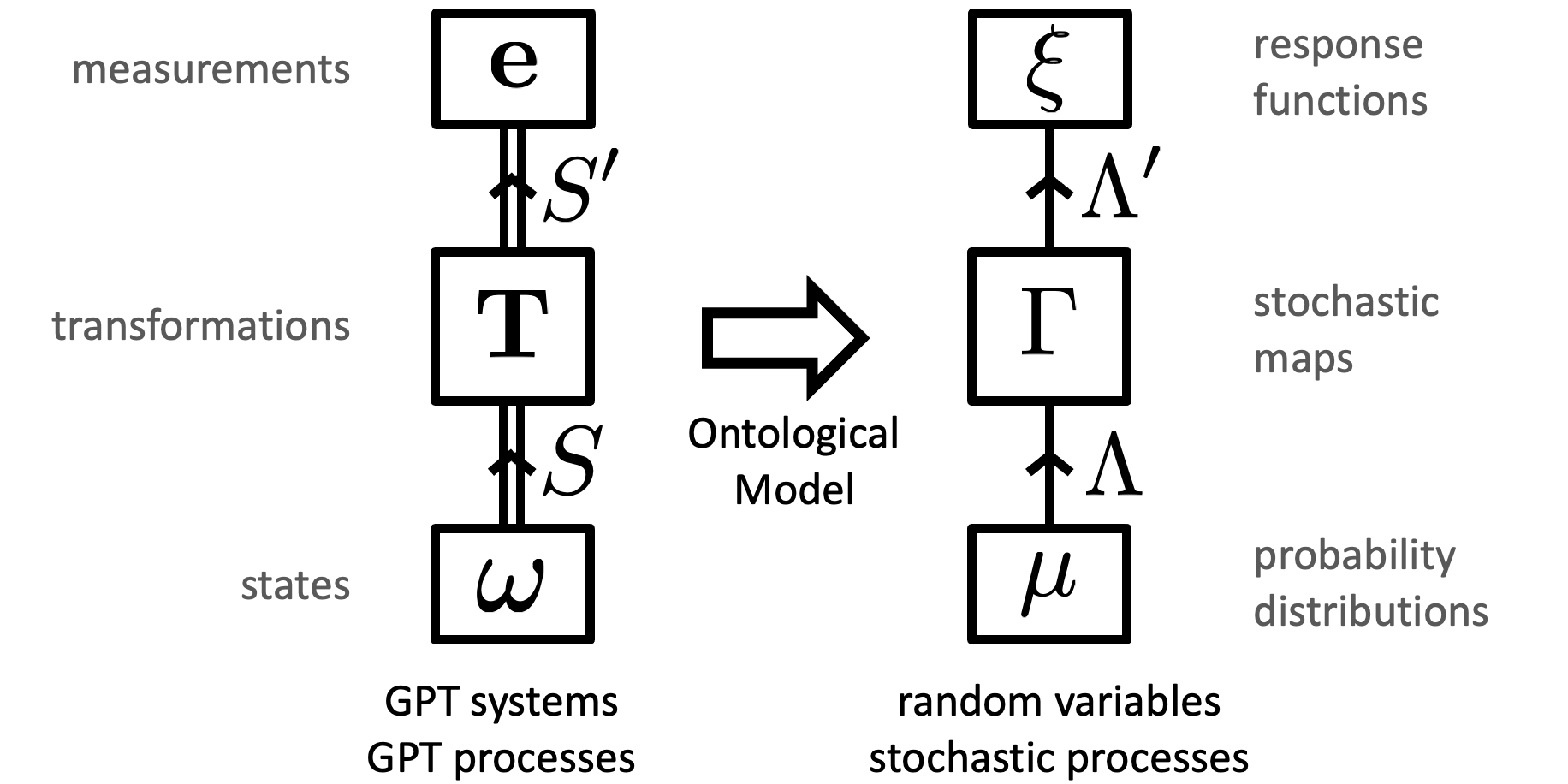
Featured image: An ontological model for a scenario with transformations. We derive constraints on the data that can be generated in any such model that is consistent with the principle of noncontextuality, which captures the class of scenarios that are classically explainable.
Popular summary
► BibTeX data
► References
[1] R. W. Spekkens. ``Contextuality for preparations, transformations, and unsharp measurements''. Phys. Rev. A 71, 052108 (2005).
https://doi.org/10.1103/PhysRevA.71.052108
[2] Robert W. Spekkens. ``The ontological identity of empirical indiscernibles: Leibniz's methodological principle and its significance in the work of Einstein'' (2019). arXiv:1909.04628.
arXiv:1909.04628
[3] Robert W. Spekkens. ``Negativity and Contextuality are Equivalent Notions of Nonclassicality''. Phys. Rev. Lett. 101, 020401 (2008).
https://doi.org/10.1103/PhysRevLett.101.020401
[4] David Schmid, John H. Selby, Elie Wolfe, Ravi Kunjwal, and Robert W. Spekkens. ``Characterization of Noncontextuality in the Framework of Generalized Probabilistic Theories''. PRX Quantum 2, 010331 (2021).
https://doi.org/10.1103/PRXQuantum.2.010331
[5] David Schmid, John H. Selby, Matthew F. Pusey, and Robert W. Spekkens. ``A structure theorem for generalized-noncontextual ontological models''. Quantum 8, 1283 (2024).
https://doi.org/10.22331/q-2024-03-14-1283
[6] Farid Shahandeh. ``Contextuality of General Probabilistic Theories''. PRX Quantum 2, 010330 (2021).
https://doi.org/10.1103/PRXQuantum.2.010330
[7] J. S. Bell. ``On the Einstein Podolsky Rosen paradox''. Physics 1, 195–200 (1964).
https://doi.org/10.1103/PhysicsPhysiqueFizika.1.195
[8] Elie Wolfe, Robert W Spekkens, and Tobias Fritz. ``The inflation technique for causal inference with latent variables''. Journal of Causal Inference 7, 20170020 (2019).
https://doi.org/10.1515/jci-2017-0020
[9] Simon Kochen and Ernst Specker. ``The problem of hidden variables in quantum mechanics''. J. Math. & Mech. 17, 59–87 (1967).
https://doi.org/10.1007/978-94-010-1795-4_17
[10] A J Leggett. ``Testing the limits of quantum mechanics: motivation, state of play, prospects''. Journal of Physics: Condensed Matter 14, R415 (2002).
https://doi.org/10.1088/0953-8984/14/15/201
[11] David Schmid. ``A review and reformulation of macroscopic realism: resolving its deficiencies using the framework of generalized probabilistic theories''. Quantum 8, 1217 (2024).
https://doi.org/10.22331/q-2024-01-03-1217
[12] David Schmid, Haoxing Du, John H. Selby, and Matthew F. Pusey. ``Uniqueness of noncontextual models for stabilizer subtheories''. Phys. Rev. Lett. 129, 120403 (2022).
https://doi.org/10.1103/PhysRevLett.129.120403
[13] Farid Shahandeh. ``Quantum computational advantage implies contextuality'' (2021). arXiv:2112.00024.
arXiv:2112.00024
[14] David Schmid and Robert W Spekkens. ``Contextual advantage for state discrimination''. Phys. Rev. X 8, 011015 (2018).
https://doi.org/10.1103/PhysRevX.8.011015
[15] Kieran Flatt, Hanwool Lee, Carles Roch I Carceller, Jonatan Bohr Brask, and Joonwoo Bae. ``Contextual advantages and certification for maximum-confidence discrimination''. PRX Quantum 3, 030337 (2022).
https://doi.org/10.1103/PRXQuantum.3.030337
[16] Sumit Mukherjee, Shivam Naonit, and A. K. Pan. ``Discriminating three mirror-symmetric states with a restricted contextual advantage''. Phys. Rev. A 106, 012216 (2022).
https://doi.org/10.1103/PhysRevA.106.012216
[17] Jaehee Shin, Donghoon Ha, and Younghun Kwon. ``Quantum contextual advantage depending on nonzero prior probabilities in state discrimination of mixed qubit states''. Entropy 23 (2021).
https://doi.org/10.3390/e23121583
[18] Lorenzo Catani, Matthew Leifer, David Schmid, and Robert W. Spekkens. ``Why interference phenomena do not capture the essence of quantum theory''. Quantum 7, 1119 (2023).
https://doi.org/10.22331/q-2023-09-25-1119
[19] Lorenzo Catani, Matthew Leifer, David Schmid, and Robert W Spekkens. ``Reply to ``comment on `why interference phenomena do not capture the essence of quantum theory''''' (2022). arXiv:2207.11791.
arXiv:2207.11791
[20] Lorenzo Catani, Matthew Leifer, Giovanni Scala, David Schmid, and Robert W. Spekkens. ``Aspects of the phenomenology of interference that are genuinely nonclassical''. Phys. Rev. A 108, 022207 (2023).
https://doi.org/10.1103/PhysRevA.108.022207
[21] John H. Selby, David Schmid, Elie Wolfe, Ana Belén Sainz, Ravi Kunjwal, and Robert W. Spekkens. ``Contextuality without incompatibility''. Phys. Rev. Lett. 130, 230201 (2023).
https://doi.org/10.1103/PhysRevLett.130.230201
[22] John H. Selby, David Schmid, Elie Wolfe, Ana Belén Sainz, Ravi Kunjwal, and Robert W. Spekkens. ``Accessible fragments of generalized probabilistic theories, cone equivalence, and applications to witnessing nonclassicality''. Phys. Rev. A 107, 062203 (2023).
https://doi.org/10.1103/PhysRevA.107.062203
[23] Armin Tavakoli and Roope Uola. ``Measurement incompatibility and steering are necessary and sufficient for operational contextuality''. Phys. Rev. Research 2, 013011 (2020).
https://doi.org/10.1103/PhysRevResearch.2.013011
[24] Lorenzo Catani, Matthew Leifer, Giovanni Scala, David Schmid, and Robert W. Spekkens. ``What is nonclassical about uncertainty relations?''. Phys. Rev. Lett. 129, 240401 (2022).
https://doi.org/10.1103/PhysRevLett.129.240401
[25] Matteo Lostaglio. ``Certifying Quantum Signatures in Thermodynamics and Metrology via Contextuality of Quantum Linear Response''. Phys. Rev. Lett. 125, 230603 (2020).
https://doi.org/10.1103/PhysRevLett.125.230603
[26] David Schmid, Roberto D Baldijão, Yìlè Yīng, Rafael Wagner, and John H Selby. ``Kirkwood-dirac representations beyond quantum states and their relation to noncontextuality''. Physical Review A 110, 052206 (2024).
https://doi.org/10.1103/PhysRevA.110.052206
[27] Matthew F. Pusey. ``Anomalous Weak Values Are Proofs of Contextuality''. Phys. Rev. Lett. 113, 200401 (2014).
https://doi.org/10.1103/PhysRevLett.113.200401
[28] Ravi Kunjwal, Matteo Lostaglio, and Matthew F. Pusey. ``Anomalous weak values and contextuality: Robustness, tightness, and imaginary parts''. Phys. Rev. A 100, 042116 (2019).
https://doi.org/10.1103/PhysRevA.100.042116
[29] Vinicius P. Rossi, David Schmid, John H. Selby, and Ana Belén Sainz. ``Contextuality with vanishing coherence and maximal robustness to dephasing''. Phys. Rev. A 108, 032213 (2023).
https://doi.org/10.1103/PhysRevA.108.032213
[30] Rafael Wagner, Anita Camillini, and Ernesto F. Galvão. ``Coherence and contextuality in a Mach-Zehnder interferometer''. Quantum 8, 1240 (2024).
https://doi.org/10.22331/q-2024-02-05-1240
[31] Roberto D. Baldijão, Rafael Wagner, Cristhiano Duarte, Bárbara Amaral, and Marcelo Terra Cunha. ``Emergence of Noncontextuality under Quantum Darwinism''. PRX Quantum 2, 030351 (2021).
https://doi.org/10.1103/PRXQuantum.2.030351
[32] Robert W. Spekkens, D. H. Buzacott, A. J. Keehn, Ben Toner, and G. J. Pryde. ``Preparation Contextuality Powers Parity-Oblivious Multiplexing''. Phys. Rev. Lett. 102, 010401 (2009).
https://doi.org/10.1103/PhysRevLett.102.010401
[33] Andre Chailloux, Iordanis Kerenidis, Srijita Kundu, and Jamie Sikora. ``Optimal bounds for parity-oblivious random access codes''. New J. Phys. 18, 045003 (2016).
https://doi.org/10.1088/1367-2630/18/4/045003
[34] Andris Ambainis, Manik Banik, Anubhav Chaturvedi, Dmitry Kravchenko, and Ashutosh Rai. ``Parity oblivious d-level random access codes and class of noncontextuality inequalities''. Quantum Inf. Process. 18, 111 (2019).
https://doi.org/10.1007/s11128-019-2228-3
[35] Debashis Saha, Paweł Horodecki, and Marcin Pawłowski. ``State independent contextuality advances one-way communication''. New J. Phys. 21, 093057 (2019).
https://doi.org/10.1088/1367-2630/ab4149
[36] Shiv Akshar Yadavalli and Ravi Kunjwal. ``Contextuality in entanglement-assisted one-shot classical communication''. Quantum 6, 839 (2022).
https://doi.org/10.22331/q-2022-10-13-839
[37] Alley Hameedi, Armin Tavakoli, Breno Marques, and Mohamed Bourennane. ``Communication games reveal preparation contextuality''. Phys. Rev. Lett. 119, 220402 (2017).
https://doi.org/10.1103/PhysRevLett.119.220402
[38] Amanda M Fonseca, Vinicius P Rossi, Roberto D Baldijão, John H Selby, and Ana Belén Sainz. ``Robustness of contextuality under different types of noise as quantifiers for parity-oblivious multiplexing tasks''. Physical Review A 111, 022217 (2025).
https://doi.org/10.1103/PhysRevA.111.022217
[39] Matteo Lostaglio and Gabriel Senno. ``Contextual advantage for state-dependent cloning''. Quantum 4, 258 (2020).
https://doi.org/10.22331/q-2020-04-27-258
[40] Pauli Jokinen, Mirjam Weilenmann, Martin Plávala, Juha-Pekka Pellonpää, Jukka Kiukas, and Roope Uola. ``No-broadcasting characterizes operational contextuality''. Physical review letters 133, 240201 (2024).
https://doi.org/10.1103/PhysRevLett.133.240201
[41] Victoria J. Wright and Máté Farkas. ``Invertible map between bell nonlocal and contextuality scenarios''. Phys. Rev. Lett. 131, 220202 (2023).
https://doi.org/10.1103/PhysRevLett.131.220202
[42] David Schmid, John H. Selby, and Robert W. Spekkens. ``Unscrambling the omelette of causation and inference: The framework of causal-inferential theories'' (2020). arXiv:2009.03297.
arXiv:2009.03297
[43] Yujie Zhang, Jonah Spodek, David Schmid, Carter Reid, Liam J. Morrison, Thomas Jennewein, Kevin J. Resch, and Robert W. Spekkens. ``Entanglement certification using noncontextuality inequalities''. Phys. Rev. X 16, 031057 (2026).
https://doi.org/10.1103/dxpr-wp6l
[44] Ravi Kunjwal and Robert W. Spekkens. ``From the Kochen-Specker Theorem to Noncontextuality Inequalities without Assuming Determinism''. Phys. Rev. Lett. 115, 110403 (2015).
https://doi.org/10.1103/PhysRevLett.115.110403
[45] Ravi Kunjwal and Robert W. Spekkens. ``From statistical proofs of the kochen-specker theorem to noise-robust noncontextuality inequalities''. Phys. Rev. A 97, 052110 (2018).
https://doi.org/10.1103/PhysRevA.97.052110
[46] Ravi Kunjwal. ``Contextuality beyond the Kochen-Specker theorem'' (2016). arXiv:1612.07250.
arXiv:1612.07250
[47] Ravi Kunjwal. ``Beyond the Cabello-Severini-Winter framework: Making sense of contextuality without sharpness of measurements''. Quantum 3, 184 (2019).
https://doi.org/10.22331/q-2019-09-09-184
[48] Ravi Kunjwal. ``Hypergraph framework for irreducible noncontextuality inequalities from logical proofs of the Kochen-Specker theorem''. Quantum 4, 219 (2020).
https://doi.org/10.22331/q-2020-01-10-219
[49] Ravi Kunjwal. ``Fine's theorem, noncontextuality, and correlations in specker's scenario''. Phys. Rev. A 91, 022108 (2015).
https://doi.org/10.1103/PhysRevA.91.022108
[50] Tomáš Gonda, Ravi Kunjwal, David Schmid, Elie Wolfe, and Ana Belén Sainz. ``Almost Quantum Correlations are Inconsistent with Specker's Principle''. Quantum 2, 87 (2018).
https://doi.org/10.22331/q-2018-08-27-87
[51] Michael D Mazurek, Matthew F Pusey, Ravi Kunjwal, Kevin J Resch, and Robert W Spekkens. ``An experimental test of noncontextuality without unphysical idealizations''. Nature communications 7, 1–7 (2016).
https://doi.org/10.1038/ncomms11780
[52] Matthew F. Pusey. ``Robust preparation noncontextuality inequalities in the simplest scenario''. Phys. Rev. A 98, 022112 (2018).
https://doi.org/10.1103/PhysRevA.98.022112
[53] John H. Selby, Elie Wolfe, David Schmid, Ana Belén Sainz, and Vinicius P. Rossi. ``Linear program for testing nonclassicality and an open-source implementation''. Phys. Rev. Lett. 132, 050202 (2024).
https://doi.org/10.1103/PhysRevLett.132.050202
[54] L. Hardy. ``Quantum Theory From Five Reasonable Axioms'' (2001). arXiv:quant-ph/0101012.
arXiv:quant-ph/0101012
[55] Jonathan Barrett. ``Information processing in generalized probabilistic theories''. Phys. Rev. A 75, 032304 (2007).
https://doi.org/10.1103/PhysRevA.75.032304
[56] Matteo Lostaglio. ``Quantum fluctuation theorems, contextuality, and work quasiprobabilities''. Phys. Rev. Lett. 120, 040602 (2018).
https://doi.org/10.1103/PhysRevLett.120.040602
[57] Hammad Anwer, Natalie Wilson, Ralph Silva, Sadiq Muhammad, Armin Tavakoli, and Mohamed Bourennane. ``Noise-robust preparation contextuality shared between any number of observers via unsharp measurements''. Quantum 5, 551 (2021).
https://doi.org/10.22331/q-2021-09-28-551
[58] Matthew F. Pusey and Matthew S. Leifer. ``Logical pre- and post-selection paradoxes are proofs of contextuality''. Electronic Proceedings in Theoretical Computer Science (EPTCS) 195, 295–306 (2015).
https://doi.org/10.4204/EPTCS.195.22
[59] Piers Lillystone, Joel J. Wallman, and Joseph Emerson. ``Contextuality and the single-qubit stabilizer subtheory''. Phys. Rev. Lett. 122, 140405 (2019).
https://doi.org/10.1103/PhysRevLett.122.140405
[60] David Schmid, Robert W. Spekkens, and Elie Wolfe. ``All the noncontextuality inequalities for arbitrary prepare-and-measure experiments with respect to any fixed set of operational equivalences''. Phys. Rev. A 97, 062103 (2018).
https://doi.org/10.1103/PhysRevA.97.062103
[61] Daniel Gottesman. ``Stabilizer codes and quantum error correction'' (1997). arXiv:quant-ph/9705052.
arXiv:quant-ph/9705052
[62] Daniel Gottesman. ``The heisenberg representation of quantum computers''. Proceedings of the XXII International Colloquium on Group Theoretical Methods in Physics, Pages 32–43 (1998).
https://doi.org/10.48550/arXiv.quant-ph/9807006
arXiv:quant-ph/9807006
[63] David Schmid, John H. Selby, and Robert W. Spekkens. ``Addressing some common objections to generalized noncontextuality''. Phys. Rev. A 109, 022228 (2024).
https://doi.org/10.1103/PhysRevA.109.022228
[64] Giulio Chiribella, Giacomo Mauro D'Ariano, and Paolo Perinotti. ``Probabilistic theories with purification''. Phys. Rev. A 81, 062348 (2010).
https://doi.org/10.1103/PhysRevA.81.062348
[65] Matthew F. Pusey, Lídia del Rio, and Bettina Meyer. ``Contextuality without access to a tomographically complete set'' (2019). arXiv:1904.08699.
arXiv:1904.08699
[66] E G Beltrametti and S Bugajski. ``A classical extension of quantum mechanics''. J. Phys. A 28, 3329–3343 (1995).
https://doi.org/10.1088/0305-4470/28/12/007
[67] Christopher Ferrie and Joseph Emerson. ``Frame representations of quantum mechanics and the necessity of negativity in quasi-probability representations''. J. Phys. A 41, 352001 (2008).
https://doi.org/10.1088/1751-8113/41/35/352001
[68] Anirudh Krishna, Robert W Spekkens, and Elie Wolfe. ``Deriving robust noncontextuality inequalities from algebraic proofs of the kochen–specker theorem: the peres–mermin square''. New Journal of Physics 19, 123031 (2017).
https://doi.org/10.1088/1367-2630/aa9168
[69] George B Dantzig and B Curtis Eaves. ``Fourier-Motzkin elimination and its dual''. J. Combin. Th. A 14, 288–297 (1973).
https://doi.org/10.1016/0097-3165(73)90004-6
[70] Egon Balas. ``Projection with a minimal system of inequalities''. Comp. Optimiz. Applic. 10, 189–193 (1998).
https://doi.org/10.1023/A:1018368920203
[71] Colin Jones, Eric C Kerrigan, and Jan Maciejowski. ``Equality Set Projection: A new algorithm for the projection of polytopes in halfspace representation''. Technical Report CUED/F-INFENG/TR.463. Cambridge University Engineering Dept (2004). url: https://infoscience.epfl.ch/handle/20.500.14299/71951.
https://infoscience.epfl.ch/handle/20.500.14299/71951
[72] Demetrius V. Shapot and Alexander M. Lukatskii. ``Solution building for arbitrary system of linear inequalities in an explicit form''. Am. J. Comp. Math. 02, 1–11 (2012).
https://doi.org/10.4236/ajcm.2012.21001
[73] S. I. Bastrakov and N. Yu. Zolotykh. ``Fast method for verifying Chernikov rules in Fourier-Motzkin elimination''. Comp. Mat. and Math. Phys. 55, 160–167 (2015).
https://doi.org/10.1134/S0965542515010042
[74] Patrick J. Daley, Kevin J. Resch, and Robert W. Spekkens. ``Experimentally adjudicating between different causal accounts of bell-inequality violations via statistical model selection''. Phys. Rev. A 105, 042220 (2022).
https://doi.org/10.1103/PhysRevA.105.042220
[75] Michael J. Grabowecky, Christopher A. J. Pollack, Andrew R. Cameron, Robert W. Spekkens, and Kevin J. Resch. ``Experimentally bounding deviations from quantum theory for a photonic three-level system using theory-agnostic tomography''. Phys. Rev. A 105, 032204 (2022).
https://doi.org/10.1103/PhysRevA.105.032204
[76] Michael D. Mazurek, Matthew F. Pusey, Kevin J. Resch, and Robert W. Spekkens. ``Experimentally Bounding Deviations From Quantum Theory in the Landscape of Generalized Probabilistic Theories''. PRX Quantum 2, 020302 (2021).
https://doi.org/10.1103/PRXQuantum.2.020302
[77] Yujie Zhang, David Schmid, Yìlè Yīng, and Robert W. Spekkens. ``Reassessing the boundary between classical and nonclassical for individual quantum processes''. Phys. Rev. X 16, 021050 (2026).
https://doi.org/10.1103/vqfz-wzjg
[78] Arthur Fine. ``Hidden variables, joint probability, and the bell inequalities''. Phys. Rev. Lett. 48, 291–295 (1982).
https://doi.org/10.1103/PhysRevLett.48.291
[79] Itamar Pitowsky. ``Quantum probability—quantum logic''. Volume 321 of Lecture Notes in Physics. Springer. Berlin, Heidelberg (1989).
https://doi.org/10.1007/BFb0021186
[80] Anubhav Chaturvedi, Máté Farkas, and Victoria J Wright. ``Characterising and bounding the set of quantum behaviours in contextuality scenarios''. Quantum 5, 484 (2021).
https://doi.org/10.22331/q-2021-06-29-484
[81] Armin Tavakoli, Emmanuel Zambrini Cruzeiro, Roope Uola, and Alastair A. Abbott. ``Bounding and simulating contextual correlations in quantum theory''. PRX Quantum 2, 020334 (2021).
https://doi.org/10.1103/PRXQuantum.2.020334
[82] Peter Janotta and Raymond Lal. ``Generalized probabilistic theories without the no-restriction hypothesis''. Phys. Rev. A 87, 052131 (2013).
https://doi.org/10.1103/PhysRevA.87.052131
Cited by
[1] Yujie Zhang, Jonah Spodek, David Schmid, Carter Reid, Liam J. Morrison, Thomas Jennewein, Kevin J. Resch, and Robert W. Spekkens, "Entanglement Certification Using Noncontextuality Inequalities", Physical Review X 16 3, 031057 (2026).
[2] David Schmid, John H. Selby, Vinicius P. Rossi, Roberto D. Baldijão, and Ana Belén Sainz, "Shadows and subsystems of generalized probabilistic theories: when tomographic incompleteness is not a loophole for contextuality proofs", Quantum 9, 1880 (2025).
[3] Pauli Jokinen, Mirjam Weilenmann, Martin Plávala, Juha-Pekka Pellonpää, Jukka Kiukas, and Roope Uola, "No-Broadcasting Characterizes Operational Contextuality", Physical Review Letters 133 24, 240201 (2024).
[4] Alisson Tezzin, Bárbara Amaral, and Jonte R. Hance, "Sufficiency of the counterfactual account of Lüders' rule to rule out ontological models of quantum mechanics", Physical Review A 112 5, 052208 (2025).
[5] Yujie Zhang, David Schmid, Yìlè Yīng, and Robert W. Spekkens, "Reassessing the Boundary between Classical and Nonclassical for Individual Quantum Processes", Physical Review X 16 2, 021050 (2026).
[6] Sujan V. K and Ravi Kunjwal, "No-go theorem for quantum realization of extremal correlations", arXiv:2509.14879, (2025).
[7] Yujie Zhang, Yìlè Yīng, and David Schmid, "Quantifiers and witnesses for the nonclassicality of measurements and of states", Quantum 10, 2180 (2026).
[8] Alisson Tezzin, Bárbara Amaral, and Jonte R. Hance, "Incompatibility of deterministic underlying states with a counterfactual account of Lüders' rule", Physical Review A 112 5, L050202 (2025).
[9] Soumyabrata Hazra, Debashis Saha, Anubhav Chaturvedi, Subhankar Bera, and A. S. Majumdar, "Efficient Computation of Generalized Noncontextual Polytopes and Quantum violation of their Facet Inequalities", Quantum 10, 2015 (2026).
[10] Theodoros Yianni and Farid Shahandeh, "Complexity of contextuality", Physical Review A 113 3, 032215 (2026).
[11] Laurens Walleghem, "Questioning the absoluteness of free choices when internalized in Wigner's friend scenarios", Physical Review A 114 3, 032431 (2026).
[12] Theodoros Yianni, Nyan Raess, and Farid Shahandeh, "Linear Algebra of Generalized Contextuality in All Prepare-Transform-Measure Scenarios", arXiv:2607.26139, (2026).
[13] Ravi Kunjwal, "Quantumness via Discrete Structures", arXiv:2512.10063, (2025).
The above citations are from SAO/NASA ADS (last updated successfully 2026-10-27 15:53:17). The list may be incomplete as not all publishers provide suitable and complete citation data.
Could not fetch Crossref cited-by data during last attempt 2026-10-27 15:53:15: Could not fetch cited-by data for 10.22331/q-2026-10-27-2250 from Crossref. This is normal if the DOI was registered recently.
This Paper is published in Quantum under the Creative Commons Attribution 4.0 International (CC BY 4.0) license. Copyright remains with the original copyright holders such as the authors or their institutions.