
Variational Perturbation Theory in Open Quantum Systems for Efficient Steady State Computation
Alice & Bob, 53 boulevard du Général Martial Valin, 75015 Paris, France
| Published: | 2026-10-22, volume 10, page 2246 |
| Editor: | Di Fang |
| Eprint: | arXiv:2504.00085v4 |
| Doi: | https://doi.org/10.22331/q-2026-10-22-2246 |
| Citation: | Quantum 10, 2246 (2026). |
Find this paper interesting or want to discuss? Scite or leave a comment on SciRate.
Abstract
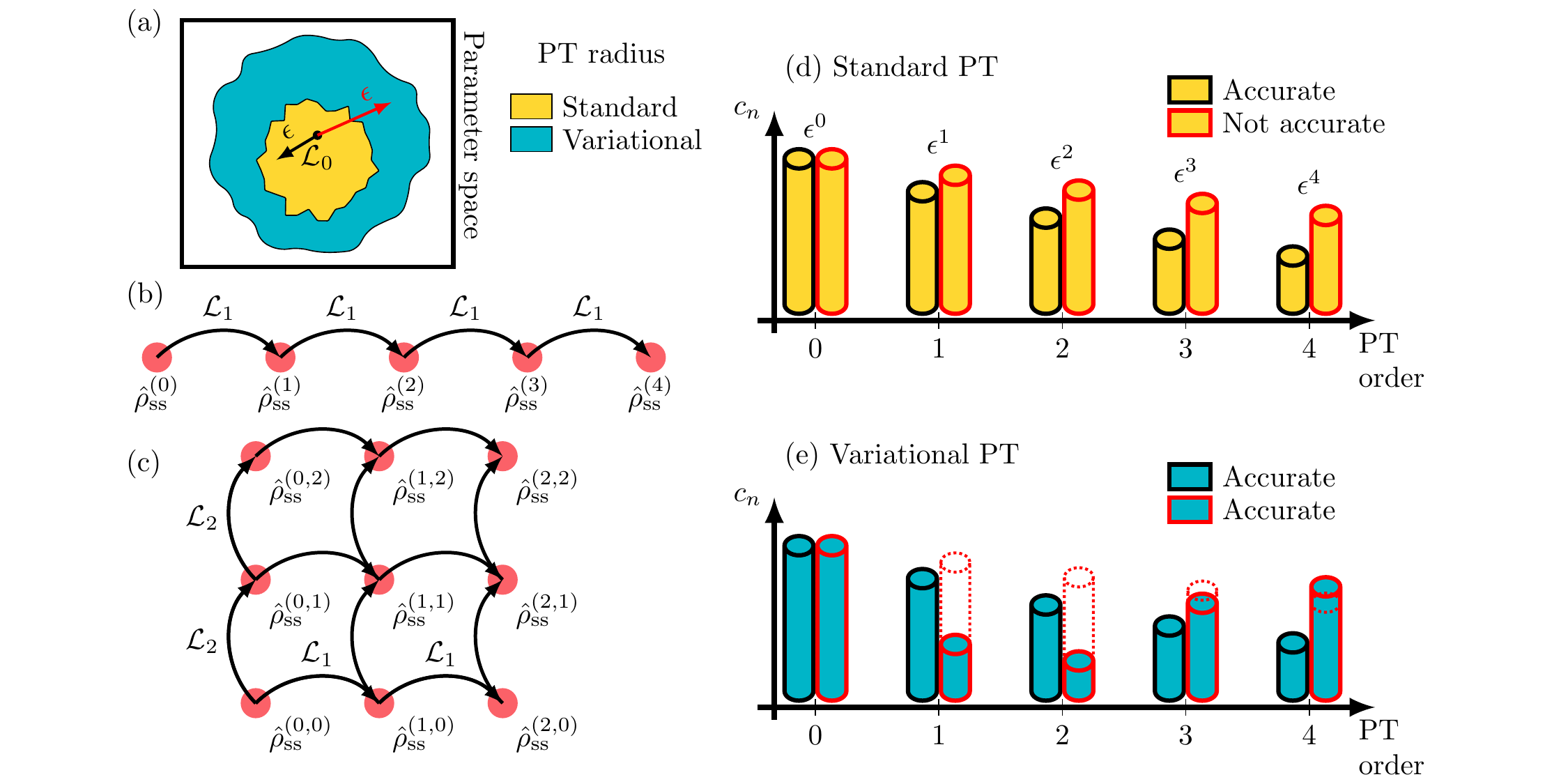
Determining the steady state of an open quantum system is crucial for characterizing quantum devices and studying various physical phenomena. Often, computing a single steady state is insufficient, and it is necessary to explore its dependence on multiple external parameters. In such cases, calculating the steady state independently for each combination of parameters quickly becomes intractable. Perturbation theory (PT) can mitigate this challenge by expanding steady states around reference parameters, minimizing redundant computations across neighboring parameter values. However, PT has two significant limitations: it relies on the pseudo-inverse – a numerically costly operation – and has a limited radius of convergence. In this work, we remove both of these roadblocks. First, we introduce a variational perturbation theory (VPT) and its multipoint generalization that significantly extends the radius of convergence even in the presence of non-analytic effects such as dissipative phase transitions. Then, we develop two numerical strategies that eliminate the need to compute pseudo-inverses. The first relies on a single LU decomposition to efficiently construct the steady state within the convergence region, while the second reformulates VPT as a Krylov space recycling problem and uses preconditioned iterative methods. We benchmark these approaches across various models, demonstrating their broad applicability and significant improvements over standard PT.
► BibTeX data
► References
[1] S. Haroche and J. M. Raimond. ``Exploring the quantum: Atoms, cavities, and photons''. Oxford University Press. Oxford (2006).
https://doi.org/10.1093/acprof:oso/9780198509141.001.0001
[2] H. M. Wiseman and G. J. Milburn. ``Quantum measurement and control''. Cambridge University Press. Cambridge (2010).
https://doi.org/10.1017/CBO9780511813948
[3] H. P. Breuer and F. Petruccione. ``The theory of open quantum systems''. Oxford University Press. Oxford (2007).
https://doi.org/10.1093/acprof:oso/9780199213900.001.0001
[4] R. Fazio, J. Keeling, L. Mazza, and M. Schiró. ``Many-body open quantum systems''. SciPost Phys. Lect. Notes 99 (2025).
https://doi.org/10.21468/SciPostPhysLectNotes.99
[5] A. Blais, A. L. Grimsmo, S. M. Girvin, and A. Wallraff. ``Circuit quantum electrodynamics''. Rev. Mod. Phys. 93, 025005 (2021).
https://doi.org/10.1103/RevModPhys.93.025005
[6] I. Carusotto and C. Ciuti. ``Quantum fluids of light''. Rev. Mod. Phys. 85, 299–366 (2013).
https://doi.org/10.1103/RevModPhys.85.299
[7] H. Ritsch, P. Domokos, F. Brennecke, and T. Esslinger. ``Cold atoms in cavity-generated dynamical optical potentials''. Rev. Mod. Phys. 85, 553–601 (2013).
https://doi.org/10.1103/RevModPhys.85.553
[8] L. D. Carr, D. DeMille, R. V. Krems, and J. Ye. ``Cold and ultracold molecules: science, technology and applications''. New J. Phys. 11, 055049 (2009).
https://doi.org/10.1088/1367-2630/11/5/055049
[9] D. Leibfried, R. Blatt, C. Monroe, and D. Wineland. ``Quantum dynamics of single trapped ions''. Rev. Mod. Phys. 75, 281–324 (2003).
https://doi.org/10.1103/RevModPhys.75.281
[10] F. Ferrari, L. Gravina, D. Eeltink, P. Scarlino, V. Savona, and F. Minganti. ``Dissipative quantum chaos unveiled by stochastic quantum trajectories''. Phys. Rev. Res. 7, 013276 (2025).
https://doi.org/10.1103/PhysRevResearch.7.013276
[11] D. Dahan, G. Arwas, and E. Grosfeld. ``Classical and quantum chaos in chirally-driven, dissipative Bose-Hubbard systems''. npj Quantum Inf. 8 (2022).
https://doi.org/10.1038/s41534-022-00518-2
[12] E. M. Kessler, G. Giedke, A. Imamoglu, S. F. Yelin, M. D. Lukin, and J. I. Cirac. ``Dissipative phase transition in a central spin system''. Phys. Rev. A 86, 012116 (2012).
https://doi.org/10.1103/PhysRevA.86.012116
[13] H. J. Carmichael. ``Breakdown of photon blockade: A dissipative quantum phase transition in zero dimensions''. Phys. Rev. X 5, 031028 (2015).
https://doi.org/10.1103/PhysRevX.5.031028
[14] F. Minganti, A. Biella, N. Bartolo, and C. Ciuti. ``Spectral theory of Liouvillians for dissipative phase transitions''. Phys. Rev. A 98, 042118 (2018).
https://doi.org/10.1103/PhysRevA.98.042118
[15] M. J. Hartmann, F. G. S. L. Brandão, and M. B. Plenio. ``Strongly interacting polaritons in coupled arrays of cavities''. Nat. Phys. 2, 849–855 (2006).
https://doi.org/10.1038/nphys462
[16] D. Roberts and A. A. Clerk. ``Driven-dissipative quantum Kerr resonators: New exact solutions, photon blockade and quantum bistability''. Phys. Rev. X 10, 021022 (2020).
https://doi.org/10.1103/PhysRevX.10.021022
[17] F. Minganti, N. Bartolo, J. Lolli, W. Casteels, and C. Ciuti. ``Exact results for Schrödinger cats in driven-dissipative systems and their feedback control''. Sci. Rep. 6, 26987 (2016).
https://doi.org/10.1038/srep26987
[18] P. D. Drummond and D. F. Walls. ``Quantum theory of optical bistability. i. nonlinear polarisability model''. J. Phys. A: Math. Gen. 13, 725–741 (1980).
https://doi.org/10.1088/0305-4470/13/2/034
[19] H. Weimer, A. Kshetrimayum, and R. Orús. ``Simulation methods for open quantum many-body systems''. Rev. Mod. Phys. 93, 015008 (2021).
https://doi.org/10.1103/RevModPhys.93.015008
[20] M. B. Plenio and P. L. Knight. ``The quantum-jump approach to dissipative dynamics in quantum optics''. Rev. Mod. Phys. 70, 101 (1998).
https://doi.org/10.1103/RevModPhys.70.101
[21] A. J. Daley. ``Quantum trajectories and open many-body quantum systems''. Adv. Phys. 63, 77–149 (2014).
https://doi.org/10.1080/00018732.2014.933502
[22] S. Finazzi, A. Le Boité, F. Storme, A. Baksic, and C. Ciuti. ``Corner-space renormalization method for driven-dissipative two-dimensional correlated systems''. Phys. Rev. Lett. 115, 080604 (2015).
https://doi.org/10.1103/PhysRevLett.115.080604
[23] R. Rota, F. Storme, N. Bartolo, R. Fazio, and C. Ciuti. ``Critical behavior of dissipative two-dimensional spin lattices''. Phys. Rev. B 95, 134431 (2017).
https://doi.org/10.1103/PhysRevB.95.134431
[24] A. Kshetrimayum, H. Weimer, and R. Orús. ``A simple tensor network algorithm for two-dimensional steady states''. Nat. Commun. 8, 1291 (2017).
https://doi.org/10.1038/s41467-017-01511-6
[25] A. H. Werner, D. Jaschke, P. Silvi, M. Kliesch, T. Calarco, J. Eisert, and S. Montangero. ``Positive tensor network approach for simulating open quantum many-body systems''. Phys. Rev. Lett. 116, 237201 (2016).
https://doi.org/10.1103/PhysRevLett.116.237201
[26] F. Vicentini, A. Biella, N. Regnault, and C. Ciuti. ``Variational neural-network ansatz for steady states in open quantum systems''. Phys. Rev. Lett. 122, 250503 (2019).
https://doi.org/10.1103/PhysRevLett.122.250503
[27] N. Yoshioka and R. Hamazaki. ``Constructing neural stationary states for open quantum many-body systems''. Phys. Rev. B 99, 214306 (2019).
https://doi.org/10.1103/PhysRevB.99.214306
[28] P. Deuar and P. D. Drummond. ``Correlations in a BEC collision: first-principles quantum dynamics with 150 000 atoms''. Phys. Rev. Lett. 98, 120402 (2007).
https://doi.org/10.1103/PhysRevLett.98.120402
[29] A. Polkovnikov. ``Phase space representation of quantum dynamics''. Ann. Phys. 325, 1790–1852 (2010).
https://doi.org/10.1016/j.aop.2010.02.006
[30] J. Jin, A. Biella, O. Viyuela, L. Mazza, J. Keeling, R. Fazio, and D. Rossini. ``Cluster mean-field approach to the steady-state phase diagram of dissipative spin systems''. Phys. Rev. X 6, 031011 (2016).
https://doi.org/10.1103/PhysRevX.6.031011
[31] G. Robichon and A. Tilloy. ``Bootstrapping the stationary state of bosonic open quantum systems''. Phys. Rev. A 113, 062440 (2026).
https://doi.org/10.1103/5db2-q49l
[32] H. Weimer. ``Variational principle for steady states of dissipative quantum many-body systems''. Phys. Rev. Lett. 114, 040402 (2015).
https://doi.org/10.1103/PhysRevLett.114.040402
[33] A. C. Y. Li, F. Petruccione, and J. Koch. ``Perturbative approach to Markovian open quantum systems''. Sci. Rep. 4, 4887 (2014).
https://doi.org/10.1038/srep04887
[34] F. Benatti, A. Nagy, and H. Narnhofer. ``Asymptotic entanglement and Lindblad dynamics: a perturbative approach''. J. Phys. A: Math. Theor. 44, 155303 (2011).
https://doi.org/10.1088/1751-8113/44/15/155303
[35] A. C. Y. Li, F. Petruccione, and J. Koch. ``Resummation for nonequilibrium perturbation theory and application to open quantum lattices''. Phys. Rev. X 6, 021037 (2016).
https://doi.org/10.1103/PhysRevX.6.021037
[36] H. Christiansen, V. V. Baran, and J. Paaske. ``Reduced basis method for driven-dissipative quantum systems''. Phys. Rev. Lett. 135, 236503 (2025).
https://doi.org/10.1103/7429-w2mx
[37] O. Nagib and T. G. Walker. ``Exact steady state of perturbed open quantum systems''. Phys. Rev. Res. 7, 033076 (2025).
https://doi.org/10.1103/kgsg-3npp
[38] A. K. Noor and H. E. Lowder. ``Approximate techniques of strctural reanalysis''. Comput. Struct. 4, 801–812 (1974).
https://doi.org/10.1016/0045-7949(74)90046-7
[39] J. N. Silverman and J. C. van Leuven. ``Perturbational-variational approach to the calculation of variational wave functions. i. theory''. Phys. Rev. 162, 1175 (1967).
https://doi.org/10.1103/PhysRev.162.1175
[40] L. Garrigue and B. Stamm. ``On reduced basis methods for eigenvalue problems, and on its coupling with perturbation theory'' (2025). arXiv:2408.11924.
arXiv:2408.11924
[41] V. Gebhart, R. Santagati, A. A. Gentile, E. M. Gauger, D. Craig, N. Ares, L. Banchi, F. Marquardt, L. Pezze, and C. Bonato. ``Learning quantum systems''. Nat. Rev. Phys. 5, 141–156 (2023).
https://doi.org/10.1038/s42254-022-00552-1
[42] G. Beaulieu, F. Minganti, S. Frasca, V. Savona, S. Felicetti, R. Di Candia, and P. Scarlino. ``Observation of first- and second-order dissipative phase transitions in a two-photon driven Kerr resonator''. Nat. Commun. 16, 1951 (2025).
https://doi.org/10.1038/s41467-025-56830-w
[43] C. Berdou, A. Murani, U. Reglade, W. C. Smith, M. Villiers, J. Palomo, M. Rosticher, A. Denis, P. Morfin, M. Delbecq, et al. ``One hundred second bit-flip time in a two-photon dissipative oscillator''. PRX Quantum 4, 020350 (2023).
https://doi.org/10.1103/PRXQuantum.4.020350
[44] L. N. Trefethen and D. Bau. ``Numerical linear algebra''. SIAM. (1997).
https://doi.org/10.1137/1.9780898719574
[45] N. Bartolo, F. Minganti, W. Casteels, and C. Ciuti. ``Exact steady state of a Kerr resonator with one- and two-photon driving and dissipation: Controllable Wigner-function multimodality and dissipative phase transitions''. Phys. Rev. A 94, 033841 (2016).
https://doi.org/10.1103/PhysRevA.94.033841
[46] W. Casteels, F. Storme, A. Le Boité, and C. Ciuti. ``Power laws in the dynamic hysteresis of quantum nonlinear photonic resonators''. Phys. Rev. A 93, 033824 (2016).
https://doi.org/10.1103/PhysRevA.93.033824
[47] S. G. Krantz and H. R. Parks. ``The implicit function theorem: history, theory, and applications''. Springer. (2002).
https://doi.org/10.1007/978-1-4612-0059-8
[48] Z. Leghtas, S. Touzard, I. M. Pop, A. Kou, B. Vlastakis, A. Petrenko, K. M. Sliwa, A. Narla, S. Shankar, M. J. Hatridge, M. Reagor, L. Frunzio, R. J. Schoelkopf, M. Mirrahimi, and M. H. Devoret. ``Confining the state of light to a quantum manifold by engineered two-photon loss''. Science 347, 853–857 (2015).
https://doi.org/10.1126/science.aaa2085
[49] R. Lescanne, M. Villiers, T. Peronnin, A. Sarlette, M. Delbecq, B. Huard, T. Kontos, M. Mirrahimi, and Z. Leghtas. ``Exponential suppression of bit-flips in a qubit encoded in an oscillator''. Nat. Phys. 16, 509–513 (2020).
https://doi.org/10.1038/s41567-020-0824-x
[50] P. Virtanen, R. Gommers, T. E. Oliphant, M. Haberland, T. Reddy, D. Cournapeau, E. Burovski, P. Peterson, W. Weckesser, J. Bright, et al. ``SciPy 1.0: fundamental algorithms for scientific computing in Python''. Nat. Methods 17, 261–272 (2020).
https://doi.org/10.1038/s41592-019-0686-2
[51] D. C. Liu and J. Nocedal. ``On the limited memory BFGS method for large scale optimization''. Math. Program. 45, 503–528 (1989).
https://doi.org/10.1007/bf01589116
[52] Y. Saad and M. H. Schultz. ``GMRES: A generalized minimal residual algorithm for solving nonsymmetric linear systems''. SIAM J. Sci. Stat. Comput. 7, 856–869 (1986).
https://doi.org/10.1137/0907058
[53] H. A. Van der Vorst. ``Bi-CGSTAB: A fast and smoothly converging variant of Bi-CG for the solution of nonsymmetric linear systems''. SIAM J. Sci. Stat. Comput. 13, 631–644 (1992).
https://doi.org/10.1137/0913035
[54] M. R. Hestenes, E. Stiefel, et al. ``Methods of conjugate gradients for solving linear systems''. J. Res. Natl. Bur. Stand. 49, 409 (1952).
https://doi.org/10.6028/jres.049.044
[55] Y. Saad. ``Iterative methods for sparse linear systems''. SIAM. (2003).
https://doi.org/10.1137/1.9780898718003
[56] P. D. Nation. ``Steady-state solution methods for open quantum optical systems'' (2015). arXiv:1504.06768.
arXiv:1504.06768
[57] M. L. Parks, E. de Sturler, G. Mackey, D. D. Johnson, and S. Maiti. ``Recycling Krylov subspaces for sequences of linear systems''. SIAM J. Sci. Comput. 28, 1651–1674 (2006).
https://doi.org/10.1137/040607277
[58] K. M. Soodhalter, D. B. Szyld, and F. Xue. ``Krylov subspace recycling for sequences of shifted linear systems''. Appl. Numer. Math. 81, 105–118 (2014).
https://doi.org/10.1016/j.apnum.2014.02.006
[59] K. M. Soodhalter, E. de Sturler, and M. E. Kilmer. ``A survey of subspace recycling iterative methods''. GAMM-Mitt. 43, e202000016 (2020).
https://doi.org/10.1002/gamm.202000016
[60] T. E. Lee, S. Gopalakrishnan, and M. D. Lukin. ``Unconventional magnetism via optical pumping of interacting spin systems''. Phys. Rev. Lett. 110, 257204 (2013).
https://doi.org/10.1103/PhysRevLett.110.257204
[61] R. Rota, F. Minganti, A. Biella, and C. Ciuti. ``Dynamical properties of dissipative ${XYZ}$ Heisenberg lattices''. New J. Phys. 20, 045003 (2018).
https://doi.org/10.1088/1367-2630/aab703
[62] D. Huybrechts, F. Minganti, F. Nori, M. Wouters, and N. Shammah. ``Validity of mean-field theory in a dissipative critical system: Liouvillian gap, $\mathbb{PT}$-symmetric antigap, and permutational symmetry in the ${XYZ}$ model''. Phys. Rev. B 101, 214302 (2020).
https://doi.org/10.1103/PhysRevB.101.214302
[63] A. Biella, J. Jin, O. Viyuela, C. Ciuti, R. Fazio, and D. Rossini. ``Linked cluster expansions for open quantum systems on a lattice''. Phys. Rev. B 97, 035103 (2018).
https://doi.org/10.1103/PhysRevB.97.035103
Cited by
[1] Hans Christiansen, Virgil V. Baran, and Jens Paaske, "Reduced Basis Method for Driven-Dissipative Quantum Systems", Physical Review Letters 135 23, 236503 (2025).
[2] Finn Schmolke, "Asymptotic Fate of Continuously Monitored Quantum Systems", arXiv:2506.10873, (2025).
[3] Omar Nagib and T. G. Walker, "Exact steady state of perturbed open quantum systems", Physical Review Research 7 3, 033076 (2025).
The above citations are from SAO/NASA ADS (last updated successfully 2026-10-22 16:56:38). The list may be incomplete as not all publishers provide suitable and complete citation data.
Could not fetch Crossref cited-by data during last attempt 2026-10-22 16:56:36: Could not fetch cited-by data for 10.22331/q-2026-10-22-2246 from Crossref. This is normal if the DOI was registered recently.
This Paper is published in Quantum under the Creative Commons Attribution 4.0 International (CC BY 4.0) license. Copyright remains with the original copyright holders such as the authors or their institutions.