
A Symmetry-Enabled Direct Quantum Protocol for Many-Body Green’s Functions
1Department of Physics, Shanghai University, Shanghai, China
2Department of Computer Science, Université de Sherbrooke, QC, Canada
3Institut quantique, Université de Sherbrooke, QC, Canada
4Mila – Québec AI Institute, Montréal, QC, Canada
| Published: | 2026-10-22, volume 10, page 2245 |
| Editor: | Changpeng Shao |
| Eprint: | arXiv:2509.03288v4 |
| Doi: | https://doi.org/10.22331/q-2026-10-22-2245 |
| Citation: | Quantum 10, 2245 (2026). |
Find this paper interesting or want to discuss? Scite or leave a comment on SciRate.
Abstract
We present a symmetry-enabled direct quantum protocol for computing many-body Green's functions, a central tool for studying strongly correlated quantum systems. Our protocol relies only on native time evolution and straightforward measurements available on current hardware platforms. By exploiting parity symmetry—satisfied by a broad class of Hamiltonians in condensed matter physics and quantum chemistry, including the Fermi–Hubbard and Heisenberg models—we introduce a tailored quench spectroscopy scheme that recovers both the real and imaginary parts of two-point time correlators, from which Green's functions can be reconstructed via efficient classical signal processing. We further develop a tailored symmetric quantum Gibbs sampler that prepares parity-resolved (symmetric and antisymmetric) thermal states, enabling finite-temperature extensions within the same framework. Finally, we show that the same symmetry-based measurement primitive extends naturally to out-of-time-ordered correlators (OTOCs). Our results provide a practical route to estimating symmetry-resolved dynamical correlators on near-term and early fault-tolerant quantum hardware.
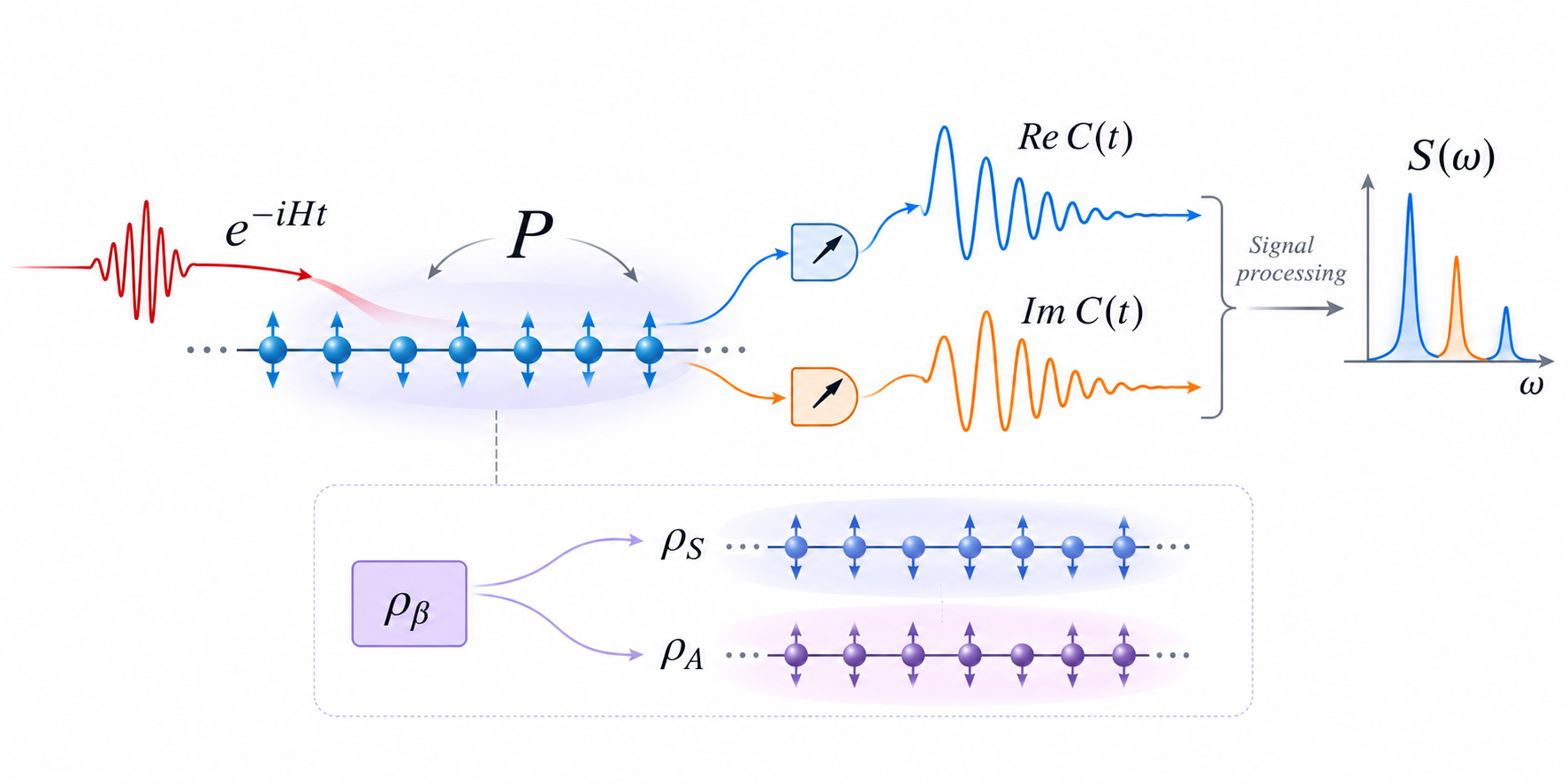
Featured image: Symmetry-enabled quantum spectroscopy. By exploiting parity symmetry, tailored quench spectroscopy enables direct measurement of the real and imaginary parts of quantum time correlations without auxiliary qubits or controlled time evolution in the measurement circuit. Classical signal processing reconstructs spectral information, while parity-resolved thermal states extend the approach to finite temperatures.
Popular summary
Quantum computers offer a promising alternative because they can directly simulate quantum dynamics. Nevertheless, many existing approaches require complicated quantum circuits involving auxiliary qubits or controlled operations, making them difficult to implement on current hardware. In this work, we introduce a simpler approach that exploits parity symmetry, a property shared by many important models of quantum matter. By applying carefully designed perturbations and measuring the subsequent evolution, our method recovers both the real and imaginary parts of time-dependent quantum correlations without auxiliary qubits or controlled time evolution in the measurement circuit. Classical signal-processing techniques can then reconstruct the corresponding Green's functions.
We further extend the approach to finite temperatures using symmetry-resolved thermal states and show that it can also access certain correlations used to investigate quantum information scrambling. Numerical simulations of interacting electron and spin models demonstrate the method's performance and robustness under the errors considered. Our results provide a promising route toward studying the dynamical properties of strongly correlated quantum systems using quantum hardware.
► BibTeX data
► References
[1] A. Altland and B.D. Simons. Condensed Matter Field Theory. Cambridge University Press, 2 edition, 2010. ISBN 9780521769754. 10.1017/CBO9780511789984. URL https://doi.org/10.1017/CBO9780511789984.
https://doi.org/10.1017/CBO9780511789984
[2] Luuk J. P. Ament, Michel van Veenendaal, Thomas P. Devereaux, John P. Hill, and Jeroen van den Brink. Resonant inelastic X-ray scattering studies of elementary excitations. Rev. Mod. Phys., 83: 705–767, Jun 2011. 10.1103/RevModPhys.83.705.
https://doi.org/10.1103/RevModPhys.83.705
[3] Maria Laura Baez, Marcel Goihl, Jonas Haferkamp, Juani Bermejo-Vega, Marek Gluza, and Jens Eisert. Dynamical structure factors of dynamical quantum simulators. Proc. Natl. Acad. Sci. U.S.A., 117 (42): 26123–26134, 2020. 10.1073/pnas.2006103117.
https://doi.org/10.1073/pnas.2006103117
[4] Bela Bauer, Dave Wecker, Andrew J Millis, Matthew B Hastings, and Matthias Troyer. Hybrid quantum-classical approach to correlated materials. Phys. Rev. X, 6 (3): 031045, 2016. 10.1103/PhysRevX.6.031045.
https://doi.org/10.1103/PhysRevX.6.031045
[5] Gino Bishop, Dmitry Bagrets, and Frank K. Wilhelm. Quantum algorithm for Green's-function measurements in the Fermi-Hubbard model. Phys. Rev. A, 111: 062610, Jun 2025. 10.1103/PhysRevA.111.062610.
https://doi.org/10.1103/PhysRevA.111.062610
[6] H.-P. Breuer and F. Petruccione. The Theory of Open Quantum Systems. Oxford University Press, 2002. ISBN 9780198520634. URL https://global.oup.com/academic/product/the-theory-of-open-quantum-systems-9780198520634.
https://global.oup.com/academic/product/the-theory-of-open-quantum-systems-9780198520634
[7] Chi-Fang Chen, Michael Kastoryano, Fernando G. S. L. Brandão, and András Gilyén. Efficient quantum thermal simulation. Nature, 646 (8085): 561–566, 2025. 10.1038/s41586-025-09583-x.
https://doi.org/10.1038/s41586-025-09583-x
[8] Hongxiang Chen, Max Nusspickel, Jules Tilly, and George H Booth. Variational quantum eigensolver for dynamic correlation functions. Phys. Rev. A, 104 (3): 032405, 2021. 10.1103/PhysRevA.104.032405.
https://doi.org/10.1103/PhysRevA.104.032405
[9] Andrew M Childs and Yuan Su. Nearly optimal lattice simulation by product formulas. Phys. Rev. Lett., 123 (5): 050503, 2019. 10.1103/PhysRevLett.123.050503.
https://doi.org/10.1103/PhysRevLett.123.050503
[10] Andrew M Childs, Yuan Su, Minh C Tran, Nathan Wiebe, and Shuchen Zhu. Theory of Trotter error with commutator scaling. Phys. Rev. X, 11 (1): 011020, 2021. 10.1103/PhysRevX.11.011020.
https://doi.org/10.1103/PhysRevX.11.011020
[11] Diogo Cruz and Duarte Magano. Superresolution of Green's functions on noisy quantum computers. Phys. Rev. A, 108 (1): 012618, 2023. 10.1103/PhysRevA.108.012618.
https://doi.org/10.1103/PhysRevA.108.012618
[12] Esther Cruz, Dominik S. Wild, Mari Carmen Bañuls, and J. Ignacio Cirac. Quantum simulation of dynamical response functions of equilibrium states. Phys. Rev. A, 112: 032610, Sep 2025. 10.1103/lpz2-j7vg.
https://doi.org/10.1103/lpz2-j7vg
[13] Lorenzo Del Re, Brian Rost, Michael Foss-Feig, A. F. Kemper, and J. K. Freericks. Robust measurements of $n$-point correlation functions of driven-dissipative quantum systems on a digital quantum computer. Phys. Rev. Lett., 132 (10): 100601, 2024. 10.1103/PhysRevLett.132.100601.
https://doi.org/10.1103/PhysRevLett.132.100601
[14] Julien Despres. Correlation Spreading in Quantum Lattice Models with Variable-Range Interactions. Phd thesis, Université Paris-Saclay, 2019. URL https://pastel.hal.science/tel-02921450. NNT: 2019SACLO018.
https://pastel.hal.science/tel-02921450
[15] Diksha Dhawan, Dominika Zgid, and Mario Motta. Quantum algorithm for imaginary-time Green’s functions. J. Chem. Theory Comput., 20 (11): 4629–4638, 2024. 10.1021/acs.jctc.4c00241.
https://doi.org/10.1021/acs.jctc.4c00241
[16] Zhiyan Ding, Chi-Fang Chen, and Lin Lin. Single-ancilla ground state preparation via Lindbladians. Phys. Rev. Research, 6: 033147, Aug 2024a. 10.1103/PhysRevResearch.6.033147.
https://doi.org/10.1103/PhysRevResearch.6.033147
[17] Zhiyan Ding, Xiantao Li, and Lin Lin. Simulating open quantum systems using Hamiltonian simulations. PRX Quantum, 5: 020332, May 2024b. 10.1103/PRXQuantum.5.020332.
https://doi.org/10.1103/PRXQuantum.5.020332
[18] Zhiyan Ding, Bowen Li, and Lin Lin. Efficient quantum Gibbs samplers with Kubo–Martin–Schwinger detailed balance condition. Commun. Math. Phys., 406 (3): 67, 2025. 10.1007/s00220-025-05235-3.
https://doi.org/10.1007/s00220-025-05235-3
[19] Zhiyan Ding, Yongtao Zhan, John Preskill, and Lin Lin. Simple and efficient end-to-end quantum thermal and ground state preparation. Nat. Phys., 22 (10): 1679–1683, August 2026. ISSN 1745-2481. 10.1038/s41567-026-03389-y.
https://doi.org/10.1038/s41567-026-03389-y
[20] Ethan N. Epperly, Lin Lin, and Yuji Nakatsukasa. A theory of quantum subspace diagonalization. SIAM J. Matrix Anal. Appl., 43 (3): 1263–1290, August 2022. ISSN 1095-7162. 10.1137/21m145954x.
https://doi.org/10.1137/21m145954x
[21] William M. C. Foulkes, Lubos Mitas, R. J. Needs, and Guna Rajagopal. Quantum Monte Carlo simulations of solids. Rev. Mod. Phys., 73 (1): 33–83, 2001. 10.1103/RevModPhys.73.33.
https://doi.org/10.1103/RevModPhys.73.33
[22] Ignacio García-Mata, Rodolfo Jalabert, and Diego Wisniacki. Out-of-time-order correlations and quantum chaos. Scholarpedia, 18 (4): 55237, 2023. ISSN 1941-6016. 10.4249/scholarpedia.55237.
https://doi.org/10.4249/scholarpedia.55237
[23] Kevin T. Geier and Philipp Hauke. From non-Hermitian linear response to dynamical correlations and fluctuation-dissipation relations in quantum many-body systems. PRX Quantum, 3: 030308, Jul 2022. 10.1103/PRXQuantum.3.030308.
https://doi.org/10.1103/PRXQuantum.3.030308
[24] Vittorio Gorini, Andrzej Kossakowski, and E. C. G. Sudarshan. Completely positive dynamical semigroups of N-level systems. J. Math. Phys., 17 (5): 821–825, 1976. 10.1063/1.522979.
https://doi.org/10.1063/1.522979
[25] Gabriel Greene-Diniz, David Zsolt Manrique, Kentaro Yamamoto, Evgeny Plekhanov, Nathan Fitzpatrick, Michal Krompiec, Rei Sakuma, and David Muñoz Ramo. Quantum computed Green's functions using a cumulant expansion of the Lanczos method. Quantum, 8: 1383, 2024. ISSN 2521-327X. 10.22331/q-2024-06-20-1383.
https://doi.org/10.22331/q-2024-06-20-1383
[26] Jeongwan Haah, Yunchao Liu, and Xinyu Tan. Efficient approximate unitary designs from random Pauli rotations. Commun. Math. Phys., 406 (12): 309, 2025. 10.1007/s00220-025-05480-6.
https://doi.org/10.1007/s00220-025-05480-6
[27] Koji Hashimoto, Keiju Murata, and Ryosuke Yoshii. Out-of-time-order correlators in quantum mechanics. J. High Energy Phys., 2017 (10): 138, 2017. 10.1007/JHEP10(2017)138.
https://doi.org/10.1007/JHEP10(2017)138
[28] Kaixuan Huang, Xiaoxia Cai, Hao Li, Zi-Yong Ge, Ruijuan Hou, Hekang Li, Tong Liu, Yunhao Shi, Chitong Chen, Dongning Zheng, Kai Xu, Zhi-Bo Liu, Zhendong Li, Heng Fan, and Wei-Hai Fang. Variational quantum computation of molecular linear response properties on a superconducting quantum processor. J. Phys. Chem. Lett., 13 (39): 9114–9121, 2022. 10.1021/acs.jpclett.2c02381.
https://doi.org/10.1021/acs.jpclett.2c02381
[29] Reinis Irmejs and Raul A Santos. Approximating dynamical correlation functions with constant depth quantum circuits. Quantum, 9: 1639, 2025. 10.22331/q-2025-02-19-1639.
https://doi.org/10.22331/q-2025-02-19-1639
[30] Amara Katabarwa, Katerina Gratsea, Athena Caesura, and Peter D. Johnson. Early fault-tolerant quantum computing. PRX Quantum, 5: 020101, Jun 2024. 10.1103/PRXQuantum.5.020101.
https://doi.org/10.1103/PRXQuantum.5.020101
[31] Michael Knap, Adrian Kantian, Thierry Giamarchi, Immanuel Bloch, Mikhail D Lukin, and Eugene Demler. Probing real-space and time-resolved correlation functions with many-body Ramsey interferometry. Phys. Rev. Lett., 111 (14): 147205, 2013. 10.1103/PhysRevLett.111.147205.
https://doi.org/10.1103/PhysRevLett.111.147205
[32] Efekan Kökcü, Heba A Labib, J. K. Freericks, and Alexander F Kemper. A linear response framework for quantum simulation of bosonic and fermionic correlation functions. Nat. Commun., 15 (1): 3881, 2024. 10.1038/s41467-024-47729-z.
https://doi.org/10.1038/s41467-024-47729-z
[33] R Kubo. The fluctuation-dissipation theorem. Rep. Prog. Phys., 29 (1): 255–284, jan 1966. 10.1088/0034-4885/29/1/306.
https://doi.org/10.1088/0034-4885/29/1/306
[34] Wenjing Liao and Albert Fannjiang. MUSIC for single-snapshot spectral estimation: Stability and super-resolution. Appl. Comput. Harmon. Anal., 40 (1): 33–67, 2016. 10.1016/j.acha.2014.12.003.
https://doi.org/10.1016/j.acha.2014.12.003
[35] Göran Lindblad. On the generators of quantum dynamical semigroups. Commun. Math. Phys., 48: 119–130, 1976. 10.1007/BF01608499.
https://doi.org/10.1007/BF01608499
[36] Ignacio Loaiza, Danial Motlagh, Kasra Hejazi, Modjtaba Shokrian Zini, Alain Delgado, and Juan Miguel Arrazola. Nonlinear spectroscopy via generalized quantum phase estimation. Quantum, 9: 1822, August 2025. ISSN 2521-327X. 10.22331/q-2025-08-07-1822.
https://doi.org/10.22331/q-2025-08-07-1822
[37] Raphaël Menu and Tommaso Roscilde. Quench dynamics of quantum spin models with flat bands of excitations. Phys. Rev. B, 98: 205145, Nov 2018. 10.1103/PhysRevB.98.205145.
https://doi.org/10.1103/PhysRevB.98.205145
[38] Kosuke Mitarai and Keisuke Fujii. Methodology for replacing indirect measurements with direct measurements. Phys. Rev. Research, 1 (1): 013006, 2019. 10.1103/PhysRevResearch.1.013006.
https://doi.org/10.1103/PhysRevResearch.1.013006
[39] Mario Motta, Chong Sun, Adrian T. K. Tan, Matthew J O’Rourke, Erika Ye, Austin J Minnich, Fernando G. S. L. Brandão, and Garnet Kin-Lic Chan. Determining eigenstates and thermal states on a quantum computer using quantum imaginary time evolution. Nat. Phys., 16 (2): 205–210, 2020. 10.1038/s41567-019-0704-4.
https://doi.org/10.1038/s41567-019-0704-4
[40] Mariana M Odashima, Beatriz G Prado, and E Vernek. Pedagogical introduction to equilibrium Green's functions: condensed-matter examples with numerical implementations. Rev. Bras. Ensino Fís., 39 (1): e1303, 2017. 10.1590/1806-9126-RBEF-2016-0087.
https://doi.org/10.1590/1806-9126-RBEF-2016-0087
[41] Atsushi Ono. Extracting nonlinear dynamical response functions from time evolution. Phys. Rev. Lett., 135: 026401, Jul 2025. 10.1103/qsxr-c2pq.
https://doi.org/10.1103/qsxr-c2pq
[42] Lei Pan, Xin Chen, Yu Chen, and Hui Zhai. Non-Hermitian linear response theory. Nat. Phys., 16 (7): 767–771, 2020. 10.1038/s41567-020-0889-6.
https://doi.org/10.1038/s41567-020-0889-6
[43] J. S. Pedernales, R. Di Candia, I. L. Egusquiza, J. Casanova, and E. Solano. Efficient quantum algorithm for computing $n$-time correlation functions. Phys. Rev. Lett., 113: 020505, Jul 2014. 10.1103/PhysRevLett.113.020505.
https://doi.org/10.1103/PhysRevLett.113.020505
[44] Samuele Piccinelli, Francesco Tacchino, Ivano Tavernelli, and Giuseppe Carleo. A circuit-differentiation framework for Green's functions on quantum computers. Quantum, 10: 2060, April 2026. ISSN 2521-327X. 10.22331/q-2026-04-13-2060. URL https://doi.org/10.22331/q-2026-04-13-2060.
https://doi.org/10.22331/q-2026-04-13-2060
[45] John Preskill. Quantum computing in the NISQ era and beyond. Quantum, 2: 79, 2018. 10.22331/q-2018-08-06-79.
https://doi.org/10.22331/q-2018-08-06-79
[46] Cambyse Rouzé, Daniel Stilck França, and Álvaro M. Alhambra. Efficient thermalization and universal quantum computing with quantum Gibbs samplers. Nat. Phys., 22 (7): 1123–1127, 2026. ISSN 1745-2481. 10.1038/s41567-026-03246-y.
https://doi.org/10.1038/s41567-026-03246-y
[47] Burak Şahinoğlu and Rolando D. Somma. Hamiltonian simulation in the low-energy subspace. npj Quantum Inf., 7: 119, 2021. 10.1038/s41534-021-00451-w.
https://doi.org/10.1038/s41534-021-00451-w
[48] R. Schmidt. Multiple emitter location and signal parameter estimation. IEEE Trans. Antennas Propag., 34 (3): 276–280, 1986. 10.1109/TAP.1986.1143830.
https://doi.org/10.1109/TAP.1986.1143830
[49] H. J. Schulz. Phase diagrams and correlation exponents for quantum spin chains of arbitrary spin quantum number. Phys. Rev. B, 34: 6372–6385, 1986. 10.1103/PhysRevB.34.6372.
https://doi.org/10.1103/PhysRevB.34.6372
[50] Jinzhao Sun, Lucia Vilchez-Estevez, Vlatko Vedral, Andrew T Boothroyd, and M. S. Kim. Probing spectral features of quantum many-body systems with quantum simulators. Nat. Commun., 16 (1): 1403, 2025. 10.1038/s41467-025-55955-2.
https://doi.org/10.1038/s41467-025-55955-2
[51] Brian Swingle, Gregory Bentsen, Monika Schleier-Smith, and Patrick Hayden. Measuring the scrambling of quantum information. Phys. Rev. A, 94: 040302(R), Oct 2016. 10.1103/PhysRevA.94.040302.
https://doi.org/10.1103/PhysRevA.94.040302
[52] Yu Tong and Yongtao Zhan. Fast mixing of weakly interacting fermionic systems at any temperature. PRX Quantum, 6 (3): 030301, 2025. 10.1103/h1dx-ps5p.
https://doi.org/10.1103/h1dx-ps5p
[53] Minh C. Tran, Yuan Su, Daniel Carney, and Jacob M. Taylor. Faster digital quantum simulation by symmetry protection. PRX Quantum, 2: 010323, Feb 2021. 10.1103/PRXQuantum.2.010323.
https://doi.org/10.1103/PRXQuantum.2.010323
[54] Guifré Vidal. Efficient simulation of one-dimensional quantum many-body systems. Phys. Rev. Lett., 93 (4): 040502, 2004. 10.1103/PhysRevLett.93.040502.
https://doi.org/10.1103/PhysRevLett.93.040502
[55] Louis Villa. Out-of-equilibrium dynamics and quench spectroscopy of ultracold many-body quantum systems. PhD thesis, Institut Polytechnique de Paris, 2021. URL https://theses.fr/2021IPPAX041.
https://theses.fr/2021IPPAX041
[56] Louis Villa, Julien Despres, and Laurent Sanchez-Palencia. Unraveling the excitation spectrum of many-body systems from quantum quenches. Phys. Rev. A, 100 (6): 063632, 2019. 10.1103/PhysRevA.100.063632.
https://doi.org/10.1103/PhysRevA.100.063632
[57] V. S. Viswanath and Gerhard Müller. The Recursion Method: Application to Many-Body Dynamics, volume 23 of Lecture Notes in Physics Monographs. Springer, Berlin, Heidelberg, 1994. 10.1007/978-3-540-48651-0.
https://doi.org/10.1007/978-3-540-48651-0
[58] Xiaoyang Wang, Long Xiong, Xiaoxia Cai, and Xiao Yuan. Computing $n$-time correlation functions without ancilla qubits. Phys. Rev. Lett., 135: 230602, Dec 2025. 10.1103/z126-zdqj.
https://doi.org/10.1103/z126-zdqj
[59] Shenglong Xu and Brian Swingle. Scrambling dynamics and out-of-time-ordered correlators in quantum many-body systems. PRX Quantum, 5: 010201, Jan 2024. 10.1103/PRXQuantum.5.010201.
https://doi.org/10.1103/PRXQuantum.5.010201
[60] Yilun Yang, Arthur Christianen, Mari Carmen Bañuls, Dominik S Wild, and J Ignacio Cirac. Phase-sensitive quantum measurement without controlled operations. Phys. Rev. Lett., 132 (22): 220601, 2024a. 10.1103/PhysRevLett.132.220601.
https://doi.org/10.1103/PhysRevLett.132.220601
[61] Yongdan Yang, Ying Li, Xiaosi Xu, and Xiao Yuan. Resource-efficient quantum-classical hybrid algorithm for energy gap evaluation. Phys. Rev. A, 109 (5): 052416, 2024b. 10.1103/PhysRevA.109.052416.
https://doi.org/10.1103/PhysRevA.109.052416
[62] Changhao Yi. Tailored quench spectroscopy code, 2025. URL https://github.com/CYI1995/TQS. GitHub repository.
https://github.com/CYI1995/TQS
[63] Changhao Yi and Elizabeth Crosson. Spectral analysis of product formulas for quantum simulation. npj Quantum Inf., 8 (1): 37, 2022. 10.1038/s41534-022-00548-w.
https://doi.org/10.1038/s41534-022-00548-w
[64] Wenjun Yu, Xiaogang Li, Qi Zhao, and Xiao Yuan. Lindbladian simulation with logarithmic precision scaling via two ancillas. Phys. Rev. Lett., 135: 160602, Oct 2025. 10.1103/2cx4-b82c.
https://doi.org/10.1103/2cx4-b82c
[65] Hongyun Zhang, Tommaso Pincelli, Chris Jozwiak, Takeshi Kondo, Ralph Ernstorfer, Takafumi Sato, and Shuyun Zhou. Angle-resolved photoemission spectroscopy. Nat. Rev. Methods Primers, 2 (1): 54, 2022. 10.1038/s43586-022-00133-7.
https://doi.org/10.1038/s43586-022-00133-7
[66] Yikang Zhang and Thomas Barthel. Criteria for Davies irreducibility of Markovian quantum dynamics. J. Phys. A: Math. Theor., 57 (11): 115301, 2024. 10.1088/1751-8121/ad2a1e.
https://doi.org/10.1088/1751-8121/ad2a1e
Cited by
[1] Zhiyan Ding, Lin Lin, Yilun Yang, and Ruizhe Zhang, "Quantum Filtering and Analysis of Multiplicities in Eigenvalue Spectra", PRX Quantum 7 2, 020318 (2026).
[2] Etienne Granet, Keisuke Murota, Henrik Dreyer, Kentaro Yamamoto, Juan Pedersen, and Hidemaro Suwa, "Dynamical structure factor with a pumping approach on a trapped-ion quantum computer", arXiv:2607.07138, (2026).
The above citations are from SAO/NASA ADS (last updated successfully 2026-10-22 16:52:07). The list may be incomplete as not all publishers provide suitable and complete citation data.
Could not fetch Crossref cited-by data during last attempt 2026-10-22 16:52:06: Could not fetch cited-by data for 10.22331/q-2026-10-22-2245 from Crossref. This is normal if the DOI was registered recently.
This Paper is published in Quantum under the Creative Commons Attribution 4.0 International (CC BY 4.0) license. Copyright remains with the original copyright holders such as the authors or their institutions.