
Symmetry defects and gauging for quantum states with matrix product unitary symmetries
1Max-Planck-Institut für Quantenoptik,Hans-Kopfermann-Str. 1, Garching, 85748, Germany
2Munich Center for Quantum Science and Technology, Schellingstraße 4, München, 80799, Germany
3University of Vienna, Faculty of Physics, Boltzmanngasse 5, 1090 Wien, Austria
| Published: | 2026-10-22, volume 10, page 2243 |
| Editor: | Luca Tagliacozzo |
| Eprint: | arXiv:2502.20257v2 |
| Doi: | https://doi.org/10.22331/q-2026-10-22-2243 |
| Citation: | Quantum 10, 2243 (2026). |
Find this paper interesting or want to discuss? Scite or leave a comment on SciRate.
Abstract
In this work, we examine the consequences of the existence of a finite group of matrix product unitary (MPU) symmetries for matrix product states (MPS). We generalize the well-understood picture of onsite unitary symmetries, which give rise to virtual symmetry defects given by insertions of operators in the bonds of the MPS. In the MPU case, we can define analogous defect tensors, this time sitting on lattice sites, that can be created, moved, and fused by local unitary operators. We leverage this formalism to study the gauging of MPU symmetries. We introduce a condition, block independence, under which we can gauge the symmetries by promoting the symmetry defects to gauge degrees of freedom, yielding an MPS of the same bond dimension that supports a local version of the symmetry given by commuting gauge constraints. Whenever block independence does not hold (which happens, in particular, whenever the symmetry representation is anomalous), a modification of our method which we call state-level gauging still gives rise to a locally symmetric MPS by promotion of the symmetry defects, at the expense of producing gauge constraints that do not commute on different sites.
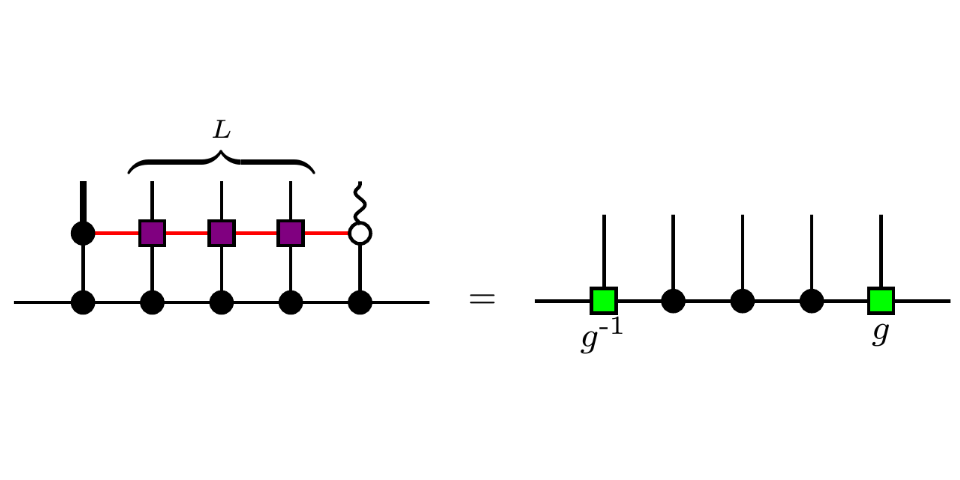
Featured image: The action of a truncated symmetry operator on a finite interval creates symmetry defects at its endpoints.
Popular summary
We focus on symmetries that can be built from many small pieces, much like assembling a structure from building blocks. This allows us to study what happens when a symmetry is applied only to part of a system, creating a symmetry defect—an object that behaves somewhat like a particle. We show how these defects can be created in pairs, moved along the chain, and combined with one another. We also explain how to turn them into new quantum degrees of freedom, effectively expanding the original system.
This process, called gauging, transforms a symmetry that acts on the system as a whole (a global symmetry) into one that acts locally. By doing so, it provides a way to construct new quantum systems and better understand the relationships between different phases of quantum matter.
► BibTeX data
► References
[1] Elliott Lieb, Theodore Schultz, and Daniel Mattis. ``Two soluble models of an antiferromagnetic chain''. Annals of Physics 16, 407–466 (1961).
https://doi.org/10.1016/0003-4916(61)90115-4
[2] Masaki Oshikawa, Masanori Yamanaka, and Ian Affleck. ``Magnetization plateaus in spin chains: ``Haldane gap'' for half-integer spins''. Phys. Rev. Lett. 78, 1984–1987 (1997).
https://doi.org/10.1103/PhysRevLett.78.1984
[3] Hal Tasaki. ``Physics and mathematics of quantum many-body systems''. Springer Cham. (2020).
https://doi.org/10.1007/978-3-030-41265-4
[4] Yohei Fuji. ``Effective field theory for one-dimensional valence-bond-solid phases and their symmetry protection''. Phys. Rev. B 93, 104425 (2016).
https://doi.org/10.1103/PhysRevB.93.104425
[5] Hoi Chun Po, Haruki Watanabe, Chao-Ming Jian, and Michael P. Zaletel. ``Lattice homotopy constraints on phases of quantum magnets''. Phys. Rev. Lett. 119, 127202 (2017).
https://doi.org/10.1103/PhysRevLett.119.127202
[6] Y. Ogata, Y. Tachikawa, and H. Tasaki. ``General Lieb–Schultz–Mattis type theorems for quantum spin chains''. Commun. Math. Phys. 385, 79–99 (2021).
https://doi.org/10.1007/s00220-021-04116-9
[7] Hal Tasaki. ``The physics and mathematics of Elliott Lieb''. Volume 2, chapter The Lieb–Schultz–Mattis theorem. A topological point of view, pages 405–446. European Mathematical Society Press. (2022).
https://doi.org/10.4171/90-2/46
[8] Lev D. Landau. ``On the theory of phase transitions''. Zh. Eksp. Teor. Fiz. 7, 19–32 (1937).
https://doi.org/10.1016/B978-0-08-010586-4.50034-1
[9] Lakshya Bhardwaj, Lea E. Bottini, Daniel Pajer, and Sakura Schäfer-Nameki. ``Categorical Landau Paradigm for Gapped Phases''. Phys. Rev. Lett. 133, 161601 (2024).
https://doi.org/10.1103/PhysRevLett.133.161601
[10] Lakshya Bhardwaj, Lea E. Bottini, Sakura Schäfer-Nameki, and Apoorv Tiwari. ``Illustrating the categorical Landau paradigm in lattice models''. Phys. Rev. B 111, 054432 (2025).
https://doi.org/10.1103/PhysRevB.111.054432
[11] Lakshya Bhardwaj, Lea E. Bottini, Daniel Pajer, and Sakura Schäfer-Nameki. ``Gapped phases with non-invertible symmetries: (1+1)d''. SciPost Phys. 18, 032 (2025).
https://doi.org/10.21468/SciPostPhys.18.1.032
[12] Nabil Iqbal and John McGreevy. ``Mean string field theory: Landau-Ginzburg theory for 1-form symmetries''. SciPost Phys. 13, 114 (2022).
https://doi.org/10.21468/SciPostPhys.13.5.114
[13] Ruizhi Liu, Ran Luo, and Yi-Nan Wang. ``Higher-matter and Landau-Ginzburg theory of higher-group symmetries''. SciPost Phys. 18, 052 (2025).
https://doi.org/10.21468/SciPostPhys.18.2.052
[14] X. G. Wen. ``Topological orders in rigid states''. International Journal of Modern Physics B 4, 239–271 (1990).
https://doi.org/10.1142/S0217979290000139
[15] Xie Chen, Zheng-Xin Liu, and Xiao-Gang Wen. ``Two-dimensional symmetry-protected topological orders and their protected gapless edge excitations''. Phys. Rev. B 84, 235141 (2011).
https://doi.org/10.1103/PhysRevB.84.235141
[16] Dominic V. Else and Chetan Nayak. ``Classifying symmetry-protected topological phases through the anomalous action of the symmetry on the edge''. Phys. Rev. B 90, 235137 (2014).
https://doi.org/10.1103/PhysRevB.90.235137
[17] J. Ignacio Cirac, David Pérez-García, Norbert Schuch, and Frank Verstraete. ``Matrix product states and projected entangled pair states: Concepts, symmetries, theorems''. Rev. Mod. Phys. 93, 045003 (2021).
https://doi.org/10.1103/RevModPhys.93.045003
[18] Shi-Ju Ran, Emanuele Tirrito, Cheng Peng, Xi Chen, Luca Tagliacozzo, Gang Su, and Maciej Lewenstein. ``Tensor network contractions, methods and applications to quantum many-body systems''. Springer Cham. (2020).
https://doi.org/10.1007/978-3-030-34489-4
[19] Xie Chen, Zheng-Cheng Gu, and Xiao-Gang Wen. ``Classification of gapped symmetric phases in one-dimensional spin systems''. Phys. Rev. B 83, 035107 (2011).
https://doi.org/10.1103/PhysRevB.83.035107
[20] Norbert Schuch, David Pérez-García, and Ignacio Cirac. ``Classifying quantum phases using matrix product states and projected entangled pair states''. Phys. Rev. B 84, 165139 (2011).
https://doi.org/10.1103/PhysRevB.84.165139
[21] D. Pérez-García, M. M. Wolf, M. Sanz, F. Verstraete, and J. I. Cirac. ``String order and symmetries in quantum spin lattices''. Phys. Rev. Lett. 100, 167202 (2008).
https://doi.org/10.1103/PhysRevLett.100.167202
[22] Lochlainn O'Raifeartaigh and Norbert Straumann. ``Gauge theory: Historical origins and some modern developments''. Rev. Mod. Phys. 72, 1–23 (2000).
https://doi.org/10.1103/RevModPhys.72.1
[23] C. N. Yang and R. L. Mills. ``Conservation of isotopic spin and isotopic gauge invariance''. Phys. Rev. 96, 191–195 (1954).
https://doi.org/10.1103/PhysRev.96.191
[24] Tai Tsun Wu and Chen Ning Yang. ``Concept of nonintegrable phase factors and global formulation of gauge fields''. Phys. Rev. D 12, 3845–3857 (1975).
https://doi.org/10.1103/PhysRevD.12.3845
[25] F. Englert and R. Brout. ``Broken symmetry and the mass of gauge vector mesons''. Phys. Rev. Lett. 13, 321–323 (1964).
https://doi.org/10.1103/PhysRevLett.13.321
[26] Peter W. Higgs. ``Broken symmetries and the masses of gauge bosons''. Phys. Rev. Lett. 13, 508–509 (1964).
https://doi.org/10.1103/PhysRevLett.13.508
[27] P. W. Anderson. ``Plasmons, gauge invariance, and mass''. Phys. Rev. 130, 439–442 (1963).
https://doi.org/10.1103/PhysRev.130.439
[28] Hagen Kleinert. ``Gauge fields in condensed matter''. World Scientific. (1989).
https://doi.org/10.1142/0356
[29] Jürg Fröhlich. ``Gauge invariance and anomalies in condensed matter physics''. J. Math. Phys. 64, 031903 (2023).
https://doi.org/10.1063/5.0135142
[30] John Kogut and Leonard Susskind. ``Hamiltonian formulation of Wilson's lattice gauge theories''. Phys. Rev. D 11, 395–408 (1975).
https://doi.org/10.1103/PhysRevD.11.395
[31] Jutho Haegeman, Karel Van Acoleyen, Norbert Schuch, J. Ignacio Cirac, and Frank Verstraete. ``Gauging quantum states: From global to local symmetries in many-body systems''. Phys. Rev. X 5, 011024 (2015).
https://doi.org/10.1103/PhysRevX.5.011024
[32] José Garre Rubio and Ilya Kull. ``Gauging quantum states with nonanomalous matrix product operator symmetries''. Phys. Rev. B 107, 075137 (2023).
https://doi.org/10.1103/PhysRevB.107.075137
[33] Maissam Barkeshli, Parsa Bonderson, Meng Cheng, and Zhenghan Wang. ``Symmetry fractionalization, defects, and gauging of topological phases''. Phys. Rev. B 100, 115147 (2019).
https://doi.org/10.1103/PhysRevB.100.115147
[34] Ilya Kull, András Molnár, Erez Zohar, and J. Ignacio Cirac. ``Classification of matrix product states with a local (gauge) symmetry''. Annals of Physics 386, 199–241 (2017).
https://doi.org/10.1016/j.aop.2017.08.029
[35] David Blanik, José Garre-Rubio, András Molnár, and Erez Zohar. ``Internal structure of gauge-invariant projected entangled pair states''. Journal of Physics A: Mathematical and Theoretical 58, 065301 (2025).
https://doi.org/10.1088/1751-8121/adae83
[36] Sahand Seifnashri. ``Lieb-Schultz-Mattis anomalies as obstructions to gauging (non-on-site) symmetries''. SciPost Phys. 16, 098 (2024).
https://doi.org/10.21468/SciPostPhys.16.4.098
[37] J.I. Cirac, D. Pérez-García, N. Schuch, and F. Verstraete. ``Matrix product density operators: Renormalization fixed points and boundary theories''. Annals of Physics 378, 100–149 (2017).
https://doi.org/10.1016/j.aop.2016.12.030
[38] J. Ignacio Cirac, David Pérez-García, Norbert Schuch, and Frank Verstraete. ``Matrix product unitaries: structure, symmetries, and topological invariants''. Journal of Statistical Mechanics: Theory and Experiment 2017, 083105 (2017).
https://doi.org/10.1088/1742-5468/aa7e55
[39] C. Schön, E. Solano, F. Verstraete, J. I. Cirac, and M. M. Wolf. ``Sequential generation of entangled multiqubit states''. Phys. Rev. Lett. 95, 110503 (2005).
https://doi.org/10.1103/PhysRevLett.95.110503
[40] Xie Chen, Arpit Dua, Michael Hermele, David T. Stephen, Nathanan Tantivasadakarn, Robijn Vanhove, and Jing-Yu Zhao. ``Sequential quantum circuits as maps between gapped phases''. Phys. Rev. B 109, 075116 (2024).
https://doi.org/10.1103/PhysRevB.109.075116
[41] András Molnár, Yimin Ge, Norbert Schuch, and J. Ignacio Cirac. ``A generalization of the injectivity condition for projected entangled pair states''. Journal of Mathematical Physics 59, 021902 (2018).
https://doi.org/10.1063/1.5007017
[42] José Garre-Rubio and Norbert Schuch. ``Fractional domain wall statistics in spin chains with anomalous symmetries''. SciPost Phys. 18, 043 (2025).
https://doi.org/10.21468/SciPostPhys.18.2.043
[43] José Garre-Rubio, Laurens Lootens, and András Molnár. ``Classifying phases protected by matrix product operator symmetries using matrix product states''. Quantum 7, 927 (2023).
https://doi.org/10.22331/q-2023-02-21-927
[44] Kenneth S. Brown. ``Abstract homotopy theory and generalized sheaf cohomology''. Transactions of the American Mathematical Society 186, 419–458 (1973).
https://doi.org/10.2307/1996573
[45] Jutho Haegeman, Bogdan Pirvu, David J. Weir, J. Ignacio Cirac, Tobias J. Osborne, Henri Verschelde, and Frank Verstraete. ``Variational matrix product ansatz for dispersion relations''. Phys. Rev. B 85, 100408 (2012).
https://doi.org/10.1103/PhysRevB.85.100408
[46] David T. Stephen. ``Non-onsite symmetries and quantum teleportation in split-index matrix product states''. Quantum 9, 1738 (2025).
https://doi.org/10.22331/q-2025-05-12-1738
[47] David Blanik, José Garre-Rubio, and Norbert Schuch. ``Gauging quantum phases: A matrix product state approach''. Phys. Rev. B 112, 115110 (2025).
https://doi.org/10.1103/gkh9-lgrk
[48] Laurens Lootens, Clément Delcamp, Gerardo Ortiz, and Frank Verstraete. ``Dualities in one-dimensional quantum lattice models: Symmetric Hamiltonians and matrix product operator intertwiners''. PRX Quantum 4, 020357 (2023).
https://doi.org/10.1103/prxquantum.4.020357
[49] José Garre Rubio. ``Emergent (2+1)D topological orders from iterative (1+1)D gauging''. Nature Commun. 15, 7986 (2024).
https://doi.org/10.1038/s41467-024-52320-7
[50] Nathan Seiberg, Sahand Seifnashri, and Shu-Heng Shao. ``Non-invertible symmetries and LSM-type constraints on a tensor product Hilbert space''. SciPost Phys. 16, 154 (2024).
https://doi.org/10.21468/SciPostPhys.16.6.154
[51] András Molnár, Alberto Ruiz de Alarcón, José Garre-Rubio, Norbert Schuch, J. Ignacio Cirac, and David Pérez-García. ``Matrix Product Operator Algebras I: Representations of Weak Hopf Algebras and Projected Entangled Pair States''. Commun. Math. Phys. 407, 203 (2026).
https://doi.org/10.1007/s00220-026-05670-w
Cited by
[1] Sahand Seifnashri, Shu-Heng Shao, and Xinping Yang, "Gauging non-invertible symmetries on the lattice", SciPost Physics 19 2, 063 (2025).
[2] Bram Vancraeynest-De Cuiper, José Garre-Rubio, Frank Verstraete, Kevin Vervoort, Dominic J. Williamson, and Laurens Lootens, "From gauging to duality in one-dimensional quantum lattice models", SciPost Physics 20 4, 113 (2026).
[3] Georgios Styliaris, Rahul Trivedi, and J. Ignacio Cirac, "Quantum Circuits for Matrix-Product Unitaries", Physical Review Letters 135 26, 260602 (2025).
[4] Kansei Inamura, "Remarks on non-invertible symmetries on a tensor product Hilbert space in 1+1 dimensions", arXiv:2602.12053, (2026).
[5] Giorgio Stucchi, J. Ignacio Cirac, Rahul Trivedi, and Georgios Styliaris, "Structure and Classification of Matrix Product Quantum Channels", Physical Review Letters 137 12, 120401 (2026).
The above citations are from SAO/NASA ADS (last updated successfully 2026-10-22 16:39:17). The list may be incomplete as not all publishers provide suitable and complete citation data.
Could not fetch Crossref cited-by data during last attempt 2026-10-22 16:39:15: Could not fetch cited-by data for 10.22331/q-2026-10-22-2243 from Crossref. This is normal if the DOI was registered recently.
This Paper is published in Quantum under the Creative Commons Attribution 4.0 International (CC BY 4.0) license. Copyright remains with the original copyright holders such as the authors or their institutions.