
Interactive proofs for verifying (quantum) learning and testing
1Department of Computer Science, University of Warwick, UK
2Dahlem Center for Complex Quantum Systems, Freie Universität Berlin, Berlin, Germany
3Helmholtz-Zentrum Berlin für Materialien und Energie, Berlin, Germany
4IBM Quantum, Almaden Research Center, San Jose, CA, USA
5African Institute for Mathematical Sciences (AIMS), South Africa
6Department of Mathematical Sciences, Stellenbosch University, Stellenbosch 7600, South Africa
7National Institute for Theoretical and Computational Sciences (NITheCS), South Africa
| Published: | 2026-10-20, volume 10, page 2239 |
| Editor: | Yu Tong |
| Eprint: | arXiv:2410.23969v3 |
| Doi: | https://doi.org/10.22331/q-2026-10-20-2239 |
| Citation: | Quantum 10, 2239 (2026). |
Find this paper interesting or want to discuss? Scite or leave a comment on SciRate.
Abstract
We consider the problem of testing and learning from data in the presence of resource constraints, such as limited memory or weak data access, which place limitations on the efficiency and feasibility of testing or learning. In particular, we ask the following question: Could a resource-constrained learner/tester use interaction with a resource-unconstrained but untrusted party to solve a learning or testing problem more efficiently than they could without such an interaction? In this work, we answer this question both abstractly and for concrete problems, in two complementary ways: For a wide variety of scenarios, we prove that a resource-constrained learner cannot gain any advantage through classical interaction with an untrusted prover. As a special case, we show that for the vast majority of testing and learning problems in which quantum memory is a meaningful resource, a memory-constrained quantum algorithm cannot overcome its limitations via classical communication with a memory-unconstrained quantum prover. In contrast, when quantum communication is allowed, we construct a variety of interactive proof protocols, for specific learning and testing problems, which allow memory-constrained quantum verifiers to gain significant advantages through delegation to untrusted provers. These results highlight both the limitations and potential of delegating learning and testing problems to resource-rich but untrusted third parties.
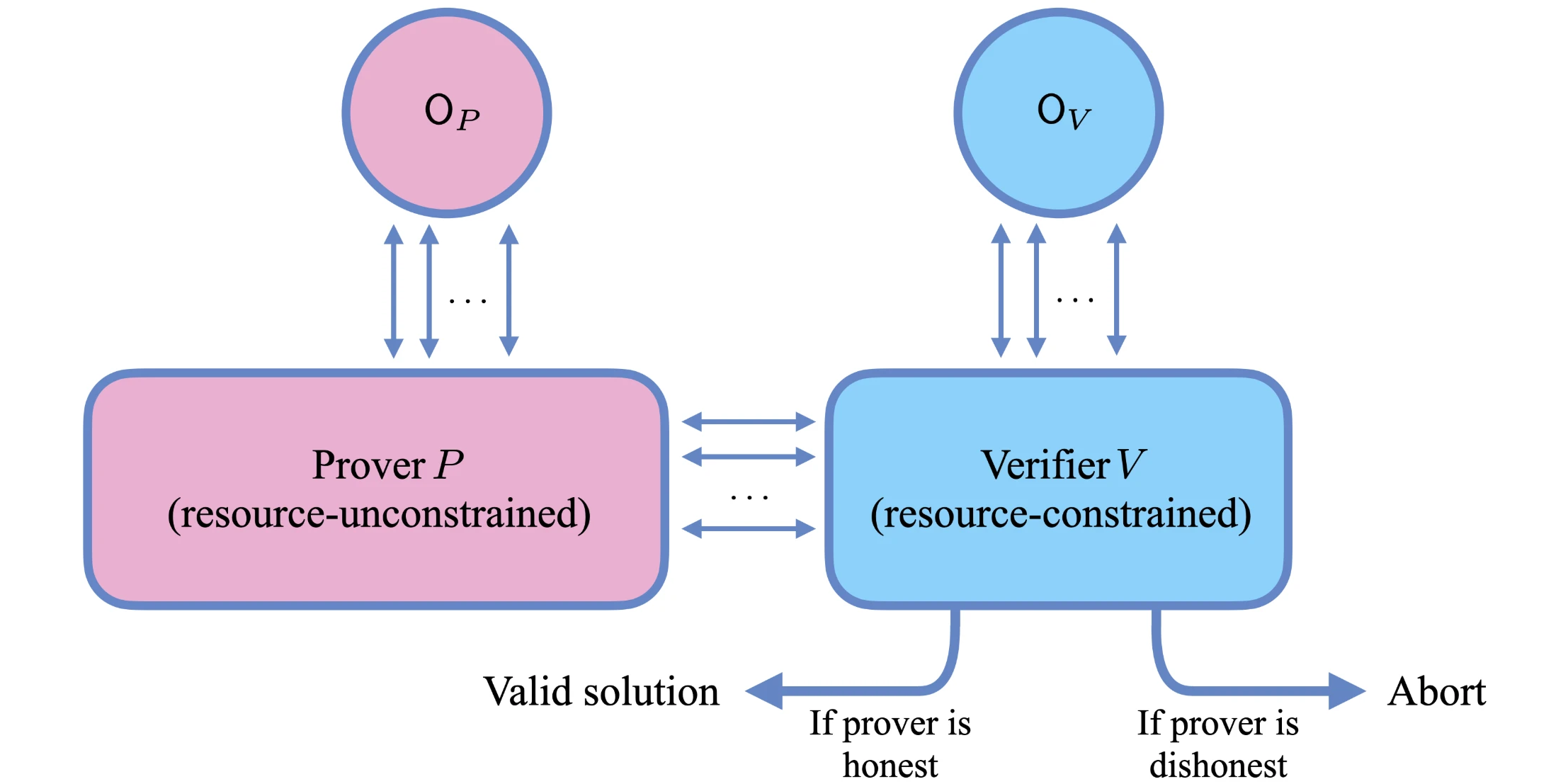
Featured image: A schematic of the interactive proofs setting analyzed in this work.
Popular summary
However, not all tasks of interest are computations on explicitly specified inputs. With the growing importance of machine learning and artificial intelligence in classical as well as quantum computing, learning and testing problems are gaining prominence. In quantum learning and testing, algorithms are designed to extract information about an unknown quantum state or process from black-box quantum data access. Existing tools for verified quantum computing are not designed to cover scenarios where the service provider uses high-quality data that the client does not have access to; in fact, verification is subtle even for classical algorithms for data processing.
We begin to map out a theory of verification for learning and testing with quantum data. Our first contribution is an impossibility result: For a broad class of learning and testing problems, when the user is strictly weaker than the provider, classical communication alone does not suffice for the user to verify the provider's answer. We complement this with positive results showing that, for a variety of quantum learning and testing tasks of interest, quantum communication allows a client limited to single-copy quantum processing to reap the copy complexity benefits of delegating tasks to a provider capable of multi-copy quantum processing. Our work shows that if quantum computing power does end up concentrated in few centres, quantum communication across a quantum internet is in many cases necessary and in several cases sufficient to allow a user with modest quantum capabilities to verifiably and efficiently delegate quantum learning and testing tasks to powerful providers.
► BibTeX data
► References
[1] L. Mirsky ``Symmetric gauge functions and unitarily invariant norms'' The Quarterly Journal of Mathematics 11, 50-59 (1960).
https://doi.org/10.1093/qmath/11.1.50
[2] Dana Angluinand Philip Laird ``Learning from noisy examples'' Machine learning 2, 343–370 (1988).
https://doi.org/10.1023/A:1022873112823
[3] Lance Fortnowand Michael Sipser ``Are there interactive protocols for co-NP languages?'' Information Processing Letters 28, 249–251 (1988).
https://doi.org/10.1016/0020-0190(88)90199-8
[4] Carsten Lund, Lance Fortnow, Howard Karloff, and Noam Nisan, ``Algebraic methods for interactive proof systems'' Journal of the ACM (JACM) 39, 859–868 (1992).
https://doi.org/10.1145/146585.146605
[5] Adi Shamir ``Ip= pspace'' Journal of the ACM (JACM) 39, 869–877 (1992).
https://doi.org/10.1145/146585.146609
[6] Nader H. Bshoutyand Jeffrey C. Jackson ``Learning DNF over the uniform distribution using a quantum example oracle'' SIAM Journal on Computing 28, 1136–1153 (1998).
https://doi.org/10.1137/S0097539795293123
[7] Michael Kearns ``Efficient noise-tolerant learning from statistical queries'' Journal of the ACM (JACM) 45, 983–1006 (1998).
https://doi.org/10.1145/293347.293351
[8] Michele Mosca, Alain Tapp, and Ronald de Wolf, ``Private quantum channels and the cost of randomizing quantum information'' (2000).
https://arxiv.org/abs/quant-ph/0003101
[9] Harry Buhrman, Richard Cleve, John Watrous, and Ronald De Wolf, ``Quantum fingerprinting'' Physical Review Letters 87, 167902 (2001).
https://doi.org/10.1103/PhysRevLett.87.167902
[10] Scott Aaronson ``The Aaronson \$25.00 Prize'' (2007) Accessed: 2024-09-25.
https://scottaaronson.blog/?p=284
[11] Scott Aaronsonand Daniel Gottesman ``Identifying stabilizer states'' (2008).
https://pirsa.org/08080052/
[12] Liam Paninski ``A coincidence-based test for uniformity given very sparsely sampled discrete data'' IEEE Transactions on Information Theory 54, 4750–4755 (2008).
https://doi.org/10.1109/TIT.2008.928987
[13] Nicoló Cesa-Bianchi, Shai Shalev-Shwartz, and Ohad Shamir, ``Efficient learning with partially observed attributes'' Journal of Machine Learning Research 12, 2857–2878 (2011).
http://jmlr.org/papers/v12/cesa-bianchi11a.html
[14] Graham Cormode, Justin Thaler, and Ke Yi, ``Verifying computations with streaming interactive proofs'' (2011).
arXiv:1109.6882
[15] Steven T Flammiaand Yi-Kai Liu ``Direct fidelity estimation from few Pauli measurements'' Physical Review Letters 106, 230501 (2011).
https://doi.org/10.1103/PhysRevLett.106.230501
[16] Dorit Aharonovand Umesh V. Vazirani ``Is quantum mechanics falsifiable? A computational perspective on the foundations of quantum mechanics'' The MIT Press (2013).
https://doi.org/10.7551/mitpress/8009.003.0012
[17] Ben W Reichardt, Falk Unger, and Umesh Vazirani, ``Classical command of quantum systems'' Nature 496, 456–460 (2013).
https://doi.org/10.1038/nature12035
[18] Amit Chakrabarti, Graham Cormode, Andrew McGregor, and Justin Thaler, ``Annotations in data streams'' ACM Transactions on Algorithms (TALG) 11, 1–30 (2014).
https://doi.org/10.1145/2636924
[19] Jeongwan Haah, Aram W. Harrow, Zhengfeng Ji, Xiaodi Wu, and Nengkun Yu, ``Sample-optimal tomography of quantum states'' Proceedings of the forty-eighth annual ACM symposium on Theory of Computing 913–925 (2016).
https://doi.org/10.1145/2897518.2897585
[20] Ryan O'Donnelland John Wright ``Efficient quantum tomography'' Proceedings of the forty-eighth annual ACM symposium on Theory of Computing 899–912 (2016).
https://doi.org/10.1145/2897518.2897544
[21] Paul F. Christiano, Jan Leike, Tom Brown, Miljan Martic, Shane Legg, and Dario Amodei, ``Deep reinforcement learning from human preferences'' Advances in Neural Information Processing Systems 30 (2017).
https://proceedings.neurips.cc/paper_files/paper/2017/file/d5e2c0adad503c91f91df240d0cd4e49-Paper.pdf
[22] Joseph F. Fitzsimonsand Elham Kashefi ``Unconditionally Verifiable Blind Computation'' Physical Review A 96, 012303 (2017).
https://doi.org/10.1103/PhysRevA.96.012303
arXiv:1203.5217
[23] Richard Kueng, Holger Rauhut, and Ulrich Terstiege, ``Low rank matrix recovery from rank one measurements'' Applied and Computational Harmonic Analysis 42, 88–116 (2017).
https://doi.org/10.1016/j.acha.2015.07.007
[24] Ashley Montanaro ``Learning stabilizer states by Bell sampling'' (2017).
arXiv:1707.04012
[25] Ryan O'Donnelland John Wright ``Efficient quantum tomography II'' Proceedings of the 49th Annual ACM SIGACT Symposium on Theory of Computing 962–974 (2017).
https://doi.org/10.1145/3055399.3055454
[26] Anne Broadbent ``How to verify a quantum computation'' Theory of Computing 14, 1–37 (2018).
https://doi.org/10.4086/toc.2018.v014a011
https://theoryofcomputing.org/articles/v014a011
[27] Alexandru Gheorghiu, Theodoros Kapourniotis, and Elham Kashefi, ``Verification of quantum computation: An overview of existing approaches'' Theory of Computing Systems 63, 715–808 (2018).
https://doi.org/10.1007/s00224-018-9872-3
[28] Scott Aaronson ``Shadow tomography of quantum states'' SIAM Journal on Computing 49, STOC18–368 (2019).
https://doi.org/10.1137/18M120275X
[29] Costin Bădescu, Ryan O'Donnell, and John Wright, ``Quantum state certification'' Proceedings of the 51st Annual ACM SIGACT Symposium on Theory of Computing 503–514 (2019).
https://doi.org/10.1145/3313276.3316344
[30] Sergey Bravyi, Dan Browne, Padraic Calpin, Earl Campbell, David Gosset, and Mark Howard, ``Simulation of quantum circuits by low-rank stabilizer decompositions'' Quantum 3, 181 (2019).
https://doi.org/10.22331/q-2019-09-02-181
[31] Ilias Diakonikolas, Themis Gouleakis, Daniel M. Kane, and Sankeerth Rao, ``Communication and memory efficient testing of discrete distributions'' (2019).
arXiv:1906.04709
[32] Alex B. Grilo, Iordanis Kerenidis, and Timo Zijlstra, ``Learning-with-errors problem is easy with quantum samples'' Physical Review A 99, 032314 (2019).
https://doi.org/10.1103/PhysRevA.99.032314
[33] Srinivasan Arunachalam, Alex B. Grilo, and Henry Yuen, ``Quantum statistical query learning'' (2020).
arXiv:2002.08240
[34] Clément L Canonne ``A survey on distribution testing: Your data is big. But is it blue?'' Theory of Computing 1–100 (2020).
https://doi.org/10.4086/toc.gs.2020.009
[35] Jelani Nelson ``Sketching Algorithms'' (2020).
https://www.sketchingbigdata.org/fall20/lec/notes.pdf
[36] Costin Bădescuand Ryan O'Donnell ``Improved quantum data analysis'' Proceedings of the 53rd Annual ACM SIGACT Symposium on Theory of Computing 1398–1411 (2021).
https://doi.org/10.1145/3406325.3451109
[37] Shafi Goldwasser, Guy N. Rothblum, Jonathan Shafer, and Amir Yehudayoff, ``Interactive proofs for verifying machine learning'' 12th Innovations in Theoretical Computer Science Conference (ITCS 2021) (2021).
https://doi.org/10.4230/LIPIcs.ITCS.2021.41
[38] David Gross, Sepehr Nezami, and Michael Walter, ``Schur–Weyl duality for the Clifford group with applications: Property testing, a robust Hudson theorem, and de Finetti representations'' Communications in Mathematical Physics 385, 1325–1393 (2021).
https://doi.org/10.1007/s00220-021-04118-7
[39] Hsin-Yuan Huang, Richard Kueng, and John Preskill, ``Information-theoretic bounds on quantum advantage in machine learning'' Physical Review Letters 126, 190505 (2021).
https://doi.org/10.1103/PhysRevLett.126.190505
[40] Jack O'Connor ``Delegating machine learning with succinct proofs'' thesis (2021).
[41] Dorit Aharonov, Jordan Cotler, and Xiao-Liang Qi, ``Quantum algorithmic measurement'' Nature Communications 13, 887 (2022).
https://doi.org/10.1038/s41467-021-27922-0
[42] Tomer Berg, Or Ordentlich, and Ofer Shayevitz, ``On The memory complexity of uniformity testing'' Proceedings of Thirty Fifth Conference on Learning Theory 178, 3506–3523 (2022).
https://proceedings.mlr.press/v178/berg22a.html
[43] Clément L Canonne ``Topics and techniques in distribution testing: A biased but representative sample'' Foundations and Trends® in Communications and Information Theory 19, 1032–1198 (2022).
https://doi.org/10.1561/0100000114
[44] Senrui Chen, Sisi Zhou, Alireza Seif, and Liang Jiang, ``Quantum advantages for Pauli channel estimation'' Physical Review A 105, 032435 (2022).
https://doi.org/10.1103/PhysRevA.105.032435
[45] Sitan Chen, Jordan Cotler, Hsin-Yuan Huang, and Jerry Li, ``Exponential separations between learning with and without quantum memory'' 2021 IEEE 62nd Annual Symposium on Foundations of Computer Science (FOCS) 574–585 (2022).
https://doi.org/10.1109/FOCS52979.2021.00063
[46] Sitan Chen, Jerry Li, Brice Huang, and Allen Liu, ``Tight bounds for quantum state certification with incoherent measurements'' 2022 IEEE 63rd Annual Symposium on Foundations of Computer Science (FOCS) 1205–1213 (2022).
https://doi.org/10.1109/FOCS54457.2022.00118
[47] Jordan Hoffmann, Sebastian Borgeaud, Arthur Mensch, Elena Buchatskaya, Trevor Cai, Eliza Rutherford, Diego de Las Casas, Lisa Anne Hendricks, Johannes Welbl, Aidan Clark, Tom Hennigan, Eric Noland, Katie Millican, George van den Driessche, Bogdan Damoc, Aurelia Guy, Simon Osindero, Karen Simonyan, Erich Elsen, Jack W. Rae, Oriol Vinyals, and Laurent Sifre, ``Training compute-optimal large language models'' (2022).
arXiv:2203.15556
[48] Hsin-Yuan Huang, Michael Broughton, Jordan Cotler, Sitan Chen, Jerry Li, Masoud Mohseni, Hartmut Neven, Ryan Babbush, Richard Kueng, and John Preskill, ``Quantum advantage in learning from experiments'' Science 376, 1182–1186 (2022).
https://doi.org/10.1126/science.abn7293
[49] Hsin-Yuan Huang, Steven T. Flammia, and John Preskill, ``Foundations for learning from noisy quantum experiments'' (2022).
arXiv:2204.13691
[50] Urmila Mahadev ``Classical verification of quantum computations'' SIAM Journal on Computing 51, 1172–1229 (2022).
https://doi.org/10.1137/20M1371828
[51] Amira Abbas, Robbie King, Hsin-Yuan Huang, William J. Huggins, Ramis Movassagh, Dar Gilboa, and Jarrod McClean, ``On quantum backpropagation, information reuse, and cheating measurement collapse'' Advances in Neural Information Processing Systems 36, 44792–44819 (2023).
https://proceedings.neurips.cc/paper_files/paper/2023/file/8c3caae2f725c8e2a55ecd600563d172-Paper-Conference.pdf
[52] Srinivasan Arunachalam, Sergey Bravyi, Arkopal Dutt, and Theodore J. Yoder, ``Optimal algorithms for learning quantum phase states'' 18th Conference on the Theory of Quantum Computation, Communication and Cryptography (TQC 2023) 266, 3:1–3:24 (2023).
https://doi.org/10.4230/LIPIcs.TQC.2023.3
[53] Srinivasan Arunachalam, Vojtech Havlicek, and Louis Schatzki, ``On the role of entanglement and statistics in learning'' Advances in Neural Information Processing Systems 36, 55064–55076 (2023).
https://proceedings.neurips.cc/paper_files/paper/2023/file/acb7ce5aab6e134300a2361dd90a501f-Paper-Conference.pdf
[54] Clément L. Canonneand Joy Qiping Yang ``Simpler distribution testing with little memory'' (2023).
arXiv:2311.01145
[55] Kean Chen, Qisheng Wang, Peixun Long, and Mingsheng Ying, ``Unitarity estimation for quantum channels'' IEEE Transactions on Information Theory (2023).
https://doi.org/10.1109/TIT.2023.3263645
[56] Sitan Chen, Jordan Cotler, Hsin-Yuan Huang, and Jerry Li, ``The complexity of NISQ'' Nature Communications 14, 6001 (2023).
https://doi.org/10.1038/s41467-023-41217-6
[57] Sitan Chen, Brice Huang, Jerry Li, Allen Liu, and Mark Sellke, ``When does adaptivity help for quantum state learning?'' (2023).
arXiv:2206.05265
[58] Sabee Grewal, Vishnu Iyer, William Kretschmer, and Daniel Liang, ``Low-stabi-lizer-complexity quantum states Are Not pseudorandom'' 14th Innovations in Theoretical Computer Science Conference (ITCS 2023) 251, 64:1–64:20 (2023).
https://doi.org/10.4230/LIPIcs.ITCS.2023.64
[59] Marcel Hinsche, Marios Ioannou, Alexander Nietner, Jonas Haferkamp, Yihui Quek, Dominik Hangleiter, Jean-Pierre Seifert, Jens Eisert, and Ryan Sweke, ``One $T$ gate makes distribution learning hard'' Physical Review Letters 130, 240602 (2023).
https://doi.org/10.1103/PhysRevLett.130.240602
[60] Hsin-Yuan Huang, Yu Tong, Di Fang, and Yuan Su, ``Learning many-body Hamiltonians with Heisenberg-limited scaling'' Physical Review Letters 130, 200403 (2023).
https://doi.org/10.1103/PhysRevLett.130.200403
[61] Saachi Mutrejaand Jonathan Shafer ``PAC verification of statistical algorithms'' Proceedings of Thirty Sixth Conference on Learning Theory 195, 5021–5043 (2023).
https://proceedings.mlr.press/v195/mutreja23a.html
[62] Alexander Nietner ``Unifying (quantum) statistical and parametrized (quantum) algorithms'' (2023).
arXiv:2310.17716
[63] Matthias C. Caro ``Learning quantum processes and Hamiltonians via the Pauli transfer matrix'' ACM Transactions on Quantum Computing 5 (2024).
https://doi.org/10.1145/3670418
[64] Matthias C. Caro, Marcel Hinsche, Marios Ioannou, Alexander Nietner, and Ryan Sweke, ``Classical verification of quantum learning'' 15th Innovations in Theoretical Computer Science Conference (ITCS 2024) 287, 24:1–24:23 (2024).
https://doi.org/10.4230/LIPIcs.ITCS.2024.24
[65] Senrui Chen, Changhun Oh, Sisi Zhou, Hsin-Yuan Huang, and Liang Jiang, ``Tight bounds on Pauli channel learning without entanglement'' Physical Review Letters 132, 180805 (2024).
https://doi.org/10.1103/PhysRevLett.132.180805
[66] Sitan Chen, Weiyuan Gong, and Qi Ye, ``Optimal tradeoffs for estimating Pauli observables'' 2024 IEEE 65th Annual Symposium on Foundations of Computer Science (FOCS) 1086–1105 (2024).
https://doi.org/10.1109/FOCS61266.2024.00072
[67] Sitan Chen, Jerry Li, and Allen Liu, ``An optimal tradeoff between entanglement and copy complexity for state tomography'' Proceedings of the 56th Annual ACM Symposium on Theory of Computing 1331–1342 (2024).
https://doi.org/10.1145/3618260.3649704
[68] Andrea Coladangelo, Alex B. Grilo, Stacey Jeffery, and Thomas Vidick, ``Verifier-on-a-leash: New schemes for verifiable delegated quantum computation, with quasilinear resources'' Theory of Computing 20, 1–87 (2024).
https://doi.org/10.4086/toc.2024.v020a003
https://theoryofcomputing.org/articles/v020a003
[69] Alicja Dutkiewicz, Thomas E. O'Brien, and Thomas Schuster, ``The advantage of quantum control in many-body Hamiltonian learning'' Quantum 8, 1537 (2024).
https://doi.org/10.22331/q-2024-11-26-1537
[70] Sabee Grewal, Vishnu Iyer, William Kretschmer, and Daniel Liang, ``Improved stabilizer estimation via Bell difference sampling'' Proceedings of the 56th Annual ACM Symposium on Theory of Computing 1352–1363 (2024).
https://doi.org/10.1145/3618260.3649738
[71] Tom Gur, Mohammad Mahdi Jahanara, Mohammad Mahdi Khodabandeh, Ninad Rajgopal, Bahar Salamatian, and Igor Shinkar, ``On the power of interactive proofs for learning'' Proceedings of the 56th Annual ACM Symposium on Theory of Computing 1063–1070 (2024).
https://doi.org/10.1145/3618260.3649784
[72] Dominik Hangleiterand Michael J. Gullans ``Bell sampling from quantum circuits'' (2024).
https://doi.org/10.1103/PhysRevLett.133.020601
arXiv:2306.00083
[73] Tobias Haug, Soovin Lee, and Myung-Shik Kim, ``Efficient quantum algorithms for stabilizer entropies'' Phys. Rev. Lett. 132, 240602 (2024).
https://doi.org/10.1103/PhysRevLett.132.240602
[74] Hsin-Yuan Huang, Yunchao Liu, Michael Broughton, Isaac Kim, Anurag Anshu, Zeph Landau, and Jarrod R McClean, ``Learning shallow quantum circuits'' Proceedings of the 56th Annual ACM Symposium on Theory of Computing 1343–1351 (2024).
https://doi.org/10.1145/3618260.3649722
[75] Robbie King, Kianna Wan, and Jarrod R McClean, ``Exponential learning advantages with conjugate states and minimal quantum memory'' PRX Quantum 5, 040301 (2024).
https://doi.org/10.1103/PRXQuantum.5.040301
[76] Haoya Li, Yu Tong, Tuvia Gefen, Hongkang Ni, and Lexing Ying, ``Heisenberg-limited Hamiltonian learning for interacting bosons'' npj Quantum Information 10, 83 (2024).
https://doi.org/10.1038/s41534-024-00881-2
[77] Wilfred Salmon, Sergii Strelchuk, and Tom Gur, ``Provable advantage in quantum PAC learning'' Proceedings of Thirty Seventh Conference on Learning Theory 247, 4487–4510 (2024).
https://proceedings.mlr.press/v247/salmon24a.html
[78] Haimeng Zhao, Laura Lewis, Ishaan Kannan, Yihui Quek, Hsin-Yuan Huang, and Matthias C. Caro, ``Learning quantum states and unitaries of bounded gate complexity'' PRX Quantum 5, 040306 (2024).
https://doi.org/10.1103/PRXQuantum.5.040306
[79] Sitan Chenand Weiyuan Gong ``Efficient Pauli channel estimation with logarithmic quantum memory'' PRX Quantum 6, 020323 (2025).
https://doi.org/10.1103/PRXQuantum.6.020323
[80] Sitan Chen, Weiyuan Gong, Qi Ye, and Zhihan Zhang, ``Stabilizer Bootstrapping: A Recipe for Efficient Agnostic Tomography and Magic Estimation'' Proceedings of the 57th Annual ACM Symposium on Theory of Computing 429–438 (2025).
https://doi.org/10.1145/3717823.3718191
[81] Marcel Hinscheand Jonas Helsen ``Single-Copy Stabilizer Testing'' Proceedings of the 57th Annual ACM Symposium on Theory of Computing 439–450 (2025).
https://doi.org/10.1145/3717823.3718169
[82] Hsin-Yuan Huang, John Preskill, and Mehdi Soleimanifar, ``Certifying almost all quantum states with few single-qubit measurements'' Nature Physics 21, 1834–1841 (2025).
https://doi.org/10.1038/s41567-025-03025-1
[83] Robbie King, David Gosset, Robin Kothari, and Ryan Babbush, ``Triply Efficient Shadow Tomography'' PRX Quantum 6, 010336 (2025).
https://doi.org/10.1103/PRXQuantum.6.010336
[84] Thomas Schuster, Jonas Haferkamp, and Hsin-Yuan Huang, ``Random unitaries in extremely low depth'' Science 389, 92–96 (2025).
https://doi.org/10.1126/science.adv8590
[85] Chirag Wadhwaand Mina Doosti ``Learning Quantum Processes with Quantum Statistical Queries'' Quantum 9, 1739 (2025).
https://doi.org/10.22331/q-2025-05-12-1739
[86] Srinivasan Arunachalamand Louis Schatzki ``Optimal Stabilizer Testing and Learning with Limited Quantum Memory'' (2026).
arXiv:2607.02444
[87] Sabee Grewal, Vishnu Iyer, William Kretschmer, and Daniel Liang, ``Agnostic Tomography of Stabilizer Product States'' Quantum 10, 2027 (2026).
https://doi.org/10.22331/q-2026-03-13-2027
[88] Meghal Gupta, William He, and Ryan O'Donnell, ``Few Single-Qubit Measurements Suffice to Certify Any Quantum State'' Proceedings of the 58th Annual ACM Symposium on Theory of Computing 54–60 (2026).
https://doi.org/10.1145/3798129.3800726
Cited by
[1] Srinivasan Arunachalam, Arkopal Dutt, Alexandru Gheorghiu, and Michael de Oliveira, "Learning depth-3 circuits via quantum agnostic boosting", arXiv:2509.14461, (2025).
[2] Abbas Poshtvan, Oleksandra Lapiha, Mina Doosti, Dominik Leichtle, Luka Music, and Elham Kashefi, "Selectively Blind Quantum Computation", arXiv:2504.17612, (2025).
[3] Fabian Wiesner, Jens Eisert, and Anna Pappa, "Unifying communication paradigms in measurement-based delegated quantum computing", arXiv:2506.21988, (2025).
[4] Miranda Christ, Daniel Reichman, and Jonathan Shafer, "Protocols for Verifying Smooth Strategies in Bandits and Games", arXiv:2507.10567, (2025).
[5] Ari Biswas, Mark Bun, Clément Canonne, and Satchit Sivakumar, "Interactive Proofs For Distribution Testing With Conditional Oracles", arXiv:2511.22122, (2025).
The above citations are from SAO/NASA ADS (last updated successfully 2026-10-20 13:38:04). The list may be incomplete as not all publishers provide suitable and complete citation data.
Could not fetch Crossref cited-by data during last attempt 2026-10-20 13:38:02: Could not fetch cited-by data for 10.22331/q-2026-10-20-2239 from Crossref. This is normal if the DOI was registered recently.
This Paper is published in Quantum under the Creative Commons Attribution 4.0 International (CC BY 4.0) license. Copyright remains with the original copyright holders such as the authors or their institutions.