
Geometric speed limit of state preparation and curved control spaces
1Freie Universität Berlin, Department of Physics, Arnimallee 14, 14195 Berlin
2Nordita, Stockholm University and KTH Royal Institute of Technology, Hannes Alfvéns väg 12, SE-106 91 Stockholm, Sweden
3Department of Materials Science and Applied Mathematics, Malmö University, SE-205 06, Malmö, Sweden
| Published: | 2026-07-15, volume 10, page 2160 |
| Editor: | Angelo Carollo |
| Eprint: | arXiv:2504.15175v3 |
| Doi: | https://doi.org/10.22331/q-2026-07-15-2160 |
| Citation: | Quantum 10, 2160 (2026). |
Find this paper interesting or want to discuss? Scite or leave a comment on SciRate.
Abstract
The preparation of quantum many-body systems faces the difficulty that in a realistic scenario only few control parameters of the system may be accessible. In this context, an interesting connection between the energy fluctuations during state preparation and its geometric length as measured by the Fubini-Study metric was discussed by Bukov et al. in 2019 [5]. An inspiring conjecture lower bounding the energy fluctuations by the minimal geometric length of all accessible state preparation protocols was put forward together with supporting examples and numerical evidence. However, we here show that the conjecture does not hold but can be violated if the accessible parameter space has extrinsic curvature, when embedded into the space of all dynamically accessible states. We illustrate this by a number of generic qubit, qutrit and harmonic oscillator systems.
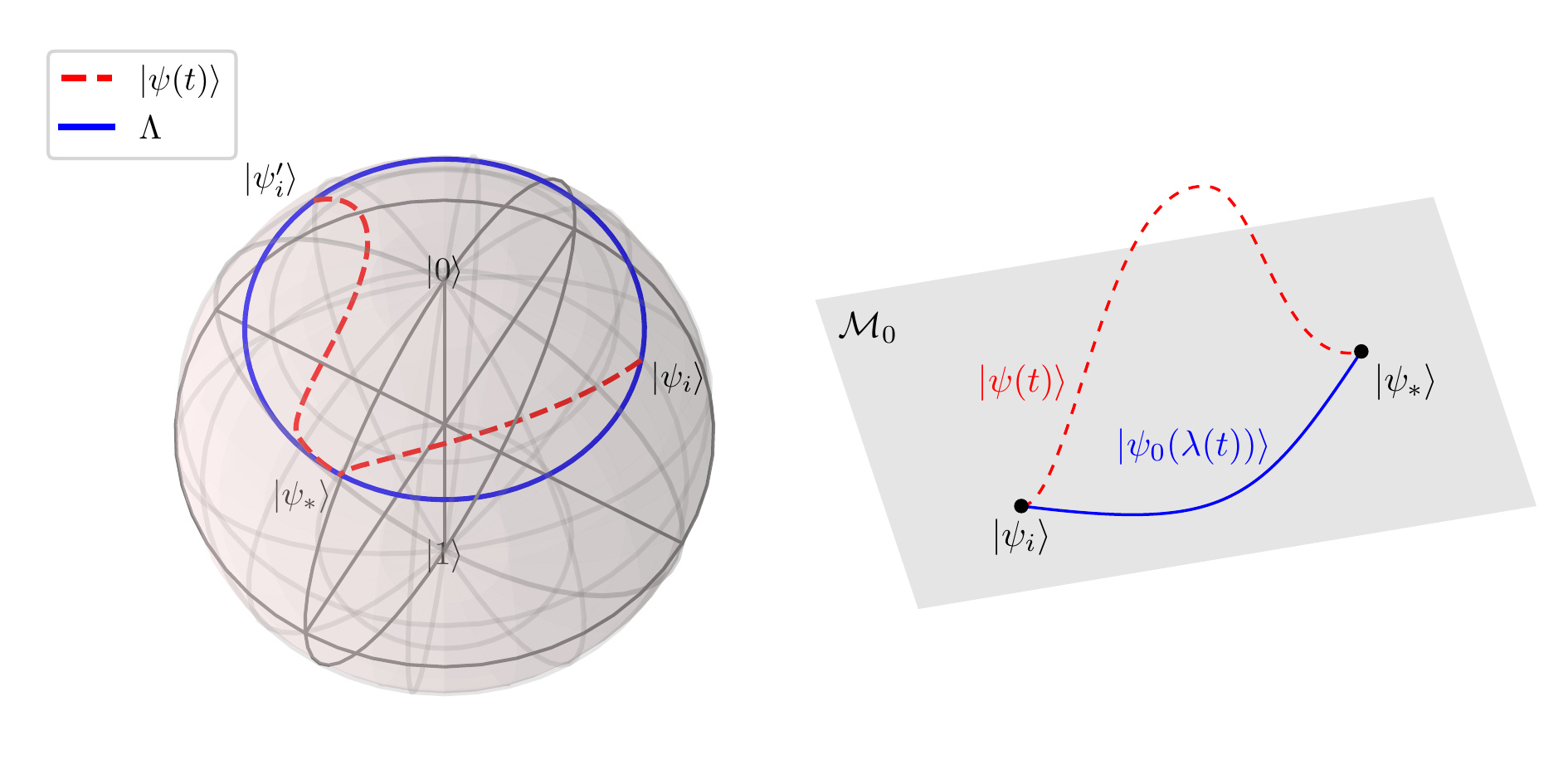
Featured image: Dynamic state paths in a generic qubit state preparation task can undercut the length of the adiabatic preparation path.
Popular summary
A recent conjecture proposed that the energetically shortest path of preparation is always the adiabatic path through the family of ground states of the system. Using a geometric perspective, we show that this conjecture does not hold in general, and illustrate this with a number of generic examples.
► BibTeX data
► References
[1] Tameem Albash and Daniel A. Lidar. Adiabatic quantum computation. Reviews of Modern Physics, 90 (1): 015002, January 2018. 10.1103/RevModPhys.90.015002.
https://doi.org/10.1103/RevModPhys.90.015002
[2] J. Anandan and Y. Aharonov. Geometry of quantum evolution. Physical Review Letters, 65 (14): 1697–1700, October 1990. 10.1103/PhysRevLett.65.1697.
https://doi.org/10.1103/PhysRevLett.65.1697
[3] Sven Bachmann, Martin Fraas, and Gian Michele Graf. Dynamical Crossing of an Infinitely Degenerate Critical Point. Annales Henri Poincaré, 18 (5): 1755–1776, May 2017. ISSN 1424-0661. 10.1007/s00023-016-0539-9.
https://doi.org/10.1007/s00023-016-0539-9
[4] Ingemar Bengtsson and Karol Zyczkowski. Geometry of Quantum States: An Introduction to Quantum Entanglement. Cambridge University Press, Cambridge, 2006. 10.1017/CBO9780511535048.
https://doi.org/10.1017/CBO9780511535048
[5] Marin Bukov, Dries Sels, and Anatoli Polkovnikov. Geometric Speed Limit of Accessible Many-Body State Preparation. Physical Review X, 9 (1): 011034, February 2019. ISSN 2160-3308. 10.1103/PhysRevX.9.011034.
https://doi.org/10.1103/PhysRevX.9.011034
[6] Ian Chi, Martin Fraas, and Tina Tan. Poincaré disk as a model of squeezed states of a harmonic oscillator. (arXiv:2404.07905), April 2024. 10.48550/arXiv.2404.07905.
https://doi.org/10.48550/arXiv.2404.07905
arXiv:2404.07905
[7] Domenico D'Alessandro. Introduction to Quantum Control and Dynamics. Chapman and Hall/CRC, New York, 2 edition, July 2021. ISBN 978-1-003-05126-8. 10.1201/9781003051268.
https://doi.org/10.1201/9781003051268
[8] Michael R. Frey. Quantum speed limits—primer, perspectives, and potential future directions. Quantum Information Processing, 15 (10): 3919–3950, October 2016. ISSN 1573-1332. 10.1007/s11128-016-1405-x.
https://doi.org/10.1007/s11128-016-1405-x
[9] Steffen J. Glaser, Ugo Boscain, Tommaso Calarco, Christiane P. Koch, Walter Köckenberger, Ronnie Kosloff, Ilya Kuprov, Burkhard Luy, Sophie Schirmer, Thomas Schulte-Herbrüggen, Dominique Sugny, and Frank K. Wilhelm. Training Schrödinger's cat: Quantum optimal control. The European Physical Journal D, 69 (12): 279, December 2015. ISSN 1434-6079. 10.1140/epjd/e2015-60464-1.
https://doi.org/10.1140/epjd/e2015-60464-1
[10] Balázs Hetényi and Péter Lévay. Fluctuations, uncertainty relations, and the geometry of quantum state manifolds. Physical Review A, 108 (3): 032218, September 2023. 10.1103/PhysRevA.108.032218.
https://doi.org/10.1103/PhysRevA.108.032218
[11] J. R. Johansson, P. D. Nation, and Franco Nori. QuTiP 2: A Python framework for the dynamics of open quantum systems. Computer Physics Communications, 184 (4): 1234–1240, April 2013. ISSN 00104655. 10.1016/j.cpc.2012.11.019.
https://doi.org/10.1016/j.cpc.2012.11.019
[12] W. O. Kermack and W. H. McCrea. On Professor Whittaker's solution of differential equations by definite integrals: Part II: Applications of the methods of non-commutative Algebra. Proceedings of the Edinburgh Mathematical Society, 2 (4): 220–239, June 1931. ISSN 1464-3839, 0013-0915. 10.1017/S0013091500007781.
https://doi.org/10.1017/S0013091500007781
[13] Michael Kolodrubetz, Dries Sels, Pankaj Mehta, and Anatoli Polkovnikov. Geometry and non-adiabatic response in quantum and classical systems. Physics Reports, 697: 1–87, June 2017. ISSN 0370-1573. 10.1016/j.physrep.2017.07.001.
https://doi.org/10.1016/j.physrep.2017.07.001
[14] Manolo R. Lam, Natalie Peter, Thorsten Groh, Wolfgang Alt, Carsten Robens, Dieter Meschede, Antonio Negretti, Simone Montangero, Tommaso Calarco, and Andrea Alberti. Demonstration of quantum brachistochrones between distant states of an atom. Physical Review X, 11 (1): 011035, February 2021. ISSN 2160-3308. 10.1103/PhysRevX.11.011035.
https://doi.org/10.1103/PhysRevX.11.011035
[15] L. Mandelstam and Igor Tamm. The uncertainty relation between energy and time in nonrelativistic quantum mechanics. J. Phys.(USSR), 9 (249): 1, 1945.
[16] Norman Margolus and Lev B. Levitin. The maximum speed of dynamical evolution. Physica D: Nonlinear Phenomena, 120 (1-2): 188–195, September 1998. ISSN 01672789. 10.1016/S0167-2789(98)00054-2.
https://doi.org/10.1016/S0167-2789(98)00054-2
[17] Christian Ventura Meinersen, Stefano Bosco, and Maximilian Rimbach-Russ. Quantum geometric protocols for fast high-fidelity adiabatic state transfer. EPJ Quantum Technology, 12 (1): 125, December 2025. ISSN 2662-4400, 2196-0763. 10.1140/epjqt/s40507-025-00426-2.
https://doi.org/10.1140/epjqt/s40507-025-00426-2
[18] Diego Paiva Pires, Marco Cianciaruso, Lucas C. Céleri, Gerardo Adesso, and Diogo O. Soares-Pinto. Generalized Geometric Quantum Speed Limits. Physical Review X, 6 (2): 021031, June 2016. 10.1103/PhysRevX.6.021031.
https://doi.org/10.1103/PhysRevX.6.021031
[19] J. P. Provost and G. Vallee. Riemannian structure on manifolds of quantum states. Communications in Mathematical Physics, 76 (3): 289–301, September 1980. ISSN 1432-0916. 10.1007/BF02193559.
https://doi.org/10.1007/BF02193559
Cited by
[1] Hong-Ye Hu, Abigail McClain Gomez, Liyuan Chen, Aaron Trowbridge, Andy J. Goldschmidt, Zachary Manchester, Frederic T. Chong, Arthur Jaffe, and Susanne F. Yelin, "Universal Dynamics with Globally Controlled Analog Quantum Simulators", arXiv:2508.19075, (2025).
The above citations are from SAO/NASA ADS (last updated successfully 2026-10-19 19:46:58). The list may be incomplete as not all publishers provide suitable and complete citation data.
On Crossref's cited-by service no data on citing works was found (last attempt 2026-10-20 07:54:01). Could not fetch ADS cited-by data during last attempt 2026-10-20 07:54:02: Cannot retrieve data from ADS due to rate limitations.
This Paper is published in Quantum under the Creative Commons Attribution 4.0 International (CC BY 4.0) license. Copyright remains with the original copyright holders such as the authors or their institutions.