
Controller-decoder system requirements derived by implementing Shor’s algorithm with surface code
Quantum Machines Inc., Tel Aviv, Israel
| Published: | 2026-07-22, volume 10, page 2170 |
| Editor: | Philipp Schindler |
| Eprint: | arXiv:2412.00289v4 |
| Doi: | https://doi.org/10.22331/q-2026-07-22-2170 |
| Citation: | Quantum 10, 2170 (2026). |
Find this paper interesting or want to discuss? Scite or leave a comment on SciRate.
Abstract
Quantum Error Correction (QEC) is regarded as the most promising path to quantum advantage. The success of QEC relies on achieving quantum gate fidelities below the error threshold of the QEC code, while accurately decoding errors through classical processing of the QEC stabilizer measurements. In this paper, we uncover the critical system-level requirements from a controller-decoder system (CDS) necessary to successfully execute the next milestone in QEC: a non-Clifford circuit. Using a representative non-Clifford circuit, of Shor factorization algorithm for the number 21, we convert the logical-level circuit to a QEC surface code circuit and finally to the physical level circuit. By taking into account realistic implementation aspects using typical superconducting qubit processor parameters, we reveal a broad range of core requirements from any CDS aimed at performing error corrected quantum computation. Our findings indicate that the controller-decoder closed-loop latency must remain within tens of microseconds, achievable by distributing decoding data into several decoders while ensuring fast communication between decoders and with the controller. By extending existing simulation techniques, we simulate the complete fault-tolerant factorization circuit at the physical level, demonstrating that near-term hardware performance in the scale of 0.1% physical error rates and 1000 qubits, are sufficient for a successful circuit execution. Overall, the requirements outlined here set the stage for near- and medium-term experimental realizations of non-Clifford QEC circuits.
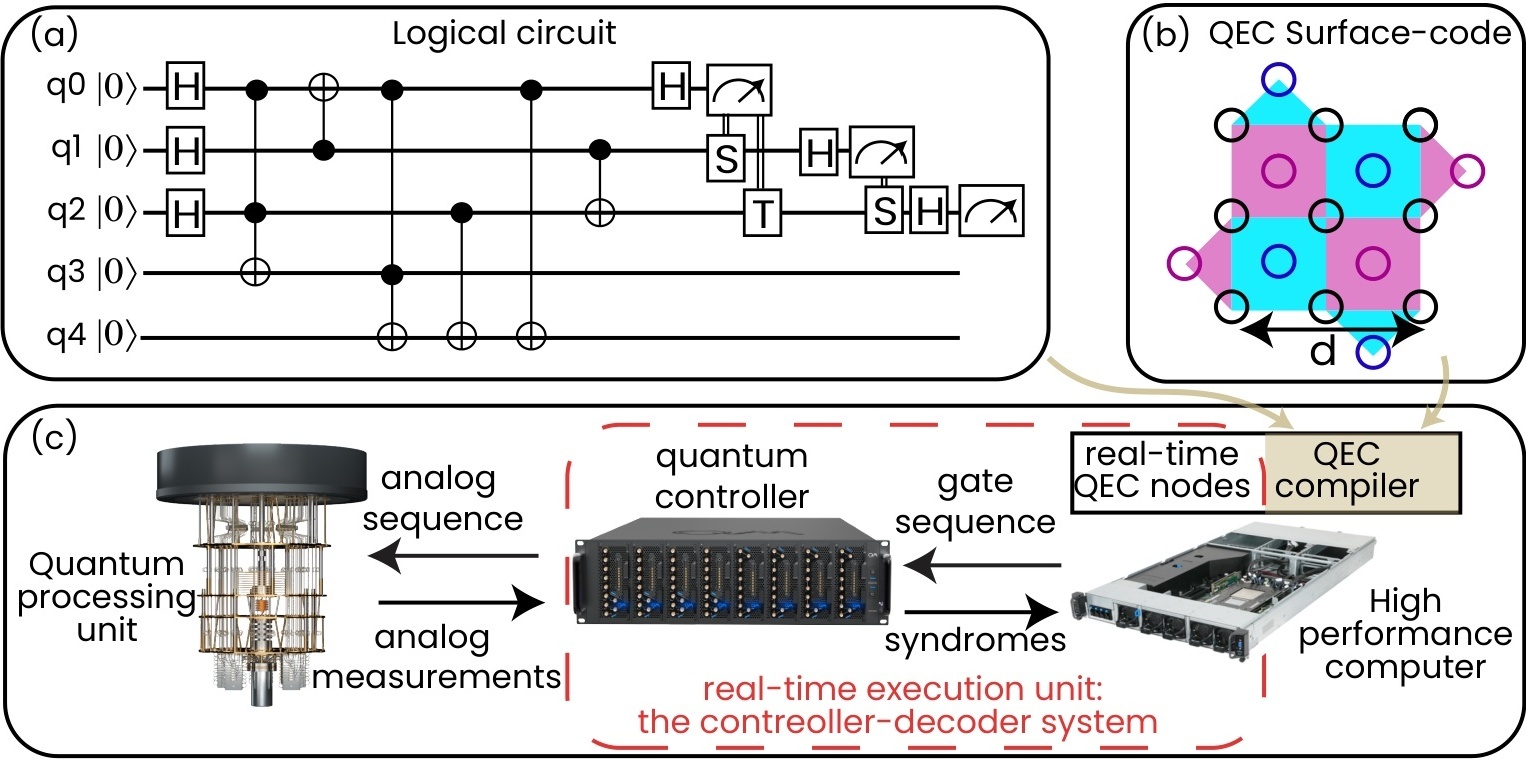
Featured image: The controller-decoder system for a non-Clifford surface-code circuit: (a) logical circuit factoring 21, (b) surface-code patch, (c) control stack linking the quantum processor, controller, and decoder in real time.
A video of the physical-level gate sequences for the factorization circuit with distance-3 surfaces. (doi.org/10.5281/zenodo.17970554)
Popular summary
► BibTeX data
► References
[1] Eric Dennis, Alexei Kitaev, Andrew Landahl, and John Preskill, ``Topological quantum memory'' Journal of Mathematical Physics 43, 4452-4505 (2002).
https://doi.org/10.1063/1.1499754
[2] Emanuel Knill, Raymond Laflamme, and Wojciech H Zurek, ``Resilient quantum computation'' Science 279, 342–345 (1998).
https://doi.org/10.1126/science.279.5349.342
[3] Volodymyr V Sivak, Alec Eickbusch, Baptiste Royer, Shraddha Singh, Ioannis Tsioutsios, Suhas Ganjam, Alessandro Miano, BL Brock, AZ Ding, and Luigi Frunzio, ``Real-time quantum error correction beyond break-even'' Nature 616, 50–55 (2023).
https://doi.org/10.1038/s41586-023-05782-6
[4] Dany Lachance-Quirion, Marc-Antoine Lemonde, Jean Olivier Simoneau, Lucas St-Jean, Pascal Lemieux, Sara Turcotte, Wyatt Wright, Amélie Lacroix, Joëlle Fréchette-Viens, and Ross Shillito, ``Autonomous quantum error correction of Gottesman-Kitaev-Preskill states'' Physical Review Letters 132, 150607 (2024).
https://doi.org/10.1103/physrevlett.132.150607
[5] Julian Kelly, Rami Barends, Austin G Fowler, Anthony Megrant, Evan Jeffrey, Theodore C White, Daniel Sank, Josh Y Mutus, Brooks Campbell, and Yu Chen, ``State preservation by repetitive error detection in a superconducting quantum circuit'' Nature 519, 66–69 (2015).
https://doi.org/10.1038/nature14270
[6] Sebastian Krinner, Nathan Lacroix, Ants Remm, Agustin Di Paolo, Elie Genois, Catherine Leroux, Christoph Hellings, Stefania Lazar, Francois Swiadek, and Johannes Herrmann, ``Realizing repeated quantum error correction in a distance-three surface code'' Nature 605, 669–674 (2022).
https://doi.org/10.1038/s41586-022-04566-8
[7] ``Suppressing quantum errors by scaling a surface code logical qubit'' Nature 614, 676–681 (2023).
https://doi.org/10.1038/s41586-022-05434-1
[8] ``Quantum error correction below the surface code threshold'' Nature 638, 920–926 (2025).
https://doi.org/10.1038/s41586-024-08449-y
[9] Dolev Bluvstein, Simon J Evered, Alexandra A Geim, Sophie H Li, Hengyun Zhou, Tom Manovitz, Sepehr Ebadi, Madelyn Cain, Marcin Kalinowski, and Dominik Hangleiter, ``Logical quantum processor based on reconfigurable atom arrays'' Nature 626, 58–65 (2024).
https://doi.org/10.1038/s41586-023-06927-3
[10] C Ryan-Anderson, NC Brown, CH Baldwin, JM Dreiling, C Foltz, JP Gaebler, TM Gatterman, N Hewitt, C Holliman, and CV Horst, ``High-fidelity and fault-tolerant teleportation of a logical qubit using transversal gates and lattice surgery on a trapped-ion quantum computer (2024)'' arXiv preprint arXiv:2404.16728.
https://doi.org/10.1126/science.adp6016
[11] Bence Hetényiand James R Wootton ``Creating entangled logical qubits in the heavy-hex lattice with topological codes'' PRX Quantum 5, 040334 (2024).
https://doi.org/10.1103/PRXQuantum.5.040334
[12] A Paetznick, MP da Silva, C Ryan-Anderson, JM Bello-Rivas, JP Campora III, A Chernoguzov, JM Dreiling, C Foltz, F Frachon, and JP Gaebler, ``Demonstration of logical qubits and repeated error correction with better-than-physical error rates'' arXiv preprint arXiv:2404.02280 (2024).
https://arxiv.org/abs/2404.02280
[13] Antti Vepsäläinen, Roni Winik, Amir H Karamlou, Jochen Braumüller, Agustin Di Paolo, Youngkyu Sung, Bharath Kannan, Morten Kjaergaard, David K Kim, and Alexander J Melville, ``Improving qubit coherence using closed-loop feedback'' Nature Communications 13, 1932 (2022).
https://doi.org/10.1038/s41467-022-29287-4
[14] Paul V Klimov, Julian Kelly, John M Martinis, and Hartmut Neven, ``The snake optimizer for learning quantum processor control parameters'' arXiv preprint arXiv:2006.04594 (2020).
https://arxiv.org/abs/2006.04594
[15] J Kelly, R Barends, AG Fowler, A Megrant, E Jeffrey, TC White, D Sank, JY Mutus, B Campbell, and Yu Chen, ``Scalable in situ qubit calibration during repetitive error detection'' Physical Review A 94, 032321 (2016).
https://doi.org/10.1103/physreva.94.032321
[16] Yilun Xu, Gang Huang, Jan Balewski, Alexis Morvan, Kasra Nowrouzi, David I Santiago, Ravi K Naik, Brad Mitchell, and Irfan Siddiqi, ``Automatic qubit characterization and gate optimization with qubic'' ACM Transactions on Quantum Computing 4, 1–12 (2022).
https://doi.org/10.1145/3529397
[17] Timothy Proctor, Melissa Revelle, Erik Nielsen, Kenneth Rudinger, Daniel Lobser, Peter Maunz, Robin Blume-Kohout, and Kevin Young, ``Detecting and tracking drift in quantum information processors'' Nature communications 11, 5396 (2020).
https://doi.org/10.1038/s41467-020-19074-4
[18] Barbara M Terhal ``Quantum error correction for quantum memories'' Reviews of Modern Physics 87, 307–346 (2015).
https://doi.org/10.1103/revmodphys.87.307
[19] Austin G Fowler, Matteo Mariantoni, John M Martinis, and Andrew N Cleland, ``Surface codes: Towards practical large-scale quantum computation'' Physical Review A—Atomic, Molecular, and Optical Physics 86, 032324 (2012).
https://doi.org/10.1103/physreva.86.032324
[20] Antonio deMarti iOlius, Patricio Fuentes, Román Orús, Pedro M Crespo, and Josu Etxezarreta Martinez, ``Decoding algorithms for surface codes'' Quantum 8, 1498 (2024).
https://doi.org/10.22331/q-2024-10-10-1498
[21] Daniel Gottesman ``The Heisenberg representation of quantum computers'' arXiv preprint quant-ph/9807006 (1998).
https://arxiv.org/abs/quant-ph/9807006
[22] P Oscar Boykin, Tal Mor, Matthew Pulver, Vwani Roychowdhury, and Farrokh Vatan, ``On universal and fault-tolerant quantum computing: a novel basis and a new constructive proof of universality for shor's basis'' 40th Annual Symposium on Foundations of Computer Science (Cat. No. 99CB37039) 486–494 (1999).
https://doi.org/10.1109/sffcs.1999.814621
[23] Namitha Liyanage, Yue Wu, Alexander Deters, and Lin Zhong, ``Scalable quantum error correction for surface codes using FPGA'' 2023 IEEE International Conference on Quantum Computing and Engineering (QCE) 1, 916–927 (2023).
https://doi.org/10.1109/qce57702.2023.00106
[24] Ben Barber, Kenton M Barnes, Tomasz Bialas, Okan Buğdaycı, Earl T Campbell, Neil I Gillespie, Kauser Johar, Ram Rajan, Adam W Richardson, and Luka Skoric, ``A real-time, scalable, fast and resource-efficient decoder for a quantum computer'' Nature Electronics 8, 84–91 (2025).
https://doi.org/10.1038/s41928-024-01319-5
[25] Francesco Battistel, Christopher Chamberland, Kauser Johar, Ramon WJ Overwater, Fabio Sebastiano, Luka Skoric, Yosuke Ueno, and Muhammad Usman, ``Real-time decoding for fault-tolerant quantum computing: Progress, challenges and outlook'' Nano Futures 7, 032003 (2023).
https://doi.org/10.1088/2399-1984/aceba6
[26] Xiang Fu, Lingling Lao, Koen Bertels, and Carmen G Almudever, ``A control microarchitecture for fault-tolerant quantum computing'' Microprocessors and Microsystems 70, 21–30 (2019).
https://doi.org/10.1016/j.micpro.2019.06.011
[27] Poulami Das, Christopher A Pattison, Srilatha Manne, Douglas M Carmean, Krysta M Svore, Moinuddin Qureshi, and Nicolas Delfosse, ``Afs: Accurate, fast, and scalable error-decoding for fault-tolerant quantum computers'' 2022 IEEE International Symposium on High-Performance Computer Architecture (HPCA) 259–273 (2022).
https://doi.org/10.1109/hpca53966.2022.00027
[28] Satvik Mauryaand Swamit Tannu ``Managing Classical Processing Requirements for Quantum Error Correction'' arXiv preprint arXiv:2406.17995 (2024).
https://doi.org/10.1145/3767295.3803584
[29] Yue Wu, Namitha Liyanage, and Lin Zhong, ``LEGO: QEC Decoding System Architecture for Dynamic Circuits'' arXiv preprint arXiv:2410.03073 (2024).
https://arxiv.org/abs/2410.03073
[30] Michael E Beverland, Prakash Murali, Matthias Troyer, Krysta M Svore, Torsten Hoefler, Vadym Kliuchnikov, Guang Hao Low, Mathias Soeken, Aarthi Sundaram, and Alexander Vaschillo, ``Assessing requirements to scale to practical quantum advantage'' arXiv preprint arXiv:2211.07629 (2022).
https://arxiv.org/abs/2211.07629
[31] Yaniv Kurman, Lior Ella, Ramon Szmuk, Oded Wertheim, Benedikt Dorschner, Sam Stanwyck, and Yonatan Cohen, ``Benchmarking the ability of a controller to execute quantum error corrected non-Clifford circuits'' IEEE Transactions on Quantum Engineering 6 (2025).
https://doi.org/10.1109/tqe.2025.3608053
[32] Laura Caune, Luka Skoric, Nick S Blunt, Archibald Ruban, Jimmy McDaniel, Joseph A Valery, Andrew D Patterson, Alexander V Gramolin, Joonas Majaniemi, Kenton M Barnes, Tomasz Bialas, Okan Buğdaycı, Ophelia Crawford, György P Gehér, Hari Krovi, Elisha Matekole, Canberk Topal, Stefano Poletto, Michael Bryant, Kalan Snyder, Neil I Gillespie, Glenn Jones, Kauser Johar, Earl T Campbell, and Alexander D Hill, ``Demonstrating real-time and low-latency quantum error correction with superconducting qubits'' Nature Communications (2024).
https://doi.org/10.1038/s41467-026-73331-6
[33] Christopher Chamberlandand Earl T Campbell ``Universal quantum computing with twist-free and temporally encoded lattice surgery'' PRX Quantum 3, 010331 (2022).
https://doi.org/10.1103/prxquantum.3.010331
[34] Daniel Litinski ``A game of surface codes: Large-scale quantum computing with lattice surgery'' Quantum 3, 128 (2019).
https://doi.org/10.22331/q-2019-03-05-128
[35] Oscar Higgott, Thomas C Bohdanowicz, Aleksander Kubica, Steven T Flammia, and Earl T Campbell, ``Improved decoding of circuit noise and fragile boundaries of tailored surface codes'' Physical Review X 13, 031007 (2023).
https://doi.org/10.1103/physrevx.13.031007
[36] Dominic Horsman, Austin G Fowler, Simon Devitt, and Rodney Van Meter, ``Surface code quantum computing by lattice surgery'' New Journal of Physics 14, 123011 (2012).
https://doi.org/10.1088/1367-2630/14/12/123011
[37] Craig Gidney ``Inplace access to the surface code y basis'' Quantum 8, 1310 (2024).
https://doi.org/10.22331/q-2024-04-08-1310
[38] Sergey Bravyiand Alexei Kitaev ``Universal quantum computation with ideal Clifford gates and noisy ancillas'' Physical Review A—Atomic, Molecular, and Optical Physics 71, 022316 (2005).
https://doi.org/10.1103/physreva.71.022316
[39] Satvik Mauryaand Swamit Tannu ``Synchronization for Fault-Tolerant Quantum Computers'' Proceedings of the 52nd Annual International Symposium on Computer Architecture (2025).
https://doi.org/10.1145/3695053.3730991
[40] Bryan Eastinand Emanuel Knill ``Restrictions on transversal encoded quantum gate sets'' Physical review letters 102, 110502 (2009).
https://doi.org/10.1103/physrevlett.102.110502
[41] Ying Li ``A magic state’s fidelity can be superior to the operations that created it'' New Journal of Physics 17, 023037 (2015).
https://doi.org/10.1088/1367-2630/17/2/023037
[42] Craig Gidney ``Cleaner magic states with hook injection'' arXiv preprint arXiv:2302.12292 (2023).
https://arxiv.org/abs/2302.12292
[43] Tomohiro Itogawa, Yugo Takada, Yutaka Hirano, and Keisuke Fujii, ``Efficient Magic State Distillation by Zero-Level Distillation'' PRX Quantum 6, 020356 (2025).
https://doi.org/10.1103/thxx-njr6
[44] Daniel Litinski ``Magic state distillation: Not as costly as you think'' Quantum 3, 205 (2019).
https://doi.org/10.22331/q-2019-12-02-205
[45] Craig Gidneyand Austin G Fowler ``Efficient magic state factories with a catalyzed |CCZ> to 2|T> transformation'' Quantum 3, 135 (2019).
https://doi.org/10.22331/q-2019-04-30-135
[46] Craig Gidney, Noah Shutty, and Cody Jones, ``Magic state cultivation: growing T states as cheap as CNOT gates'' arXiv preprint arXiv:2409.17595 (2024).
https://arxiv.org/abs/2409.17595
[47] Craig Gidney ``How to factor 2048 bit RSA integers with less than a million noisy qubits'' arXiv preprint arXiv:2505.15917 (2025).
https://arxiv.org/abs/2505.15917
[48] Matthew Amy, Dmitri Maslov, Michele Mosca, and Martin Roetteler, ``A meet-in-the-middle algorithm for fast synthesis of depth-optimal quantum circuits'' IEEE Transactions on Computer-Aided Design of Integrated Circuits and Systems 32, 818–830 (2013).
https://doi.org/10.1109/tcad.2013.2244643
[49] Bob Coecke ``Basic ZX-calculus for students and professionals'' arXiv preprint arXiv:2303.03163 (2023).
https://arxiv.org/abs/2303.03163
[50] Aleks Kissingerand John Van De Wetering ``Reducing the number of non-Clifford gates in quantum circuits'' Physical Review A 102, 022406 (2020).
https://doi.org/10.1103/physreva.102.022406
[51] Niel De Beaudrap, Xiaoning Bian, and Quanlong Wang, ``Techniques to Reduce $\pi/4$-Parity-Phase Circuits, Motivated by the ZX Calculus'' arXiv preprint arXiv:1911.09039 (2019).
https://doi.org/10.4204/eptcs.318.9
[52] Stephane Beauregard ``Circuit for Shor's algorithm using 2n+ 3 qubits'' arXiv preprint quant-ph/0205095 (2002).
https://doi.org/10.26421/qic3.2-8
[53] Daniel Herr, Franco Nori, and Simon J Devitt, ``Optimization of lattice surgery is NP-hard'' Npj quantum information 3, 35 (2017).
https://doi.org/10.1038/s41534-017-0035-1
[54] Lingling Lao, Bas van Wee, Imran Ashraf, J Van Someren, Nader Khammassi, Koen Bertels, and Carmen G Almudever, ``Mapping of lattice surgery-based quantum circuits on surface code architectures'' Quantum Science and Technology 4, 015005 (2018).
https://doi.org/10.1088/2058-9565/aadd1a
[55] Michael Beverland, Vadym Kliuchnikov, and Eddie Schoute, ``Surface code compilation via edge-disjoint paths'' PRX Quantum 3, 020342 (2022).
https://doi.org/10.1103/prxquantum.3.020342
[56] Yutaro Akahoshi, Kazunori Maruyama, Hirotaka Oshima, Shintaro Sato, and Keisuke Fujii, ``Partially fault-tolerant quantum computing architecture with error-corrected clifford gates and space-time efficient analog rotations'' PRX quantum 5, 010337 (2024).
https://doi.org/10.1103/prxquantum.5.010337
[57] Yaniv Kurman ``Factorization Circuit Video'' (2025).
https://doi.org/10.5281/zenodo.17970554
[58] Craig Gidney ``Stim: a fast stabilizer circuit simulator'' Quantum 5, 497 (2021).
https://doi.org/10.22331/q-2021-07-06-497
[59] Oscar Higgott ``Pymatching: A python package for decoding quantum codes with minimum-weight perfect matching'' ACM Transactions on Quantum Computing 3, 1–16 (2022).
https://doi.org/10.1145/3505637
[60] Nicolas Delfosseand Naomi H Nickerson ``Almost-linear time decoding algorithm for topological codes'' Quantum 5, 595 (2021).
https://doi.org/10.22331/q-2021-12-02-595
[61] Yue Wuand Lin Zhong ``Fusion blossom: Fast mwpm decoders for qec'' 2023 IEEE International Conference on Quantum Computing and Engineering (QCE) 1, 928–938 (2023).
https://doi.org/10.1109/qce57702.2023.00107
[62] Vladimir Kolmogorov ``Blossom V: a new implementation of a minimum cost perfect matching algorithm'' Mathematical Programming Computation 1, 43–67 (2009).
https://doi.org/10.1007/s12532-009-0002-8
[63] Christopher T Chubb ``General tensor network decoding of 2D Pauli codes'' arXiv preprint arXiv:2101.04125 (2021).
https://arxiv.org/abs/2101.04125
[64] Poulami Das, Aditya Locharla, and Cody Jones, ``Lilliput: a lightweight low-latency lookup-table decoder for near-term quantum error correction'' Proceedings of the 27th ACM International Conference on Architectural Support for Programming Languages and Operating Systems 541–553 (2022).
https://doi.org/10.1145/3503222.3507707
[65] Kai Meinerz, Chae-Yeun Park, and Simon Trebst, ``Scalable neural decoder for topological surface codes'' Physical Review Letters 128, 080505 (2022).
https://doi.org/10.1103/physrevlett.128.080505
[66] Oscar Higgottand Craig Gidney ``Sparse blossom: correcting a million errors per core second with minimum-weight matching'' Quantum 9, 1600 (2025).
https://doi.org/10.22331/q-2025-01-20-1600
[67] Samuel C Smith, Benjamin J Brown, and Stephen D Bartlett, ``Local predecoder to reduce the bandwidth and latency of quantum error correction'' Physical Review Applied 19, 034050 (2023).
https://doi.org/10.1103/physrevapplied.19.034050
[68] Laura Caune, Brendan Reid, Joan Camps, and Earl Campbell, ``Belief propagation as a partial decoder'' arXiv preprint arXiv:2306.17142 (2023).
https://arxiv.org/abs/2306.17142
[69] Johannes Bausch, Andrew W Senior, Francisco JH Heras, Thomas Edlich, Alex Davies, Michael Newman, Cody Jones, Kevin Satzinger, Murphy Yuezhen Niu, and Sam Blackwell, ``Learning high-accuracy error decoding for quantum processors'' Nature 635, 834–840 (2024).
https://doi.org/10.1038/s41586-024-08148-8
[70] Tobias Fischbach, Pierre Talbot, and Pascal Bouvry, ``A Review on Quantum Circuit Optimization using ZX-Calculus'' arXiv preprint arXiv:2509.20663 (2025).
https://arxiv.org/abs/2509.20663
[71] Sergey Bravyi, Andrew W Cross, Jay M Gambetta, Dmitri Maslov, Patrick Rall, and Theodore J Yoder, ``High-threshold and low-overhead fault-tolerant quantum memory'' Nature 627, 778–782 (2024).
https://doi.org/10.1038/s41586-024-07107-7
[72] Diego Ruiz, Jérémie Guillaud, Anthony Leverrier, Mazyar Mirrahimi, and Christophe Vuillot, ``LDPC-cat codes for low-overhead quantum computing in 2D'' Nature Communications 16, 1040 (2025).
https://doi.org/10.1038/s41467-025-56298-8
[73] Edward H Chen, Theodore J Yoder, Youngseok Kim, Neereja Sundaresan, Srikanth Srinivasan, Muyuan Li, Antonio D Córcoles, Andrew W Cross, and Maika Takita, ``Calibrated decoders for experimental quantum error correction'' Physical Review Letters 128, 110504 (2022).
https://doi.org/10.1103/physrevlett.128.110504
[74] Evan T Hockings, Andrew C Doherty, and Robin Harper, ``Scalable noise characterization of syndrome-extraction circuits with averaged circuit eigenvalue sampling'' PRX quantum 6, 010334 (2025).
https://doi.org/10.1103/prxquantum.6.010334
[75] Masoud Mohseni, Artur Scherer, K Grace Johnson, Oded Wertheim, Matthew Otten, Navid Anjum Aadit, Kirk M Bresniker, Kerem Y Camsari, Barbara Chapman, and Soumitra Chatterjee, ``How to build a quantum supercomputer: Scaling challenges and opportunities'' TBD (2024).
https://arxiv.org/abs/2411.10406
[76] Yaniv Kurman ``YanivKurman/factorization_paper_simulations: v1.0.0 (paper version)'' (2025).
https://doi.org/10.5281/zenodo.17970516
[77] Peter W Shor ``Polynomial-time algorithms for prime factorization and discrete logarithms on a quantum computer'' SIAM review 41, 303–332 (1999).
https://doi.org/10.1137/s0036144598347011
Cited by
Could not fetch Crossref cited-by data during last attempt 2026-07-22 11:25:46: Could not fetch cited-by data for 10.22331/q-2026-07-22-2170 from Crossref. This is normal if the DOI was registered recently. Could not fetch ADS cited-by data during last attempt 2026-07-22 11:25:53: Cannot retrieve data from ADS due to rate limitations.
This Paper is published in Quantum under the Creative Commons Attribution 4.0 International (CC BY 4.0) license. Copyright remains with the original copyright holders such as the authors or their institutions.