
Bounding the entanglement of a state from its spectrum
1Física Teòrica: Informació i Fenòmens Quàntics, Departament de Física, Universitat Autònoma de Barcelona, E-08193 Bellaterra, Spain.
2Faculty of Physics, Astronomy and Applied Computer Science, Jagiellonian University, ul. Łojasiewicza 11, 30-348 Kraków, Poland.
3Naturwissenschaftlich-Technische Fakultät, Universität Siegen, Walter-Flex-Straße 3, 57068 Siegen, Germany.
4ICREA – Institució Catalana de Recerca i Estudis Avançats, Lluis Companys 23, 08010 Barcelona, Spain.
| Published: | 2026-11-06, volume 10, page 2260 |
| Editor: | Remigiusz Augusiak |
| Eprint: | arXiv:2604.02420v4 |
| Doi: | https://doi.org/10.22331/q-2026-11-06-2260 |
| Citation: | Quantum 10, 2260 (2026). |
Find this paper interesting or want to discuss? Scite or leave a comment on SciRate.
Abstract
We introduce a framework to upper bound the entanglement content of a bipartite quantum state from its spectrum alone. Using linear maps and their inverses, we derive rigorous constraints on the maximal entanglement that can be activated under global unitary transformations. We use as entanglement quantifiers the negativity and the Schmidt number; however, our framework is general and applies to any other entanglement measure. Our approach yields compact analytical sufficient criteria for bounding the entanglement of full-rank states in arbitrary dimensions and reveals new spectral constraints on Schmidt number witnesses.
Popular summary
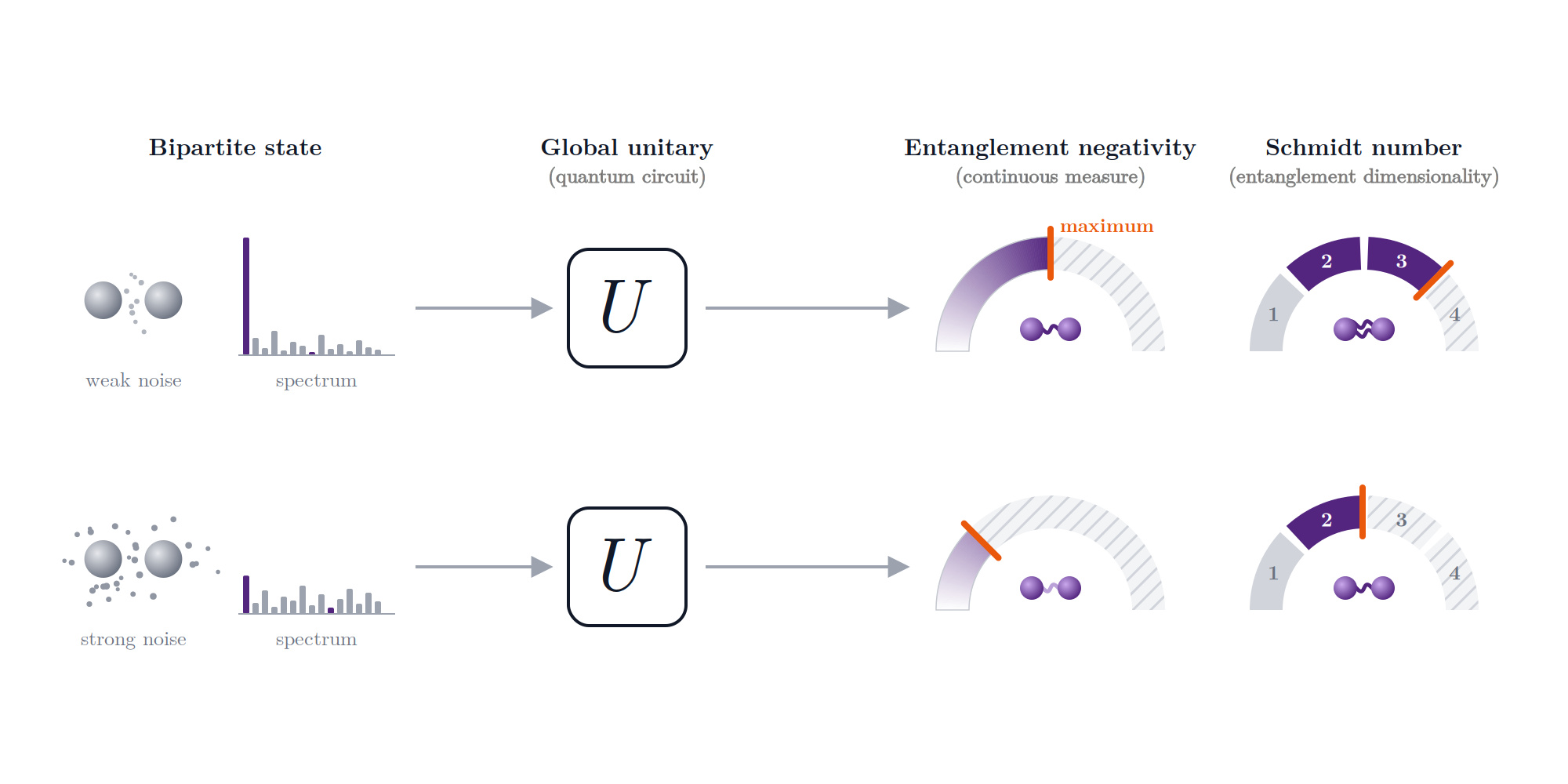
In this work, we tackle this open problem and find useful criteria to determine the maximal amount of entanglement that can be possibly created in a mixed quantum state with unitary evolutions. Although the problem is in general a difficult optimization, the bounds introduced depend solely on two eigenvalues of the state, and in fact are shown to be tight for certain noise models. Thus they apply effectively at low computational cost, and allow us to address the problem for high-dimensional quantum systems. We bound both continuous and discrete entanglement measures, namely the entanglement negativity and the so-called Schmidt number (which accounts for the amount of entangled degrees of freedom).
► BibTeX data
► References
[1] M. Kus and K. Zyczkowski. ``Geometry of entangled states''. Physical Review A 63, 032307 (2001).
https://doi.org/10.1103/PhysRevA.63.032307
[2] Barbara M. Terhal. ``Bell inequalities and the separability criterion''. Physics Letters A 271, 319–326 (2000).
https://doi.org/10.1016/S0375-9601(00)00401-1
[3] M. Lewenstein, B. Kraus, J. I. Cirac, and P. Horodecki. ``Optimization of entanglement witnesses''. Physical Review A 62, 052310 (2000).
https://doi.org/10.1103/PhysRevA.62.052310
[4] O. Gühne and G. Tóth. ``Entanglement detection''. Physics Reports 474, 1–75 (2009).
https://doi.org/10.1016/j.physrep.2009.02.004
[5] A.C. Doherty, P.A. Parrilo, and F.M. Spedalieri. ``Complete family of separability criteria''. Physical Review A 69, 022308 (2004).
https://doi.org/10.1103/PhysRevA.69.022308
[6] Andrew C. Doherty, Pablo A. Parrilo, and Federico M. Spedalieri. ``Detecting multipartite entanglement''. Physical Review A 71, 032333 (2005).
https://doi.org/10.1103/PhysRevA.71.032333
[7] M. Keyl and R. F. Werner. ``Estimating the spectrum of a density operator''. Physical Review A 64, 052311 (2001).
https://doi.org/10.1103/PhysRevA.64.052311
[8] Seth Lloyd, Masoud Mohseni, and Patrick Rebentrost. ``Quantum principal component analysis''. Nature Physics 10, 631–633 (2014).
https://doi.org/10.1038/nphys3029
[9] Jeongwan Haah, Aram W. Harrow, Zhengfeng Ji, Xiaodi Wu, and Nengkun Yu. ``Sample-optimal tomography of quantum states''. IEEE Transactions on Information Theory 63, 5628–5641 (2017).
https://doi.org/10.1109/TIT.2017.2719044
[10] Paweł Cieśliński, Satoya Imai, Jan Dziewior, Otfried Gühne, Lukas Knips, Wiesław Laskowski, Jasmin Meinecke, Tomasz Paterek, and Tamás Vértesi. ``Analysing quantum systems with randomised measurements''. Physics Reports 1095, 1–48 (2024).
https://doi.org/10.1016/j.physrep.2024.09.009
[11] Paolo Zanardi, Christof Zalka, and Lara Faoro. ``Entangling power of quantum evolutions''. Physical Review A 62, 030301 (2000).
https://doi.org/10.1103/PhysRevA.62.030301
[12] Lin Chen and Li Yu. ``Entanglement cost and entangling power of bipartite unitary and permutation operators''. Physical Review A 93, 042331 (2016).
https://doi.org/10.1103/PhysRevA.93.042331
[13] Tomasz Linowski, Grzegorz Rajchel-Mieldzioć, and Karol Życzkowski. ``Entangling power of multipartite unitary gates''. Journal of Physics A: Mathematical and Theoretical 53, 125303 (2020).
https://doi.org/10.1088/1751-8121/ab749a
[14] W. J. Munro, D. F. V. James, A. G. White, and P. G. Kwiat. ``Maximizing the entanglement of two mixed qubits''. Physical Review A 64, 030302 (2001).
https://doi.org/10.1103/PhysRevA.64.030302
[15] Satoshi Ishizaka and Tohya Hiroshima. ``Maximally entangled mixed states under nonlocal unitary operations in two qubits''. Physical Review A 62, 022310 (2000).
https://doi.org/10.1103/PhysRevA.62.022310
[16] F. Verstraete, K. Audenaert, and B. De Moor. ``Maximally entangled mixed states of two qubits''. Physical Review A 64, 012316 (2001).
https://doi.org/10.1103/PhysRevA.64.012316
[17] Tzu-Chieh Wei, Kae Nemoto, Paul M. Goldbart, Paul G. Kwiat, William J. Munro, and Frank Verstraete. ``Maximal entanglement versus entropy for mixed quantum states''. Physical Review A 67, 022110 (2003).
https://doi.org/10.1103/PhysRevA.67.022110
[18] E. Serrano-Ensástiga and J. Martin. ``Maximum entanglement of mixed symmetric states under unitary transformations''. SciPost Physics 15, 120 (2023).
https://doi.org/10.21468/SciPostPhys.15.3.120
[19] Eduardo Serrano-Ensástiga, Diego Morachis Galindo, Jesús A. Maytorena, and Chryssomalis Chryssomalakos. ``Entangling power for symmetric multiqubit systems: A geometrical approach''. Annals of Physics 481, 170143 (2025). arXiv:2410.03361.
https://doi.org/10.1016/j.aop.2025.170143
arXiv:2410.03361
[20] Shuheng Liu, Matteo Fadel, Qiongyi He, Marcus Huber, and Giuseppe Vitagliano. ``Bounding entanglement dimensionality from the covariance matrix''. Quantum 8, 1236 (2024).
https://doi.org/10.22331/q-2024-01-30-1236
[21] Nathaniel Johnston, Benjamin Lovitz, and Aravindan Vijayaraghavan. ``A Complete Hierarchy of Linear Systems for Certifying Quantum Entanglement of Subspaces''. Physical Review A 106, 062443 (2022).
https://doi.org/10.1103/PhysRevA.106.062443
[22] K. Zyczkowski, P. Horodecki, A. Sanpera, and M. Lewenstein. ``On the volume of the set of mixed entangled states''. Physical Review A 58, 883–892 (1998).
https://doi.org/10.1103/PhysRevA.58.883
[23] G. Vidal and R. F. Werner. ``A computable measure of entanglement''. Physical Review A 65, 032314 (2002).
https://doi.org/10.1103/PhysRevA.65.032314
[24] Barbara M. Terhal and Paweł Horodecki. ``Schmidt number for density matrices''. Physical Review A 61, 040301 (2000).
https://doi.org/10.1103/PhysRevA.61.040301
[25] Bivas Mallick, Saheli Mukherjee, Nirman Ganguly, and A. S. Majumdar. ``Absolute Schmidt number: characterization, detection and resource-theoretic quantification'' (2026). arXiv:2604.02439.
arXiv:2604.02439
[26] L. Gurvits and H. Barnum. ``Separable balls around the maximally mixed multipartite quantum states''. Physical Review A 68, 042312 (2003).
https://doi.org/10.1103/PhysRevA.68.042312
[27] N. Johnston. ``Separability from Spectrum for Qubit-Qudit States''. Physical Review A 88, 062330 (2013).
https://doi.org/10.1103/PhysRevA.88.062330
[28] Jofre Abellanet-Vidal, Guillem Müller-Rigat, Grzegorz Rajchel-Mieldzioć, and Anna Sanpera. ``Sufficient criteria for absolute separability in arbitrary dimensions via linear map inverses''. Reports on Progress in Physics 88, 107601 (2025).
https://doi.org/10.1088/1361-6633/ae0cfa
[29] R. Hildebrand. ``PPT from spectra''. Physical Review A 76, 052325 (2007).
https://doi.org/10.1103/PhysRevA.76.052325
[30] S. Arunachalam, N. Johnston, and V. Russo. ``Is absolute separability determined by the partial transpose?''. Quantum Information and Computation 15, 694–720 (2015).
https://doi.org/10.26421/QIC15.7-8-10
[31] M. A. Nielsen. ``Conditions for a class of entanglement transformations''. Physical Review Letters 83, 436–439 (1999).
https://doi.org/10.1103/PhysRevLett.83.436
[32] R. Horodecki, P. Horodecki, M. Horodecki, and K. Horodecki. ``Quantum entanglement''. Reviews of Modern Physics 81, 865–942 (2009).
https://doi.org/10.1103/RevModPhys.81.865
[33] Christopher Eltschka and Jens Siewert. ``Quantifying entanglement resources''. Journal of Physics A: Mathematical and Theoretical 47, 424005 (2014).
https://doi.org/10.1088/1751-8113/47/42/424005
[34] Martin B. Plenio and Shashank Virmani. ``An introduction to entanglement measures''. Quantum Information & Computation 7, 1–51 (2007).
https://doi.org/10.26421/QIC7.1-2-1
[35] V. Vedral, M. B. Plenio, M. A. Rippin, and P. L. Knight. ``Quantifying Entanglement''. Physical Review Letters 78, 2275–2279 (1997).
https://doi.org/10.1103/PhysRevLett.78.2275
[36] Guifre Vidal. ``Entanglement monotones''. Journal of Modern Optics 47, 355–376 (2000).
https://doi.org/10.1080/09500340008244048
[37] Armin Uhlmann. ``Roofs and Convexity''. Entropy 12, 1799–1832 (2010).
https://doi.org/10.3390/e12071799
[38] A. Peres. ``Separability Criterion for Density Matrices''. Physical Review Letters 77, 1413–1415 (1996).
https://doi.org/10.1103/PhysRevLett.77.1413
[39] Michał Horodecki, Paweł Horodecki, and Ryszard Horodecki. ``Separability of mixed states: necessary and sufficient conditions''. Physics Letters A 223, 1–8 (1996).
https://doi.org/10.1016/S0375-9601(96)00706-2
[40] Soojoon Lee, Dong Pyo Chi, Sung Dahm Oh, and Jaewan Kim. ``Convex-roof extended negativity as an entanglement measure for bipartite quantum systems''. Physical Review A 68, 062304 (2003).
https://doi.org/10.1103/PhysRevA.68.062304
[41] Barbara M. Terhal. ``A family of indecomposable positive linear maps based on entangled quantum states''. Linear Algebra and its Applications 323, 61–73 (2001).
https://doi.org/10.1016/S0024-3795(00)00251-2
[42] M. Lewenstein, B. Kraus, P. Horodecki, and J. I. Cirac. ``Characterization of separable states and entanglement witnesses''. Physical Review A 63, 044304 (2001).
https://doi.org/10.1103/PhysRevA.63.044304
[43] Lieven Clarisse, Sibasish Ghosh, Simone Severini, and Anthony Sudbery. ``The disentangling power of unitaries''. Physics Letters A 365, 400–402 (2007).
https://doi.org/10.1016/j.physleta.2007.02.001
[44] M. Lewenstein, R. Augusiak, D. Chruściński, S. Rana, and J. Samsonowicz. ``Sufficient separability criteria and linear maps''. Physical Review A 93, 042335 (2016).
https://doi.org/10.1103/PhysRevA.93.042335
[45] M. Lewenstein, G. Müller-Rigat, J. Tura, and A. Sanpera. ``Linear maps as sufficient criteria for entanglement depth and compatibility in many-body systems''. Open Systems & Information Dynamics 29, 2250011 (2022).
https://doi.org/10.1142/S1230161222500111
[46] I. Bardet, B. Collins, and G. Sapra. ``Characterization of Equivariant Maps and Application to Entanglement Detection''. Annales Henri Poincaré 21, 3385–3406 (2020).
https://doi.org/10.1007/s00023-020-00941-1
[47] B. V. Rajarama Bhat. ``Linear maps respecting unitary conjugation''. Banach Journal of Mathematical Analysis 5, 1–5 (2011).
https://doi.org/10.15352/bjma/1313362996
[48] G. Vidal and R. Tarrach. ``Robustness of entanglement''. Physical Review A 59, 141–155 (1999).
https://doi.org/10.1103/PhysRevA.59.141
[49] QuTiP development team. ``Generating random quantum states & operators''. https://qutip.org/docs/4.0.2/guide/guide-random.html (2026). Accessed: 2026-02-13.
https://qutip.org/docs/4.0.2/guide/guide-random.html
[50] Animesh Datta. ``On the negativity of random pure states''. Physical Review A 81, 052312 (2010).
https://doi.org/10.1103/PhysRevA.81.052312
[51] Christopher Eltschka and Jens Siewert. ``Negativity as an Estimator of Entanglement Dimension''. Physical Review Letters 111, 100503 (2013).
https://doi.org/10.1103/PhysRevLett.111.100503
[52] Christopher Eltschka, Géza Tóth, and Jens Siewert. ``Partial transposition as a direct link between concurrence and negativity''. Physical Review A 91, 032327 (2015).
https://doi.org/10.1103/PhysRevA.91.032327
[53] Kai Chen, Sergio Albeverio, and Shao-Ming Fei. ``Concurrence of Arbitrary Dimensional Bipartite Quantum States''. Physical Review Letters 95, 040504 (2005).
https://doi.org/10.1103/PhysRevLett.95.040504
[54] Kai Chen, Sergio Albeverio, and Shao-Ming Fei. ``Entanglement of Formation of Bipartite Quantum States''. Physical Review Letters 95, 210501 (2005).
https://doi.org/10.1103/PhysRevLett.95.210501
[55] Shao-Ming Fei and Xianqing Li-Jost. ``R Function Related to Entanglement of Formation''. Physical Review A 73, 024302 (2006).
https://doi.org/10.1103/PhysRevA.73.024302
[56] Ming Li and Shao-Ming Fei. ``Measurable bounds for entanglement of formation''. Physical Review A 82, 044303 (2010).
https://doi.org/10.1103/PhysRevA.82.044303
[57] William K. Wootters. ``Entanglement of Formation of an Arbitrary State of Two Qubits''. Physical Review Letters 80, 2245–2248 (1998).
https://doi.org/10.1103/PhysRevLett.80.2245
[58] Sam A. Hill and William K. Wootters. ``Entanglement of a Pair of Quantum Bits''. Physical Review Letters 78, 5022–5025 (1997).
https://doi.org/10.1103/PhysRevLett.78.5022
[59] Anna Sanpera, Dagmar Bruß, and Maciej Lewenstein. ``Schmidt-number witnesses and bound entanglement''. Physical Review A 63, 050301 (2001).
https://doi.org/10.1103/PhysRevA.63.050301
[60] Armin Tavakoli and Simon Morelli. ``Enhanced Schmidt-number criteria based on correlation trace norms''. Physical Review A 110, 062417 (2024).
https://doi.org/10.1103/PhysRevA.110.062417
[61] Zhen Wang, Bao-Zhi Sun, Shao-Ming Fei, and Zhi-Xi Wang. ``Schmidt number criterion via general symmetric informationally complete measurements''. Quantum Information Processing 23, 401 (2024).
https://doi.org/10.1007/s11128-024-04611-7
[62] Lieven Clarisse. ``On the Schmidt robustness of pure states''. Journal of Physics A: Mathematical and General 39, 4239–4249 (2006).
https://doi.org/10.1088/0305-4470/39/16/010
[63] Frank Verstraete, Koenraad Audenaert, Jeroen Dehaene, and Bart De Moor. ``A comparison of the entanglement measures negativity and concurrence''. Journal of Physics A: Mathematical and General 34, 10327 (2001).
https://doi.org/10.1088/0305-4470/34/47/329
[64] Michał Horodecki and Paweł Horodecki. ``Reduction criterion of separability and limits for a class of distillation protocols''. Physical Review A 59, 4206–4216 (1999).
https://doi.org/10.1103/PhysRevA.59.4206
[65] M.A. Jivulescu, N. Lupa, I. Nechita, and D. Reeb. ``Positive reduction from spectra''. Linear Algebra and its Applications 469, 276–304 (2015).
https://doi.org/10.1016/j.laa.2014.11.031
[66] N. Johnston and E. Patterson. ``The Inverse Eigenvalue Problem for Entanglement Witnesses''. Linear Algebra and its Applications 550, 1–27 (2018).
https://doi.org/10.1016/j.laa.2018.03.043
[67] G Sarbicki. ``Spectral properties of entanglement witnesses''. Journal of Physics A: Mathematical and Theoretical 41, 375303 (2008).
https://doi.org/10.1088/1751-8113/41/37/375303
[68] D. Chruscinski and A. Kossakowski. ``Spectral conditions for positive maps''. Communications in Mathematical Physics 290, 1051–1064 (2009).
https://doi.org/10.1007/s00220-009-0790-8
[69] G. Champagne, N. Johnston, M. MacDonald, and Logan Pipes. ``Spectral Properties of Symmetric Quantum States and Symmetric Entanglement Witnesses''. Linear Algebra and its Applications 649, 273–300 (2022).
https://doi.org/10.1016/j.laa.2022.05.004
[70] Zhiwei Song and Lin Chen. ``Spectral characterizations of entanglement witnesses''. Journal of Mathematical Physics 67, 072204 (2026).
https://doi.org/10.1063/5.0302887
[71] Frederik vom Ende and Simon Cichy. ``Simple sufficient criteria for optimality of entanglement witnesses'' (2025). arXiv:2505.15615.
arXiv:2505.15615
[72] S. Rana. ``Negative eigenvalues of partial transposition of arbitrary bipartite states''. Physical Review A 87, 054301 (2013).
https://doi.org/10.1103/PhysRevA.87.054301
[73] P. Horodecki, M. Horodecki, and R. Horodecki. ``Bound Entanglement Can Be Activated''. Physical Review Letters 82, 1056–1059 (1999).
https://doi.org/10.1103/PhysRevLett.82.1056
[74] Barbara M. Terhal. ``Detecting quantum entanglement''. Theoretical Computer Science 287, 313–335 (2002).
https://doi.org/10.1016/S0304-3975(02)00139-1
[75] Andreas Elben. ``Mixed-State Entanglement from Local Randomized Measurements''. Physical Review Letters 125 (2020).
https://doi.org/10.1103/PhysRevLett.125.200501
[76] Antoine Neven, Jose Carrasco, Vittorio Vitale, Christian Kokail, Andreas Elben, Marcello Dalmonte, Pasquale Calabrese, Peter Zoller, Benoit Vermersch, Richard Kueng, and Barbara Kraus. ``Symmetry-resolved entanglement detection using partial transpose moments''. npj Quantum Information 7, 152 (2021).
https://doi.org/10.1038/s41534-021-00487-y
Cited by
Could not fetch Crossref cited-by data during last attempt 2026-11-06 08:02:08: Could not fetch cited-by data for 10.22331/q-2026-11-06-2260 from Crossref. This is normal if the DOI was registered recently. Could not fetch ADS cited-by data during last attempt 2026-11-06 08:02:08: Cannot retrieve data from ADS due to rate limitations.
This Paper is published in Quantum under the Creative Commons Attribution 4.0 International (CC BY 4.0) license. Copyright remains with the original copyright holders such as the authors or their institutions.