
The three kinds of three-qubit entanglement
Department of Theoretical Solid State Physics, HUN-REN Wigner Research Centre for Physics, Budapest, Hungary
Department of Theoretical Physics, University of the Basque Country UPV/EHU, Bilbao, Spain
EHU Quantum Center, University of the Basque Country UPV/EHU, Leioa, Biscay, Spain
| Published: | 2026-10-22, volume 10, page 2242 |
| Editor: | Jens Siewert |
| Eprint: | arXiv:2511.07617v3 |
| Doi: | https://doi.org/10.22331/q-2026-10-22-2242 |
| Citation: | Quantum 10, 2242 (2026). |
Find this paper interesting or want to discuss? Scite or leave a comment on SciRate.
Abstract
We construct an important missing piece in the entanglement theory of pure three-qubit states, which is a polynomial measure of W-entanglement. This works in parallel to the three-tangle, which is a polynomial measure of GHZ-entanglement, and to the bipartite concurrence, which is a polynomial measure of bipartite entanglement. We also show that these entanglement measures are ordered, the bipartite measure is larger than the W measure, which is larger than the GHZ measure. It is meaningful then to consider these three types of three-qubit entanglement, which are also ordered, bipartite is weaker than W, which is weaker than GHZ, in parallel to the order of the three kinds of equivalence classes of entangled three-qubit states.
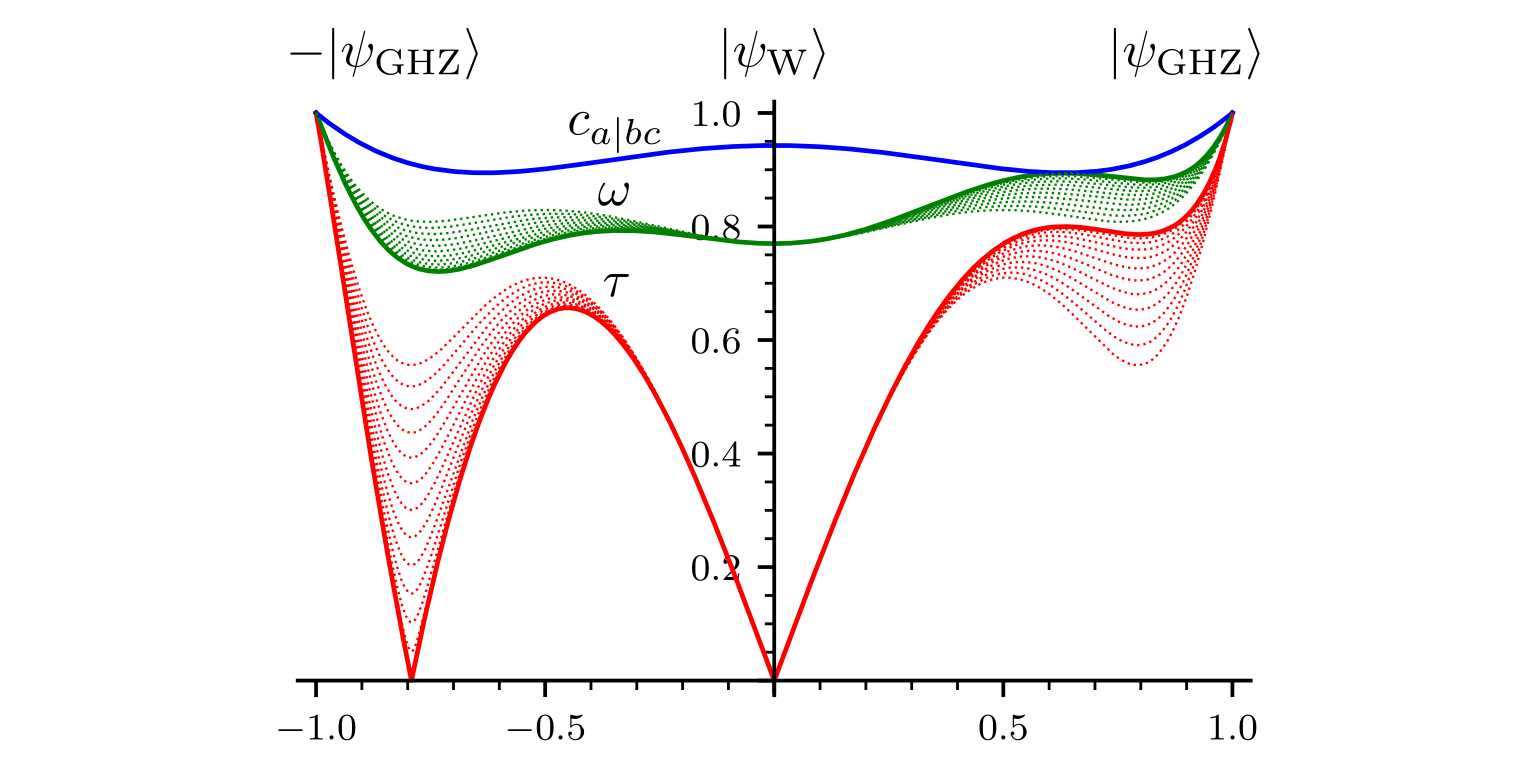
Featured image: Illustration of the ordering of the measures of bipartite-, W- and GHZ-entanglement for the superposition of GHZ and W states.
► BibTeX data
► References
[1] Valerie Coffman, Joydip Kundu, and William K. Wootters. ``Distributed entanglement''. Physical Review A 61, 052306 (2000).
https://doi.org/10.1103/PhysRevA.61.052306
[2] William K. Wootters. ``Entanglement of formation of an arbitrary state of two qubits''. Physical Review Letters 80, 2245–2248 (1998).
https://doi.org/10.1103/PhysRevLett.80.2245
[3] Wolfgang Dür, Guifré Vidal, and J. Ignacio Cirac. ``Three qubits can be entangled in two inequivalent ways''. Physical Review A 62, 062314 (2000).
https://doi.org/10.1103/PhysRevA.62.062314
[4] Leron Borsten, Duminda Dahanayake, Michael J. Duff, William Rubens, and Hajar Ebrahim. ``Freudenthal triple classification of three-qubit entanglement''. Physical Review A 80, 032326 (2009).
https://doi.org/10.1103/PhysRevA.80.032326
[5] Leron Borsten, Duminda Dahanayake, Michael J. Duff, Hajar Ebrahim, and William Rubens. ``Black holes, qubits and octonions''. Physics Reports 471, 113–219 (2009).
https://doi.org/10.1016/j.physrep.2008.11.002
[6] Péter Lévay. ``Qubits from extra dimensions''. Phys. Rev. D 84, 125020 (2011).
https://doi.org/10.1103/PhysRevD.84.125020
[7] Leron Borsten, Michael J. Duff, and Péter Lévay. ``The black-hole/qubit correspondence: an up-to-date review''. Classical and Quantum Gravity 29, 224008 (2012).
https://doi.org/10.1088/0264-9381/29/22/224008
[8] Péter Lévay and Szilárd Szalay. ``Attractor mechanism as a distillation procedure''. Phys. Rev. D 82, 026002 (2010).
https://doi.org/10.1103/PhysRevD.82.026002
[9] Péter Lévay and Szilárd Szalay. ``STU attractors from vanishing concurrence''. Phys. Rev. D 83, 045005 (2011).
https://doi.org/10.1103/PhysRevD.83.045005
[10] Leron Borsten. ``Freudenthal ranks: GHZ versus W''. Journal of Physics A: Mathematical and Theoretical 46, 455303 (2013).
https://doi.org/10.1088/1751-8113/46/45/455303
[11] John Harrison Watrous. ``Quantum computation lecture notes''. Page CPSC 519/619. University of Calgary. (2006). url: https://cs.uwaterloo.ca/ watrous/QC-notes/.
https://cs.uwaterloo.ca/~watrous/QC-notes/
[12] N. David Mermin. ``Quantum mysteries revisited''. American Journal of Physics 58, 731–734 (1990).
https://doi.org/10.1119/1.16503
[13] Szilárd Szalay. ``Multipartite entanglement measures''. Physical Review A 92, 042329 (2015).
https://doi.org/10.1103/PhysRevA.92.042329
[14] Szilárd Szalay, Gergely Barcza, Tibor Szilvási, Libor Veis, and Örs Legeza. ``The correlation theory of the chemical bond''. Sci. Rep. 7, 2237 (2017).
https://doi.org/10.1038/s41598-017-02447-z
[15] Szilárd Szalay. ``$k$-stretchability of entanglement, and the duality of $k$-separability and $k$-producibility''. Quantum 3, 204 (2019).
https://doi.org/10.22331/q-2019-12-02-204
[16] Szilárd Szalay. ``Quantum entanglement in finite-dimensional hilbert spaces'' (2013). url: http://arxiv.org/abs/1302.4654.
arXiv:1302.4654
[17] Ingemar Bengtsson and Karol Życzkowski. ``Geometry of quantum states: An introduction to quantum entanglement''. Cambridge University Press. (2017). 2nd edition.
https://doi.org/10.1017/9781139207010
[18] Arthur Cayley. ``On the theory of linear transformations''. Cambridge Mathematical Journal 4, 193–209 (1845). url: https://gdz.sub.uni-goettingen.de/id/PPN600493016_0004.
https://gdz.sub.uni-goettingen.de/id/PPN600493016_0004
[19] Izrail M. Gelfand, Mikhail M. Kapranov, and Andrey V. Zelevinsky. ``Discriminants, resultants, and multidimensional determinants''. Birkhäuser Boston, MA. (1994).
https://doi.org/10.1007/978-0-8176-4771-1
[20] Szilárd Szalay and Frédéric Holweck. ``Local qubit invariants on quantum computer''. Physica Scripta 101, 335105 (2026).
https://doi.org/10.1088/1402-4896/ae96dd
[21] Szilárd Szalay and Zoltán Kökényesi. ``Partial separability revisited: Necessary and sufficient criteria''. Physical Review A 86, 032341 (2012).
https://doi.org/10.1103/PhysRevA.86.032341
[22] Anthony Sudbery. ``On local invariants of pure three-qubit states''. Journal of Physics A: Mathematical and General 34, 643 (2001).
https://doi.org/10.1088/0305-4470/34/3/323
[23] Antonio Acín, Alexander Andrianov, Enric Jané, and Rolf Tarrach. ``Three-qubit pure-state canonical forms''. Journal of Physics A: Mathematical and General 34, 6725 (2001).
https://doi.org/10.1088/0305-4470/34/35/301
[24] Julia Kempe. ``Multiparticle entanglement and its applications to cryptography''. Physical Review A 60, 910–916 (1999).
https://doi.org/10.1103/PhysRevA.60.910
[25] Guifré Vidal. ``Entanglement monotones''. Journal of Modern Optics 47, 355–376 (2000).
https://doi.org/10.1080/09500340008244048
[26] Michał Horodecki. ``Entanglement measures''. Quantum Information and Computation 1, 3 (2001).
https://doi.org/10.26421/QIC1.1-2
[27] Robert Lohmayer, Andreas Osterloh, Jens Siewert, and Armin Uhlmann. ``Entangled three-qubit states without concurrence and three-tangle''. Physical Review Letters 97, 260502 (2006).
https://doi.org/10.1103/PhysRevLett.97.260502
[28] Christopher Eltschka, Thierry Bastin, Andreas Osterloh, and Jens Siewert. ``Multipartite-entanglement monotones and polynomial invariants''. Physical Review A 85, 022301 (2012).
https://doi.org/10.1103/PhysRevA.85.022301
[29] Frank Verstraete, Jeroen Dehaene, and Bart De Moor. ``Normal forms and entanglement measures for multipartite quantum states''. Physical Review A 68, 012103 (2003).
https://doi.org/10.1103/PhysRevA.68.012103
[30] Antonio Acín, Dagmar Bruß, Maciej Lewenstein, and Anna Sanpera. ``Classification of mixed three-qubit states''. Physical Review Letters 87, 040401 (2001).
https://doi.org/10.1103/PhysRevLett.87.040401
[31] Zhi-Hao Ma, Zhi-Hua Chen, Jing-Ling Chen, Christoph Spengler, Andreas Gabriel, and Marcus Huber. ``Measure of genuine multipartite entanglement with computable lower bounds''. Physical Review A 83, 062325 (2011).
https://doi.org/10.1103/PhysRevA.83.062325
[32] Charles H. Bennett, Herbert J. Bernstein, Sandu Popescu, and Benjamin Schumacher. ``Concentrating partial entanglement by local operations''. Physical Review A 53, 2046–2052 (1996).
https://doi.org/10.1103/PhysRevA.53.2046
[33] Péter Lévay and Péter Vrana. ``Three fermions with six single-particle states can be entangled in two inequivalent ways''. Physical Review A 78, 022329 (2008).
https://doi.org/10.1103/PhysRevA.78.022329
[34] Péter Vrana and Péter Lévay. ``Special entangled quantum systems and the freudenthal construction''. Journal of Physics A: Mathematical and Theoretical 42, 285303 (2009).
https://doi.org/10.1088/1751-8113/42/28/285303
[35] Gábor Sárosi and Péter Lévay. ``Entanglement in fermionic fock space''. Journal of Physics A: Mathematical and Theoretical 47, 115304 (2014).
https://doi.org/10.1088/1751-8113/47/11/115304
[36] Gábor Sárosi and Péter Lévay. ``Entanglement classification of three fermions with up to nine single-particle states''. Physical Review A 89, 042310 (2014).
https://doi.org/10.1103/PhysRevA.89.042310
[37] Gábor Sárosi and Péter Lévay. ``Coffman-kundu-wootters inequality for fermions''. Physical Review A 90, 052303 (2014).
https://doi.org/10.1103/PhysRevA.90.052303
[38] Frédéric Holweck and Péter Lévay. ``Classification of multipartite systems featuring only $|$W$\rangle$ and $|$GHZ$\rangle$ genuine entangled states''. Journal of Physics A: Mathematical and Theoretical 49, 085201 (2016).
https://doi.org/10.1088/1751-8113/49/8/085201
[39] Péter Lévay. ``Geometry of three-qubit entanglement''. Physical Review A 71, 012334 (2005).
https://doi.org/10.1103/PhysRevA.71.012334
[40] Antonio Acín, Alexander Andrianov, L. Costa, Enric Jané, José I. Latorre, and Rolf Tarrach. ``Generalized Schmidt decomposition and classification of three-quantum-bit states''. Physical Review Letters 85, 1560–1563 (2000).
https://doi.org/10.1103/PhysRevLett.85.1560
Cited by
Could not fetch Crossref cited-by data during last attempt 2026-10-22 16:27:44: Could not fetch cited-by data for 10.22331/q-2026-10-22-2242 from Crossref. This is normal if the DOI was registered recently. On SAO/NASA ADS no data on citing works was found (last attempt 2026-10-22 16:27:45).
This Paper is published in Quantum under the Creative Commons Attribution 4.0 International (CC BY 4.0) license. Copyright remains with the original copyright holders such as the authors or their institutions.