
Work statistics of sudden quantum quenches: A random matrix theory perspective on Gaussianity and its deviations
Shanghai Institute for Mathematics and Interdisciplinary Sciences, Block A, International Innovation Plaza, No. 657 Songhu Road, Yangpu District, Shanghai, China
| Published: | 2026-10-22, volume 10, page 2241 |
| Editor: | Michele Campisi |
| Eprint: | arXiv:2509.09640v2 |
| Doi: | https://doi.org/10.22331/q-2026-10-22-2241 |
| Citation: | Quantum 10, 2241 (2026). |
Find this paper interesting or want to discuss? Scite or leave a comment on SciRate.
Abstract
We show that, for sudden quenches, the work distribution reduces to the statistics of the traces of powers of Haar unitaries, which are random unitary matrices drawn uniformly from the unitary group. For translation-invariant quadratic fermionic chains with interactions extending to $m$ neighbors and periodic boundary conditions, the Loschmidt amplitude admits a unitary matrix model / Toeplitz representation, which yields a work variable of the form $W=\sum_{r\le m} a_r \Re\operatorname{Tr} U^r$ (and in models with pairing terms -superconducting pairing- additional $b_r \Im\operatorname{Tr} U^r$ terms appear). By invoking multivariate central limit theorems for vectors of traces of unitaries, we obtain a Gaussian distribution for $P(W)$ with variance $\mathrm{Var}(W)=\frac{1}{2}\sum_r r (a_r^2+b_r^2)$ and asymptotic independence across different powers. We also characterise the conditions under which non-Gaussian tails arise, for example from many interaction terms or their slow decay, as well as the appearance of Fisher-Hartwig singularities. We illustrate these mechanisms in the XY chain. Various numerical diagnostics support the analytical results.
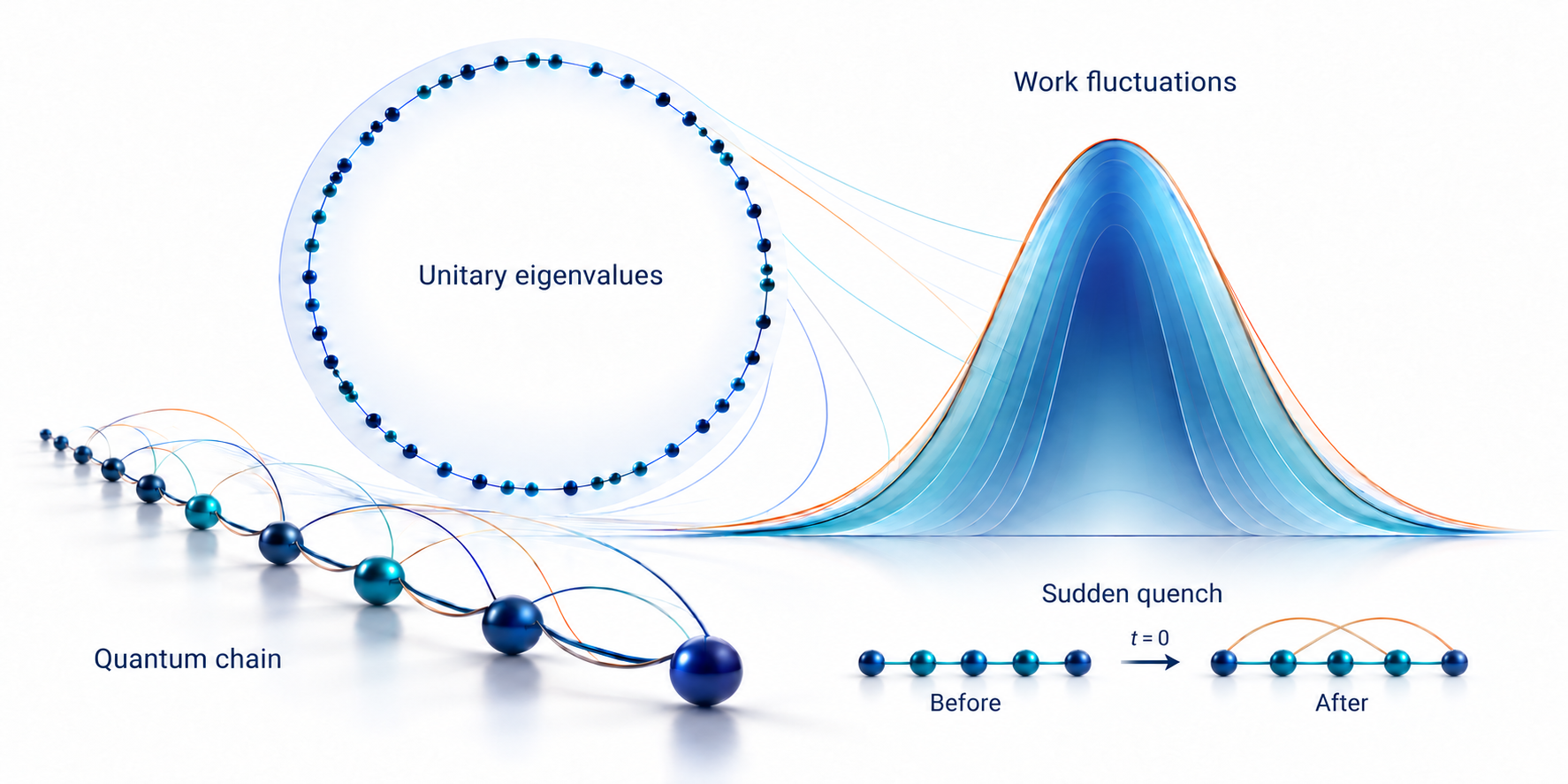
Featured image: Sudden quantum quenches and work fluctuations. The inset depicts an abrupt change of the chain’s couplings at t = 0. For the quenches studied, work statistics map to weighted sums of traces of random unitary matrices, represented here by their eigenvalues on the unit circle. This connection explains the emergence of Gaussian distributions and helps identify departures from Gaussianity. Conceptual illustration.
Popular summary
We study quenches in periodic quantum chains (rings) described by noninteracting fermions, a textbook setting that includes the XY spin chain. For the quenches considered, the work distribution coincides with that of a classic object of random matrix theory: a weighted sum of traces of powers of a random unitary matrix. Results about such matrices then explain when a Gaussian distribution (the familiar bell curve) emerges in large systems, and give its width directly from the couplings between sites.
The same dictionary shows where the Gaussian description stops being the whole story. Couplings that decay sufficiently slowly with distance can make the width grow with system size. Singularities tied to certain critical or boundary settings change the fluctuations, and finite systems show corrections to the limiting distribution. A growing width does not by itself spoil the Gaussian shape, which can survive once the width is scaled out. Examples in the XY chain and numerical tests illustrate these mechanisms. The upshot is a direct link between the shape and size of work fluctuations and the structure of the underlying model.
► BibTeX data
► References
[1] P. Talkner, E. Lutz, and P. Hänggi, Fluctuation theorems: Work is not an observable, Physical Review E 75, 050102(R) (2007).
https://doi.org/10.1103/PhysRevE.75.050102
[2] M. Campisi, P. Hänggi, and P. Talkner, Colloquium: Quantum fluctuation relations: Foundations and applications, Reviews of Modern Physics 83, 771 (2011).
https://doi.org/10.1103/RevModPhys.83.771
[3] S. Deffner and S. Campbell, Quantum Thermodynamics: An introduction to the thermodynamics of quantum information (Morgan & Claypool Publishers, 2019).
https://doi.org/10.1088/2053-2571/ab21c6
[4] R. Dorner, S. R. Clark, L. Heaney, R. Fazio, J. Goold, and V. Vedral, Extracting quantum work statistics and fluctuation theorems by single-qubit interferometry, Physical Review Letters 110, 230601 (2013).
https://doi.org/10.1103/PhysRevLett.110.230601
[5] L. Mazzola, G. De Chiara, and M. Paternostro, Measuring the characteristic function of the work distribution, Physical Review Letters 110, 230602 (2013).
https://doi.org/10.1103/PhysRevLett.110.230602
[6] T. B. Batalhão, A. M. Souza, L. Mazzola, R. Auccaise, R. S. Sarthour, I. S. Oliveira, J. Goold, G. De Chiara, M. Paternostro, and R. M. Serra, Experimental reconstruction of work distribution and study of fluctuation relations in a closed quantum system, Physical Review Letters 113, 140601 (2014).
https://doi.org/10.1103/PhysRevLett.113.140601
[7] T. Gorin, T. Prosen, T. H. Seligman, and M. Žnidarič, Dynamics of Loschmidt echoes and fidelity decay, Physics Reports 435, 33 (2006).
https://doi.org/10.1016/j.physrep.2006.09.003
[8] M. Heyl, A. Polkovnikov, and S. Kehrein, Dynamical quantum phase transitions in the transverse-field Ising model, Physical Review Letters 110, 135704 (2013).
https://doi.org/10.1103/PhysRevLett.110.135704
[9] M. Heyl, Dynamical quantum phase transitions: a review, Reports on Progress in Physics 81, 054001 (2018).
https://doi.org/10.1088/1361-6633/aaaf9a
[10] A. Gambassi and A. Silva, Statistics of the work in quantum quenches, universality and the critical Casimir effect (2011), arXiv:1106.2671 [cond-mat.stat-mech].
https://doi.org/10.48550/arXiv.1106.2671
arXiv:1106.2671
[11] A. Gambassi and A. Silva, Large deviations and universality in quantum quenches, Phys. Rev. Lett. 109, 250602 (2012).
https://doi.org/10.1103/PhysRevLett.109.250602
[12] J. Goold, F. Plastina, A. Gambassi, and A. Silva, The role of quantum work statistics in many-body physics, in Thermodynamics in the Quantum Regime: Fundamental Aspects and New Directions, edited by F. Binder, L. A. Correa, C. Gogolin, J. Anders, and G. Adesso (Springer, Cham, 2019) pp. 317–336, arXiv:1804.02805 [cond-mat.stat-mech].
https://doi.org/10.1007/978-3-319-99046-0_13
arXiv:1804.02805
[13] S. Gherardini, L. Buffoni, and N. Defenu, Universal defects statistics with strong long-range interactions, Phys. Rev. Lett. 133, 113401 (2024).
https://doi.org/10.1103/PhysRevLett.133.113401
[14] A. Solfanelli and N. Defenu, Universal work statistics in long-range interacting quantum systems, Phys. Rev. Lett. 134, 030402 (2025).
https://doi.org/10.1103/PhysRevLett.134.030402
[15] N. Defenu, T. Donner, T. Macrì, G. Pagano, S. Ruffo, and A. Trombettoni, Long-range interacting quantum systems, Rev. Mod. Phys. 95, 035002 (2023).
https://doi.org/10.1103/RevModPhys.95.035002
[16] M. Esposito, U. Harbola, and S. Mukamel, Nonequilibrium fluctuations, fluctuation theorems, and counting statistics in quantum systems, Reviews of Modern Physics 81, 1665 (2009).
https://doi.org/10.1103/RevModPhys.81.1665
[17] A. Silva, Statistics of the work done on a quantum critical system by quenching a control parameter, Physical Review Letters 101, 120603 (2008).
https://doi.org/10.1103/PhysRevLett.101.120603
[18] D. Pérez-García, L. Santilli, and M. Tierz, Dynamical quantum phase transitions from random matrix theory, Quantum 8, 1271 (2024a).
https://doi.org/10.22331/q-2024-02-29-1271
[19] D. Pérez-García, L. Santilli, and M. Tierz, Hawking-Page transition on a spin chain, Physical Review Research 6, 033007 (2024b).
https://doi.org/10.1103/PhysRevResearch.6.033007
[20] P. J. Forrester, Log-gases and random matrices (LMS-34) (Princeton university press, 2010).
https://doi.org/10.1515/9781400835416
[21] D. García-García and M. Tierz, Toeplitz minors and specializations of skew Schur polynomials, Journal of Combinatorial Theory, Series A 172, 105201 (2020).
https://doi.org/10.1016/j.jcta.2019.105201
[22] P. Diaconis and M. Shahshahani, On the eigenvalues of random matrices, Journal of Applied Probability 31A, 49 (1994).
https://doi.org/10.1017/S0021900200106989
[23] P. Diaconis and S. N. Evans, Linear functionals of eigenvalues of random matrices, Transactions of the American Mathematical Society 353, 2615 (2001).
https://doi.org/10.1090/S0002-9947-01-02800-8
[24] K. Johansson, On random matrices from the compact classical groups, Annals of Mathematics 145, 519 (1997).
https://doi.org/10.2307/2951843
[25] K. Johansson and G. Lambert, Multivariate normal approximation for traces of random unitary matrices, The Annals of Probability 49, 2961 (2021).
https://doi.org/10.1214/21-AOP1520
[26] M. Duits and K. Johansson, Powers of large random unitary matrices and Toeplitz determinants, Transactions of the American Mathematical Society 362, 1169 (2010).
https://doi.org/10.1090/S0002-9947-09-04542-5
[27] R. E. Hartwig and M. E. Fisher, Asymptotic behavior of Toeplitz matrices and determinants, Archive for Rational Mechanics and Analysis 32, 190 (1969).
https://doi.org/10.1007/BF00247509
[28] K. Zawadzki, A. Kiely, G. T. Landi, and S. Campbell, Non-Gaussian work statistics at finite-time driving, Physical Review A 107, 012209 (2023).
https://doi.org/10.1103/PhysRevA.107.012209
[29] E. Lieb, T. Schultz, and D. Mattis, Two soluble models of an antiferromagnetic chain, Annals of Physics 16, 407 (1961).
https://doi.org/10.1016/0003-4916(61)90115-4
[30] P. Pfeuty, The one-dimensional Ising model with a transverse field, Annals of Physics 57, 79 (1970).
https://doi.org/10.1016/0003-4916(70)90270-8
[31] E. Barouch and B. M. McCoy, Statistical mechanics of the XY model. II. spin-correlation functions, Physical Review A 3, 786 (1971).
https://doi.org/10.1103/PhysRevA.3.786
[32] N. Onishi and S. Yoshida, Generator coordinate method applied to nuclei in the transition region, Nuclear Physics 80, 367 (1966).
https://doi.org/10.1016/0029-5582(66)90096-4
[33] L. M. Robledo, Sign of the overlap of Hartree–Fock–Bogoliubov wave functions, Physical Review C 79, 021302 (2009).
https://doi.org/10.1103/PhysRevC.79.021302
[34] I. Klich, An elementary derivation of Levitov's formula, Quantum Noise in Mesoscopic Physics, 397 (2003).
https://doi.org/10.1007/978-94-010-0089-5_19
[35] E. L. Basor and T. Ehrhardt, Asymptotics of determinants of Bessel operators, Communications in Mathematical Physics 234, 491 (2003).
https://doi.org/10.1007/s00220-002-0769-1
[36] B.-Q. Jin and V. E. Korepin, Quantum spin chain, Toeplitz determinants and the Fisher–Hartwig conjecture, Journal of Statistical Physics 116, 79 (2004).
https://doi.org/10.1023/B:JOSS.0000037230.37166.42
[37] D. Perez-Garcia and M. Tierz, Mapping between the Heisenberg XX spin chain and low-energy QCD, Physical Review X 4, 021050 (2014).
https://doi.org/10.1103/PhysRevX.4.021050
[38] L. Santilli and M. Tierz, Phase transition in complex-time Loschmidt echo of short and long range spin chain, Journal of Statistical Mechanics: Theory and Experiment 2020, 063102 (2020).
https://doi.org/10.1088/1742-5468/ab837b
[39] E. M. Rains, High powers of random elements of compact Lie groups, Probability Theory and Related Fields 107, 219 (1997).
https://doi.org/10.1007/s004400050084
[40] E. L. Basor, Y. Chen, and T. Ehrhardt, Painlevé V and time-dependent Jacobi polynomials, Journal of Physics A: Mathematical and Theoretical 43, 015204 (2010).
https://doi.org/10.1088/1751-8113/43/1/015204
[41] O. Lisovyy, H. Nagoya, and J. Roussillon, Irregular conformal blocks and connection formulae for Painlevé V functions, Journal of Mathematical Physics 59, 091409 (2018), arXiv:1806.08344.
https://doi.org/10.1063/1.5031841
arXiv:1806.08344
[42] F. Ares, J. G. Esteve, and F. Falceto, Rényi entanglement entropy in fermionic chains, Int. J. Geom. Methods Mod. Phys. 12, 1560002 (2015a).
https://doi.org/10.1142/S0219887815600026
[43] F. Ares, J. G. Esteve, F. Falceto, and A. R. de Queiroz, Entanglement in fermionic chains with finite-range coupling and broken symmetries, Phys. Rev. A 92, 042334 (2015b), arXiv:1506.06665 [quant-ph].
https://doi.org/10.1103/PhysRevA.92.042334
arXiv:1506.06665
[44] F. Ares, J. G. Esteve, F. Falceto, and A. R. de Queiroz, Entanglement entropy in the long-range Kitaev chain, Phys. Rev. A 97, 062301 (2018), arXiv:1801.07043 [quant-ph].
https://doi.org/10.1103/PhysRevA.97.062301
arXiv:1801.07043
[45] A. Solfanelli, S. Ruffo, S. Succi, and N. Defenu, Logarithmic, fractal and volume-law entanglement in a Kitaev chain with long-range hopping and pairing, Journal of High Energy Physics 05, 066 (2023), arXiv:2301.13231 [quant-ph].
https://doi.org/10.1007/JHEP05(2023)066
arXiv:2301.13231
[46] P. Deift, A. Its, and I. Krasovsky, Asymptotics of Toeplitz, Hankel, and Toeplitz+Hankel determinants with Fisher-Hartwig singularities, Annals of mathematics 174, 1243 (2011).
https://doi.org/10.4007/annals.2011.174.2.12
[47] A. C. Barato and U. Seifert, Thermodynamic uncertainty relation for biomolecular processes, Phys. Rev. Lett. 114, 158101 (2015), arXiv:1502.05944 [cond-mat.stat-mech].
https://doi.org/10.1103/PhysRevLett.114.158101
arXiv:1502.05944
[48] Y. Hasegawa and T. Van Vu, Fluctuation theorem uncertainty relation, Phys. Rev. Lett. 123, 110602 (2019), arXiv:1902.06376 [cond-mat.stat-mech].
https://doi.org/10.1103/PhysRevLett.123.110602
arXiv:1902.06376
[49] D. Freedman and P. Diaconis, On the histogram as a density estimator: $L_{2}$ theory, Zeitschrift für Wahrscheinlichkeitstheorie und Verwandte Gebiete 57, 453 (1981).
https://doi.org/10.1007/BF01025868
[50] P. Diaconis, Patterns in eigenvalues: the 70th Josiah Willard Gibbs lecture, Bulletin of the American Mathematical Society 40, 155 (2003).
https://doi.org/10.1090/S0273-0979-03-00975-3
[51] D. J. Gross and E. Witten, Possible third-order phase transition in the large-$N$ lattice gauge theory, Physical Review D 21, 446 (1980).
https://doi.org/10.1103/PhysRevD.21.446
[52] S. R. Wadia, $N = \infty$ phase transition in a class of exactly soluble model lattice gauge theories, Physics Letters B 93, 403 (1980).
https://doi.org/10.1016/0370-2693(80)90353-6
[53] P. Le Doussal, S. N. Majumdar, and G. Schehr, Multicritical edge statistics for the momenta of fermions in nonharmonic traps, Physical review letters 121, 030603 (2018).
https://doi.org/10.1103/PhysRevLett.121.030603
[54] C. A. Tracy and H. Widom, Level-spacing distributions and the Airy kernel, Communications in Mathematical Physics 159, 151 (1994).
https://doi.org/10.1007/BF02100489
Cited by
Could not fetch Crossref cited-by data during last attempt 2026-10-22 08:45:09: Could not fetch cited-by data for 10.22331/q-2026-10-22-2241 from Crossref. This is normal if the DOI was registered recently. Could not fetch ADS cited-by data during last attempt 2026-10-22 08:45:16: Cannot retrieve data from ADS due to rate limitations.
This Paper is published in Quantum under the Creative Commons Attribution 4.0 International (CC BY 4.0) license. Copyright remains with the original copyright holders such as the authors or their institutions.