
From Superradiance to Superabsorption: An Exact Treatment of Non-Markovian Cooperative Radiation
1Departamento de Física Teórica, Facultad de Ciencias Físicas, Universidad Complutense, 28040 Madrid, Spain.
2CCS-Center for Computational Simulation, Campus de Montegancedo UPM, 28660 Boadilla del Monte, Madrid, Spain.
| Published: | 2026-07-15, volume 10, page 2159 |
| Editor: | Philip Taranto |
| Eprint: | arXiv:2601.05989v3 |
| Doi: | https://doi.org/10.22331/q-2026-07-15-2159 |
| Citation: | Quantum 10, 2159 (2026). |
Find this paper interesting or want to discuss? Scite or leave a comment on SciRate.
Abstract
We investigate the emergence of cooperative radiation phenomena in ensembles of two-level atoms coupled to a lossy resonant cavity beyond the Markovian and mean-field approximations. By deriving a complete analytical solution for the two-emitter case and employing a numerically exact method for larger ensembles, we characterize the full transition from Markovian to non-Markovian collective dynamics for systems of up to $10^3$ emitters. Our results reveal three distinct regimes: a Markovian phase exhibiting the standard superradiant burst, a non-Markovian phase featuring spontaneous superabsorption of the emitted field, and a critical regime marked by pulsed collective emission. We show that the critical spectral width separating these behaviors increases monotonically with the number of emitters, demonstrating that environmental memory effects can be enhanced by cooperativity. Finally, we find that the superradiant scaling of the peak intensity progressively degrades with increasing system size, approaching a subquadratic law in the limit of a perfect cavity. In this regime, spontaneous superabsorption emerges as a distinct manifestation of non-Markovian cooperativity.
Popular summary
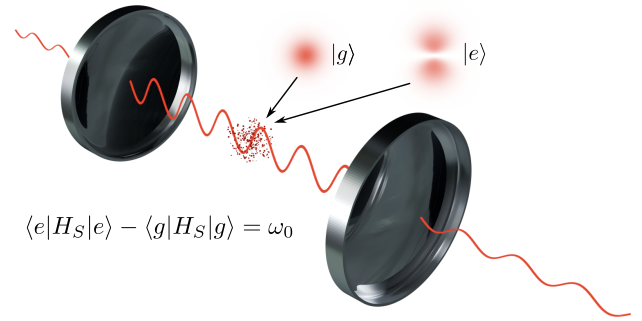
In this work, we develop an exact theoretical description of collective atomic emission beyond this memoryless limit, combining analytical solutions with large-scale, numerically exact simulations. We uncover three distinct dynamical regimes: standard superradiant emission, a critical regime with pulsed light bursts, and a strongly non-Markovian regime where atoms spontaneously reabsorb previously emitted radiation.
Our results show that environmental memory fundamentally reshapes cooperative light–matter interactions and even limits the familiar quadratic scaling of superradiance. These findings open new possibilities for controlling light emission, energy recycling, and collective absorption in quantum optical devices and emerging quantum technologies.
► BibTeX data
► References
[1] R. H. Dicke, Coherence in spontaneous radiation processes, Phys. Rev. 93, 99 (1954).
https://doi.org/10.1103/PhysRev.93.99
[2] G. S. Agarwal, Master-equation approach to spontaneous emission, Phys. Rev. A 2, 2038 (1970).
https://doi.org/10.1103/PhysRevA.2.2038
[3] N. E. Rehler and J. H. Eberly, Superradiance, Phys. Rev. A 3, 1735 (1971).
https://doi.org/10.1103/PhysRevA.3.1735
[4] R. Bonifacio, P. Schwendimann, and F. Haake, Quantum Statistical Theory of Superradiance. I, Phys. Rev. A 4, 302 (1971).
https://doi.org/10.1103/PhysRevA.4.302
[5] R. Bonifacio, P. Schwendimann, and F. Haake, Quantum Statistical Theory of Superradiance. II, Phys. Rev. A 4, 854 (1971).
https://doi.org/10.1103/PhysRevA.4.854
[6] J. H. Eberly, Superradiance revisited, Am. J. Phys. 40, 1374 (1972).
https://doi.org/10.1119/1.1986858
[7] M. Gross and S. Haroche, Superradiance: An essay on the theory of collective spontaneous emission, Phys. Rep. 93, 301 (1982).
https://doi.org/10.1016/0370-1573(82)90102-8
[8] L. Mandel and E. Wolf, Optical Coherence and Quantum Optics (Cambridge University Press, Cambridge, 1995), DOI: 10.1017/CBO9781139644105.
https://doi.org/10.1017/CBO9781139644105
[9] H.-P. Breuer and F. Petruccione, The Theory of Open Quantum Systems (Oxford University Press, Oxford, 2002), DOI: 10.1093/acprof:oso/9780199213900.001.0001.
https://doi.org/10.1093/acprof:oso/9780199213900.001.0001
[10] N. Skribanowitz, I. P. Herman, J. C. MacGillivray, and M. S. Feld, Observation of Dicke Superradiance in Optically Pumped HF Gas, Phys. Rev. Lett. 30, 309 (1973).
https://doi.org/10.1103/PhysRevLett.30.309
[11] M. Gross, C. Fabre, P. Pillet, and S. Haroche, Observation of Near-Infrared Dicke Superradiance on Cascading Transitions in Atomic Sodium, Phys. Rev. Lett. 36, 1035 (1976).
https://doi.org/10.1103/PhysRevLett.36.1035
[12] D. Pavolini, A. Crubellier, P. Pillet, L. Cabaret, and S. Liberman, Experimental Evidence for Subradiance, Phys. Rev. Lett. 54, 1917 (1985).
https://doi.org/10.1103/PhysRevLett.54.1917
[13] R. G. DeVoe and R. G. Brewer, Observation of Superradiant and Subradiant Spontaneous Emission of Two Trapped Ions, Phys. Rev. Lett. 76, 2049 (1996).
https://doi.org/10.1103/PhysRevLett.76.2049
[14] M. Scheibner, T. Schmidt, L. Worschech, A. Forchel, G. Bacher, T. Passow, and D. Hommel, Superradiance of quantum dots, Nat. Phys. 3, 106 (2007).
https://doi.org/10.1038/nphys494
[15] J. A. Mlynek, A. A. Abdumalikov, C. Eichler, and A. Wallraff, Observation of Dicke superradiance for two artificial atoms in a cavity with high decay rate, Nat. Commun. 5, 5186 (2014).
https://doi.org/10.1038/ncomms6186
[16] P. Solano, P. Barberis-Blostein, F. K. Fatemi, L. A. Orozco, and S. L. Rolston, Super-radiance reveals infinite-range dipole interactions through a nanofiber, Nat. Commun. 8, 1857 (2017).
https://doi.org/10.1038/s41467-017-01994-3
[17] J.-H. Kim, S. Aghaeimeibodi, C. J. K. Richardson, R. P. Leavitt, and E. Waks, Super-radiant emission from quantum dots in a nanophotonic waveguide, Nano Lett. 18, 4734 (2018).
https://doi.org/10.1021/acs.nanolett.8b01133
[18] L. Chen, P. Wang, Z. Meng, L. Huang, H. Cai, D.-W. Wang, S.-Y. Zhu, and J. Zhang, Experimental Observation of One Dimensional Superradiance Lattices in Ultracold Atoms, Phys. Rev. Lett. 120, 193601 (2018).
https://doi.org/10.1103/PhysRevLett.120.193601
[19] Z. Yan, J. Ho, Y.-H. Lu, S. J. Masson, A. Asenjo-Garcia, and D. M. Stamper-Kurn, Superradiant and Subradiant Cavity Scattering by Atom Arrays, Phys. Rev. Lett. 131, 253603 (2023).
https://doi.org/10.1103/PhysRevLett.131.253603
[20] F. Dinc, I. Ercan and A. M. Brańczyk, Exact Markovian and non-Markovian time dynamics in waveguide QED: collective interactions, bound states in continuum, superradiance and subradiance, Quantum 3, 213 (2019).
https://doi.org/10.22331/q-2019-12-09-213
[21] F. Dinc and A. M. Brańczyk, Non-Markovian super-superradiance in a linear chain of up to 100 qubits, Phys. Rev. Research 1, 032042(R) (2019).
https://doi.org/10.1103/PhysRevResearch.1.032042
[22] K. Sinha, P. Meystre, E. A. Goldschmidt, F. K. Fatemi, S. L. Rolston and P. Solano, Non-Markovian Collective Emission from Macroscopically Separated Emitters, Phys. Rev. Lett. 124, 043603 (2020).
https://doi.org/10.1103/PhysRevLett.124.043603
[23] Q-.Y. Qiu, Y. Wu, and X-.Y. Lü, Collective radiance of giant atoms in non-Markovian regime, Sci. China: Phys. Mech. Astron. 66, 224212 (2023).
https://doi.org/10.1007/s11433-022-1990-x
[24] R. L. Capurso, G. Calajó, S. Montangero, S. Pascazio, F. V. Pepe, M. Maffei, G. Magnifico and P. Facchi, Superradiant decay in non-Markovian Waveguide Quantum Electrodynamics (2025), arXiv:2511.22332 [quant-ph].
https://doi.org/10.48550/arXiv.2511.22332
arXiv:2511.22332
[25] S. John and T. Quang, Collective Switching and Inversion without Fluctuation of Two-Level Atoms in Confined Photonic Systems, Phys. Rev. Lett. 78, 1888 (1997).
https://doi.org/10.1103/PhysRevLett.78.1888
[26] N. Vats and S. John, Non-Markovian quantum fluctuations and superradiance near a photonic band edge, Phys. Rev. A 58, 4168 (1998).
https://doi.org/10.1103/PhysRevA.58.4168
[27] A. González-Tudela and J. I. Cirac, Markovian and non-Markovian dynamics of quantum emitters coupled to two-dimensional structured reservoirs, Phys. Rev. A 96, 043811 (2017).
https://doi.org/10.1103/PhysRevA.96.043811
[28] A. González-Tudela and J. I. Cirac, Quantum Emitters in Two-Dimensional Structured Reservoirs in the Non-perturbative Regime, Phys. Rev. Lett. 119, 143602 (2017).
https://doi.org/10.1103/PhysRevLett.119.143602
[29] I. Thanopulos, V. Karanikolas, N. Iliopoulos, and E. Paspalakis, Non-Markovian spontaneous emission dynamics of a quantum emitter near a MoS2 nanodisk, Phys. Rev. B 99, 195412 (2019).
https://doi.org/10.1103/PhysRevB.99.195412
[30] S. C. Hou, G. Q. Shuai, X. Y. Zhang, J. Shen, and X. X. Yi, Influence of initial states on memory effects: A study of early-time superradiance, Phys. Rev. A 109, 053708 (2024).
https://doi.org/10.1103/PhysRevA.109.053708
[31] D. De Bernardis, T. Jaako, and P. Rabl, Cavity quantum electrodynamics in the nonperturbative regime, Phys. Rev. A 97, 043820 (2018).
https://doi.org/10.1103/PhysRevA.97.043820
[32] J. Q. Quach et al., Superabsorption in an organic microcavity: Toward a quantum battery, Sci. Adv. 8, eabk3160 (2022).
https://doi.org/10.1126/sciadv.abk3160
[33] S. Kamimura, H. Hakoshima, Y. Matsuzaki, K. Yoshida and Y. Tokura, Quantum-Enhanced Heat Engine Based on Superabsorption, Phys. Rev. Lett. 128, 180602 (2022).
https://doi.org/10.1103/PhysRevLett.128.180602
[34] K. D. Higgins, S. C. Benjamin, T. M. Stace, G. J. Milburn, B. W. Lovett, E. M. Gauger, Superabsorption of light via quantum engineering, Nat. Commun. 5, 4705 (2014).
https://doi.org/10.1038/ncomms5705
[35] D. Yang, S.-h. Oh, J. Han, G. Son, J. Kim, J. Kim, M. Lee, K. An, Realization of superabsorption by time reversal of superradiance, Nat. Photonics 15, 272–276 (2021).
https://doi.org/10.1038/s41566-021-00770-6
[36] I. González and A. Rivas, Correlated and critical phenomena in multipartite quantum non-Markovianity, Phys. Rev. A 111, L020204 (2025).
https://doi.org/10.1103/PhysRevA.111.L020204
[37] A. Rivas and S. F. Huelga, Open Quantum Systems. An Introduction (Springer, Heidelberg, 2011), DOI: 10.1007/978-3-642-23354-8.
https://doi.org/10.1007/978-3-642-23354-8
[38] B. M. Garraway, Nonperturbative decay of an atomic system in a cavity, Phys. Rev. A 55, 2290 (1997).
https://doi.org/10.1103/PhysRevA.55.2290
[39] S. Maniscalco, F. Francica, R. L. Zaffino, N. Lo Gullo, and F. Plastina, Protecting Entanglement via the Quantum Zeno Effect, Phys. Rev. Lett. 100, 090503 (2008).
https://doi.org/10.1103/PhysRevLett.100.090503
[40] D. Chruściński, S. Hesabi, and D. Lonigro, On Markovianity and classicality in multilevel spin-boson models, Sci. Rep. 13, 1518 (2023).
https://doi.org/10.1038/s41598-023-28606-z
[41] H.-P. Breuer, E.-M. Laine, and J. Piilo, Measure for the Degree of Non-Markovian Behavior of Quantum Processes in Open Systems, Phys. Rev. Lett. 103, 210401 (2009).
https://doi.org/10.1103/PhysRevLett.103.210401
[42] A. Rivas, S. F. Huelga, and M. B. Plenio, Entanglement and Non-Markovianity of Quantum Evolutions, Phys. Rev. Lett. 105, 050403 (2010).
https://doi.org/10.1103/PhysRevLett.105.050403
[43] A. Rivas, S. F. Huelga, and M. B. Plenio, Quantum non-Markovianity: Characterization, quantification and detection, Rep. Prog. Phys. 77, 094001 (2014).
https://doi.org/10.1088/0034-4885/77/9/094001
[44] H.-P. Breuer, E.-M. Laine, J. Piilo, and B. Vacchini, Colloquium: Non-Markovian dynamics in open quantum systems, Rev. Mod. Phys. 88, 021002 (2016).
https://doi.org/10.1103/RevModPhys.88.021002
[45] L. Li, M. J. W. Hall, and H. M. Wiseman, Concepts of quantum non-Markovianity: A hierarchy, Phys. Rep. 759, 1 (2018).
https://doi.org/10.1016/j.physrep.2018.07.001
[46] M. J. W. Hall, J. D. Cresser, L. Li and E. Andersson, Canonical form of master equations and characterization of non-Markovianity, Phys. Rev. A 89, 042120 (2014).
https://doi.org/10.1103/PhysRevA.89.042120
[47] N. Megier, D. Chruściński, J. Piilo, and W. T. Strunz, Eternal non-Markovianity: from random unitary to Markov chain realisations, Sci. Rep. 7, 6379 (2017).
https://doi.org/10.1038/s41598-017-06059-5
[48] A. A. Budini and J. P. Garrahan, Solvable class of non-Markovian quantum multipartite dynamics, Phys. Rev. A 104, 032206 (2021).
https://doi.org/10.1103/PhysRevA.104.032206
[49] G. Amati, Dynamical signatures of non-Markovianity in a dissipative-driven qubit, Phys. Rev. A 109, 052433 (2024).
https://doi.org/10.1103/PhysRevA.109.052433
[50] B. Gulácsi and G. Burkard, Signatures of non-Markovianity of a superconducting qubit, Phys. Rev. B 107, 174511 (2023).
https://doi.org/10.1103/PhysRevB.107.174511
[51] B. M. Garraway and P. L. Knight, Cavity modified quantum beats, Phys. Rev. A 54, 3592 (1996).
https://doi.org/10.1103/PhysRevA.54.3592
[52] L. Mazzola, S. Maniscalco, J. Piilo, K.-A. Suominen, and B. M. Garraway, Sudden death and sudden birth of entanglement in common structured reservoirs, Phys. Rev. A 79, 042302 (2009).
https://doi.org/10.1103/PhysRevA.79.042302
[53] D. Tamascelli, A. Smirne, S. F. Huelga, and M. B. Plenio, Nonperturbative Treatment of non-Markovian Dynamics of Open Quantum Systems, Phys. Rev. Lett. 120, 030402 (2018).
https://doi.org/10.1103/PhysRevLett.120.030402
[54] N. Lambert, S. Ahmed, M. Cirio, and F. Nori, Modelling the ultra-strongly coupled spin-boson model with unphysical modes, Nat. Commun. 10, 3721 (2019).
https://doi.org/10.1038/s41467-019-11656-1
[55] G. Pleasance, B. M. Garraway, and F. Petruccione, Generalized theory of pseudomodes for exact descriptions of non-Markovian quantum processes, Phys. Rev. Research 2, 043058 (2020).
https://doi.org/10.1103/PhysRevResearch.2.043058
[56] M. Tavis and F. W. Cummings, Exact Solution for an $N$-Molecule—Radiation-Field Hamiltonian, Phys. Rev. 170, 379 (1968).
https://doi.org/10.1103/PhysRev.170.379
[57] J. Larson and T. Mavrogordatos, The Jaynes–Cummings Model and its Descendants, 2nd ed. (IOP Publishing, Bristol, 2024), DOI: 10.1088/978-0-7503-6452-2.
https://doi.org/10.1088/978-0-7503-6452-2
[58] B. Buča and T. Prosen, A note on symmetry reductions of the Lindblad equation: transport in constrained open spin chains, New J. Phys. 14, 073007 (2012).
https://doi.org/10.1088/1367-2630/14/7/073007
[59] Z.-X. Gong, M. Xu, M. Foss-Feig, J. K. Thompson, A. M. Rey, M. Holland, and A. V. Gorshkov, Steady-state superradiance with Rydberg polaritons (2016), arXiv:1611.00797 [quant-ph].
https://doi.org/10.48550/arXiv.1611.00797
arXiv:1611.00797
[60] L. Freter, P. Fowler-Wright, J. Cuerda, B. W. Lovett, J. Keeling and P. Törmä, Theory of dynamical superradiance in organic materials, Nanophotonics 14, 5323 (2025).
https://doi.org/10.1515/nanoph-2025-0427
[61] K. Müller and W. Strunz, Genuine Quantum effects in Dicke-type Models at large atom numbers, Phys. Rev. Lett. 135, 123602 (2025).
https://doi.org/10.1103/42rz-xhxz
[62] R. Fazio, J. Keeling, L. Mazza, and M. Schirò, Many-Body Open Quantum Systems, SciPost Phys. Lect. Notes 99 (2025).
https://doi.org/10.21468/SciPostPhysLectNotes.99
Cited by
[1] Antonio Morales-Pérez, Iñaki García-Elcano, Chiara Devescovi, Maia G. Vergniory, Aitzol García-Etxarri, and Alejandro González-Tudela, "Constructing mode-resolved quantum optical models for emitters in photonic crystals", arXiv:2607.12603, (2026).
The above citations are from SAO/NASA ADS (last updated successfully 2026-10-20 00:01:07). The list may be incomplete as not all publishers provide suitable and complete citation data.
On Crossref's cited-by service no data on citing works was found (last attempt 2026-10-20 12:09:39). Could not fetch ADS cited-by data during last attempt 2026-10-20 12:09:43: Cannot retrieve data from ADS due to rate limitations.
This Paper is published in Quantum under the Creative Commons Attribution 4.0 International (CC BY 4.0) license. Copyright remains with the original copyright holders such as the authors or their institutions.