
Near-Optimal Parameter Tuning of Level-1 QAOA for Ising Models
1Centre for Quantum Technologies (CQT), National University of Singapore, Singapore 117543, Republic of Singapore
2Quantum Innovation Centre (Q.InC), Agency for Science, Technology and Research (A*STAR), 2 Fusionopolis Way, Innovis #08-03, Singapore 138634, Republic of Singapore
3Centre for Quantum Computation and Communication Technologies (CQC2T), Department of Quantum Science and Technology, Research School of Physics, Australian National University, Acton 2601, Australia
4Institute of High Performance Computing (IHPC), Agency for Science, Technology and Research (A*STAR), 1 Fusionopolis Way, #16-16 Connexis, Singapore 138632, Republic of Singapore
5Science, Mathematics and Technology Cluster, Singapore University of Technology and Design, 8 Somapah Road, Singapore 487372, Republic of Singapore
6Engineering Cluster, Singapore Institute of Technology, 1 Punggol Coast Road, Singapore 828608, Republic of Singapore
7School of Computational Sciences, Korea Institute for Advanced Study (KIAS), Seoul 02455, Korea
8Electronics and Telecommunications Research Institute (ETRI), Daejeon 34129, Korea
| Published: | 2026-07-15, volume 10, page 2158 |
| Editor: | Alessio Benavoli |
| Eprint: | arXiv:2501.16419v4 |
| Doi: | https://doi.org/10.22331/q-2026-07-15-2158 |
| Citation: | Quantum 10, 2158 (2026). |
Find this paper interesting or want to discuss? Scite or leave a comment on SciRate.
Abstract
The Quantum Approximate Optimisation Algorithm (QAOA) tackles combinatorial optimisation problems by encoding their solutions into the ground state of an Ising Hamiltonian prepared by a $p$-level parameterised circuit, with the angles tuned classically. Parameter optimisation is widely regarded as a central bottleneck, even for the shallowest circuits. Focusing on QAOA at $p=1$ (QAOA$_1$), we show that tuning the two angles $(\gamma, \beta)$ for weighted Ising models is not a black-box search but a structured signal-processing problem. We prove that the QAOA$_1$ expectation value is a partial Fourier series in $\gamma$ whose frequencies are determined explicitly by the problem's couplings and fields, giving instance-wise bandwidth bounds and, via the Nyquist–Shannon theorem, the sampling resolution needed to avoid the aliasing that causes coarse-grid searches to return spurious optima. We then eliminate the mixer angle analytically, computing $\beta^*(\gamma)$ in closed form to reduce the search to one dimension, and apply a subdivision algorithm that locates the globally optimal $\gamma$ in polynomial time with a certificate of optimality when the weights are commensurable and bounded. For regular weighted graphs, we further prove the conventional wisdom that the globally optimal $\gamma^* \in \mathbb{R}^+$ concentrates near zero and coincides with the first local optimum, giving a rigorous account of the empirical success of small-angle initialisation and allowing gradient descent to replace exhaustive line searches. Validated within Recursive QAOA (RQAOA) on weighted instances of 128 and 256 qubits, our method consistently outperforms both coarsely optimised RQAOA and semidefinite programming.
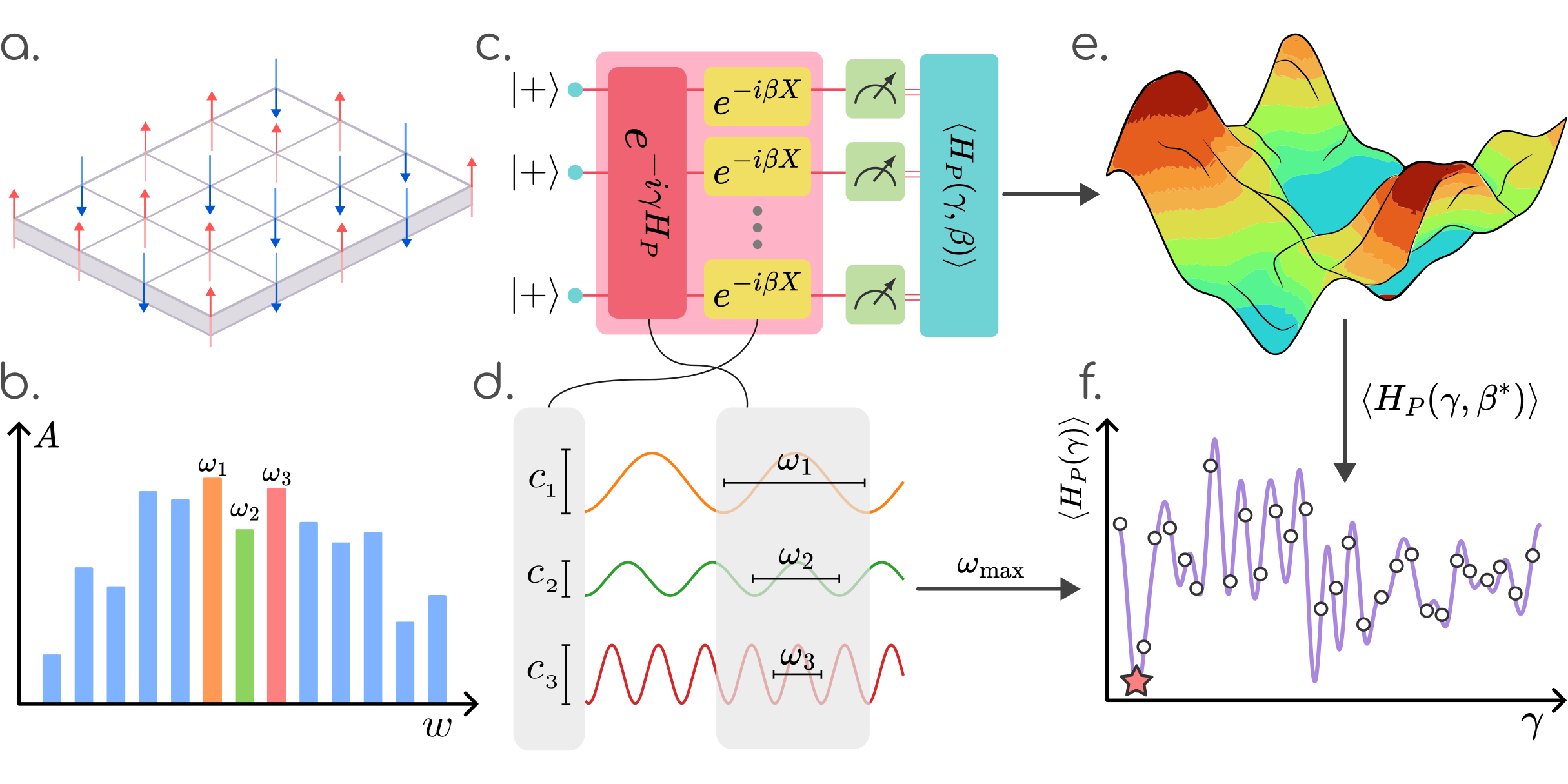
Featured image: A weighted Ising/QUBO instance defines a problem Hamiltonian whose spectrum sets the frequencies accessible to the QAOA$_1$ landscape; since the shallow circuit expresses only a subset of these, the expectation value is a truncated Fourier series. We compute its bandwidth analytically, use it to set a Nyquist-safe sampling scale, and eliminate $\beta$ in closed form, reducing the problem to a one-dimensional optimisation over $\gamma$ solved with a certificate of global optimality – with the optimum concentrating near $\gamma \approx 0$ on average.
Popular summary
The difficulty lies hidden in the structure of the cost landscape. As the parameters are varied, the output of QAOA$_1$ does not change smoothly – it oscillates, and the rate of oscillation grows with the weights and connectivity of the problem being solved. For large, dense, or heavily weighted problems, these oscillations become so rapid that standard coarse searches over the parameters miss them entirely, landing on spurious minima rather than the true optimum. This explains a widely observed but poorly understood failure mode: naive parameter optimisation, even with local refinement, can produce dramatically suboptimal results – not because the underlying problem is fundamentally hard to optimise, but because the search is being conducted at the wrong resolution.
Our main contribution is to replace this heuristic search with a principled, mathematically grounded procedure. We show that the oscillation pattern of QAOA$_1$ can be fully characterised in advance, directly from the coefficients of the problem itself, allowing us to calculate exactly how finely the parameters need to be sampled to avoid missing the true optimum. We then eliminate one of the two parameters entirely: for any fixed value of $\gamma$, the best choice of $\beta$ can be computed directly, reducing the original two-dimensional search to a much simpler one-dimensional problem over $\gamma$ alone. We solve this remaining problem using a systematic search procedure that progressively narrows down the range of possible values, ruling out regions that provably cannot contain the best solution – producing not merely a good parameter setting, but a guarantee that nothing better was missed.
For large regular weighted problems, we further prove that the best choice of $\gamma$ typically lies close to zero and coincides with the first local optimum encountered when searching outward from zero. This provides a rigorous theoretical explanation for why simple strategies that start near zero tend to work well in practice, and allows a fast local search to replace an exhaustive one.
We validate the full approach within Recursive QAOA (RQAOA), where accurate parameter tuning consistently enables RQAOA$_1$ to outperform both coarsely tuned variants and classical semidefinite programming across dense, weighted benchmark instances with 128 and 256 qubits.
► BibTeX data
► References
[1] Peter W Shor. ``Polynomial-time algorithms for prime factorization and discrete logarithms on a quantum computer''. SIAM Review 41, 303–332 (1999).
https://doi.org/10.1137/S0036144598347011
[2] Lov K Grover. ``Quantum mechanics helps in searching for a needle in a haystack''. Physical Review Letters 79, 325 (1997).
https://doi.org/10.1103/PhysRevLett.79.325
[3] John Preskill. ``Quantum computing in the NISQ era and beyond''. Quantum 2, 79 (2018).
https://doi.org/10.22331/q-2018-08-06-79
[4] Bin Cheng, Xiu-Hao Deng, Xiu Gu, Yu He, Guangchong Hu, Peihao Huang, Jun Li, Ben-Chuan Lin, Dawei Lu, Yao Lu, Chudan Qiu, Hui Wang, Tao Xin, Shi Yu, Man-Hong Yung, Junkai Zeng, Song Zhang, Youpeng Zhong, Xinhua Peng, Franco Nori, and Dapeng Yu. ``Noisy intermediate-scale quantum computers''. Frontiers of Physics 18, 21308 (2023).
https://doi.org/10.1007/s11467-022-1249-z
[5] Marco Cerezo, Andrew Arrasmith, Ryan Babbush, Simon C Benjamin, Suguru Endo, Keisuke Fujii, Jarrod R McClean, Kosuke Mitarai, Xiao Yuan, Lukasz Cincio, et al. ``Variational quantum algorithms''. Nature Reviews Physics 3, 625–644 (2021).
https://doi.org/10.1038/s42254-021-00348-9
[6] Kishor Bharti, Alba Cervera-Lierta, Thi Ha Kyaw, Tobias Haug, Sumner Alperin-Lea, Abhinav Anand, Matthias Degroote, Hermanni Heimonen, Jakob S Kottmann, Tim Menke, et al. ``Noisy intermediate-scale quantum algorithms''. Reviews of Modern Physics 94, 015004 (2022).
https://doi.org/10.1103/RevModPhys.94.015004
[7] Lennart Bittel and Martin Kliesch. ``Training variational quantum algorithms is $\text{NP-Hard}$''. Physical Review Letters 127, 120502 (2021).
https://doi.org/10.1103/PhysRevLett.127.120502
[8] Jarrod R McClean, Sergio Boixo, Vadim N Smelyanskiy, Ryan Babbush, and Hartmut Neven. ``Barren plateaus in quantum neural network training landscapes''. Nature communications 9, 4812 (2018).
https://doi.org/10.1038/s41467-018-07090-4
[9] Eric R Anschuetz and Bobak T Kiani. ``Quantum variational algorithms are swamped with traps''. Nature Communications 13, 7760 (2022).
https://doi.org/10.1038/s41467-022-35364-5
[10] Samson Wang, Enrico Fontana, Marco Cerezo, Kunal Sharma, Akira Sone, Lukasz Cincio, and Patrick J Coles. ``Noise-induced barren plateaus in variational quantum algorithms''. Nature communications 12, 6961 (2021).
https://doi.org/10.1038/s41467-021-27045-6
[11] Marco Cerezo, Akira Sone, Tyler Volkoff, Lukasz Cincio, and Patrick J Coles. ``Cost function dependent barren plateaus in shallow parametrized quantum circuits''. Nature communications 12, 1791 (2021).
https://doi.org/10.1038/s41467-021-21728-w
[12] Carlos Ortiz Marrero, Mária Kieferová, and Nathan Wiebe. ``Entanglement-induced barren plateaus''. PRX Quantum 2, 040316 (2021).
https://doi.org/10.1103/PRXQuantum.2.040316
[13] Nikita A. Nemkov, Evgeniy O. Kiktenko, and Aleksey K. Fedorov. ``Barren plateaus swamped with traps''. Physical Review A 111, 012441 (2025).
https://doi.org/10.1103/PhysRevA.111.012441
[14] Edward Farhi, Jeffrey Goldstone, and Sam Gutmann. ``A quantum approximate optimization algorithm'' (2014). arXiv:1411.4028.
arXiv:1411.4028
[15] Johannes Weidenfeller, Lucia C. Valor, Julien Gacon, Caroline Tornow, Luciano Bello, Stefan Woerner, and Daniel J. Egger. ``Scaling of the quantum approximate optimization algorithm on superconducting qubit based hardware''. Quantum 6, 870 (2022).
https://doi.org/10.22331/q-2022-12-07-870
[16] Stuart Andrew Hadfield. ``Quantum algorithms for scientific computing and approximate optimization''. PhD thesis. Columbia University. (2018).
https://doi.org/10.7916/D8X650C9
[17] Zhihui Wang, Stuart Hadfield, Zhang Jiang, and Eleanor G Rieffel. ``Quantum approximate optimization algorithm for MaxCut: A fermionic view''. Physical Review A 97, 022304 (2018).
https://doi.org/10.1103/PhysRevA.97.022304
[18] Asier Ozaeta, Wim van Dam, and Peter L McMahon. ``Expectation values from the single-layer quantum approximate optimization algorithm on ising problems''. Quantum Science and Technology 7, 045036 (2022).
https://doi.org/10.1088/2058-9565/ac9013
[19] V Vijendran, Aritra Das, Dax Enshan Koh, Syed M Assad, and Ping Koy Lam. ``An expressive ansatz for low-depth quantum approximate optimisation''. Quantum Science and Technology 9, 025010 (2024).
https://doi.org/10.1088/2058-9565/ad200a
[20] Joao Basso, Edward Farhi, Kunal Marwaha, Benjamin Villalonga, and Leo Zhou. ``The Quantum Approximate Optimization Algorithm at High Depth for MaxCut on Large-Girth Regular Graphs and the Sherrington-Kirkpatrick Model''. In François Le Gall and Tomoyuki Morimae, editors, 17th Conference on the Theory of Quantum Computation, Communication and Cryptography (TQC 2022). Volume 232 of Leibniz International Proceedings in Informatics (LIPIcs), pages 7:1–7:21. Dagstuhl, Germany (2022). Schloss Dagstuhl – Leibniz-Zentrum für Informatik.
https://doi.org/10.4230/LIPIcs.TQC.2022.7
[21] Truman Yu Ng, Jin Ming Koh, and Dax Enshan Koh. ``Analytical expressions for the quantum approximate optimization algorithm and its variants'' (2024). arXiv:2411.09745.
arXiv:2411.09745
[22] Jonathan Wurtz and Danylo Lykov. ``Fixed-angle conjectures for the quantum approximate optimization algorithm on regular MaxCut graphs''. Physical Review A 104, 052419 (2021).
https://doi.org/10.1103/PhysRevA.104.052419
[23] Fernando G. S. L. Brandao, Michael Broughton, Edward Farhi, Sam Gutmann, and Hartmut Neven. ``For fixed control parameters the quantum approximate optimization algorithm's objective function value concentrates for typical instances'' (2018). arXiv:1812.04170.
arXiv:1812.04170
[24] Vishwanathan Akshay, Daniil Rabinovich, Ernesto Campos, and Jacob Biamonte. ``Parameter concentrations in quantum approximate optimization''. Physical Review A 104, L010401 (2021).
https://doi.org/10.1103/PhysRevA.104.L010401
[25] Vivek Katial, Kate Smith-Miles, Charles Hill, and Lloyd Hollenberg. ``On the instance dependence of parameter initialization for the quantum approximate optimization algorithm: insights via instance space analysis''. INFORMS Journal on Computing 37, 146–171 (2025).
https://doi.org/10.1287/ijoc.2024.0564
[26] Alexey Galda, Xiaoyuan Liu, Danylo Lykov, Yuri Alexeev, and Ilya Safro. ``Transferability of optimal QAOA parameters between random graphs''. In 2021 IEEE International Conference on Quantum Computing and Engineering (QCE). Pages 171–180. (2021).
https://doi.org/10.1109/QCE52317.2021.00034
[27] Alexey Galda, Eesh Gupta, Jose Falla, Xiaoyuan Liu, Danylo Lykov, Yuri Alexeev, and Ilya Safro. ``Similarity-based parameter transferability in the quantum approximate optimization algorithm''. Frontiers in Quantum Science and Technology 2, 1200975 (2023).
https://doi.org/10.3389/frqst.2023.1200975
[28] Isak Lyngfelt and Laura García-Álvarez. ``Symmetry-informed transferability of optimal parameters in the quantum approximate optimization algorithm''. Physical Review A 111, 022418 (2025).
https://doi.org/10.1103/PhysRevA.111.022418
[29] Quinn Langfitt, Jose Falla, Ilya Safro, and Yuri Alexeev. ``Parameter transferability in QAOA under noisy conditions''. In 2023 IEEE International Conference on Quantum Computing and Engineering (QCE). Volume 02, pages 300–301. (2023).
https://doi.org/10.1109/QCE57702.2023.10252
[30] Ryo Sakai, Hiromichi Matsuyama, Wai-Hong Tam, Yu Yamashiro, and Keisuke Fujii. ``Linearly simplified QAOA parameters and transferability'' (2024). arXiv:2405.00655.
arXiv:2405.00655
[31] Stefan H Sack and Maksym Serbyn. ``Quantum annealing initialization of the quantum approximate optimization algorithm''. Quantum 5, 491 (2021).
https://doi.org/10.22331/q-2021-07-01-491
[32] Daniel Liang, Li Li, and Stefan Leichenauer. ``Investigating quantum approximate optimization algorithms under bang-bang protocols''. Physical Review Research 2, 033402 (2020).
https://doi.org/10.1103/PhysRevResearch.2.033402
[33] Alicia B Magann, Kenneth M Rudinger, Matthew D Grace, and Mohan Sarovar. ``Lyapunov-control-inspired strategies for quantum combinatorial optimization''. Physical Review A 106, 062414 (2022).
https://doi.org/10.1103/PhysRevA.106.062414
[34] Leo Zhou, Sheng-Tao Wang, Soonwon Choi, Hannes Pichler, and Mikhail D Lukin. ``Quantum approximate optimization algorithm: Performance, mechanism, and implementation on near-term devices''. Physical Review X 10, 021067 (2020).
https://doi.org/10.1103/PhysRevX.10.021067
[35] Xiao-Hui Ni, Bin-Bin Cai, Hai-Ling Liu, Su-Juan Qin, Fei Gao, and Qiao-Yan Wen. ``Multilevel leapfrogging initialization strategy for quantum approximate optimization algorithm''. Advanced Quantum Technologies 7, 2300419 (2024).
https://doi.org/10.1002/qute.202300419
[36] Xinwei Lee, Ningyi Xie, Dongsheng Cai, Yoshiyuki Saito, and Nobuyoshi Asai. ``A depth-progressive initialization strategy for quantum approximate optimization algorithm''. Mathematics 11, 2176 (2023).
https://doi.org/10.3390/math11092176
[37] Ruslan Shaydulin, Phillip C Lotshaw, Jeffrey Larson, James Ostrowski, and Travis S Humble. ``Parameter transfer for quantum approximate optimization of weighted MaxCut''. ACM Transactions on Quantum Computing 4, 1–15 (2023).
https://doi.org/10.1145/3584706
[38] Michał Stęchły, Lanruo Gao, Boniface Yogendran, Enrico Fontana, and Manuel Rudolph. ``Connecting the Hamiltonian structure to the QAOA energy and Fourier landscape structure'' (2024). arXiv:2305.13594.
arXiv:2305.13594
[39] Mahabubul Alam, Abdullah Ash-Saki, and Swaroop Ghosh. ``Accelerating quantum approximate optimization algorithm using machine learning''. In 2020 Design, Automation & Test in Europe Conference & Exhibition (DATE). Pages 686–689. IEEE (2020).
https://doi.org/10.23919/DATE48585.2020.9116348
[40] Ningyi Xie, Xinwei Lee, Dongsheng Cai, Yoshiyuki Saito, and Nobuyoshi Asai. ``Quantum approximate optimization algorithm parameter prediction using a convolutional neural network''. Journal of Physics: Conference Series 2595, 012001 (2023).
https://doi.org/10.1088/1742-6596/2595/1/012001
[41] Zhiding Liang, Gang Liu, Zheyuan Liu, Jinglei Cheng, Tianyi Hao, Kecheng Liu, Hang Ren, Zhixin Song, Ji Liu, Fanny Ye, and Yiyu Shi. ``Invited: Graph learning for parameter prediction of quantum approximate optimization algorithm''. In Proceedings of the 61st ACM/IEEE Design Automation Conference. DAC '24New York, NY, USA (2024). Association for Computing Machinery.
https://doi.org/10.1145/3649329.3663523
[42] Fanxu Meng, Xiangzhen Zhou, Pengcheng Zhu, and Yu Luo. ``Conditional diffusion-based parameter generation for quantum approximate optimization algorithm''. EPJ Quantum Technology 12, 100 (2025).
https://doi.org/10.1140/epjqt/s40507-025-00397-4
[43] Ohad Amosy, Tamuz Danzig, Ohad Lev, Ely Porat, Gal Chechik, and Adi Makmal. ``Iteration-free quantum approximate optimization algorithm using neural networks''. Quantum Machine Intelligence 6, 38 (2024).
https://doi.org/10.1007/s42484-024-00159-y
[44] Sami Khairy, Ruslan Shaydulin, Lukasz Cincio, Yuri Alexeev, and Prasanna Balaprakash. ``Reinforcement-learning-based variational quantum circuits optimization for combinatorial problems'' (2019). arXiv:1911.04574.
arXiv:1911.04574
[45] J. A. Montañez-Barrera, Dennis Willsch, and Kristel Michielsen. ``Transfer learning of optimal QAOA parameters in combinatorial optimization''. Quantum Information Processing 24, 129 (2025).
https://doi.org/10.1007/s11128-025-04743-4
[46] Jose Falla, Quinn Langfitt, Yuri Alexeev, and Ilya Safro. ``Graph representation learning for parameter transferability in quantum approximate optimization algorithm''. Quantum Machine Intelligence 6, 46 (2024).
https://doi.org/10.1007/s42484-024-00178-9
[47] Lixue Cheng, Yu-Qin Chen, Shi-Xin Zhang, and Shengyu Zhang. ``Quantum approximate optimization via learning-based adaptive optimization''. Communications Physics 7, 83 (2024).
https://doi.org/10.1038/s42005-024-01577-x
[48] Sergey Bravyi, Alexander Kliesch, Robert Koenig, and Eugene Tang. ``Obstacles to variational quantum optimization from symmetry protection''. Physical Review Letters 125, 260505 (2020).
https://doi.org/10.1103/PhysRevLett.125.260505
[49] Seongmin Kim, Vincent R. Pascuzzi, Zhihao Xu, Tengfei Luo, Eungkyu Lee, and In-Saeng Suh. ``Distributed quantum approximate optimization algorithm on a quantum-centric supercomputing architecture''. npj Quantum Information (2026).
https://doi.org/10.1038/s41534-026-01283-2
[50] Bo Yue, Shibei Xue, Yu Pan, Min Jiang, and Daoyi Dong. ``Local to global: A distributed quantum approximate optimization algorithm for pseudo-Boolean optimization problems'' (2023). arXiv:2310.05062.
arXiv:2310.05062
[51] Kuan-Cheng Chen, Xiaotian Xu, Felix Burt, Chen-Yu Liu, Shang Yu, and Kin K. Leung. ``Noise-aware distributed quantum approximate optimization algorithm on near-term quantum hardware''. In 2024 IEEE International Conference on Quantum Computing and Engineering (QCE). Volume 02, pages 144–149. (2024).
https://doi.org/10.1109/QCE60285.2024.10268
[52] Jernej Rudi Finžgar, Aron Kerschbaumer, Martin JA Schuetz, Christian B Mendl, and Helmut G Katzgraber. ``Quantum-informed recursive optimization algorithms''. PRX Quantum 5, 020327 (2024).
https://doi.org/10.1103/PRXQuantum.5.020327
[53] Lucas T Brady and Stuart Hadfield. ``Iterative quantum algorithms for maximum independent set''. Physical Review A 110, 052435 (2024).
https://doi.org/10.1103/PhysRevA.110.052435
[54] Bao Bach, Jose Falla, and Ilya Safro. ``MLQAOA: Graph Learning Accelerated Hybrid Quantum-Classical Multilevel QAOA''. In 2024 IEEE International Conference on Quantum Computing and Engineering (QCE). Volume 01, pages 1–12. (2024).
https://doi.org/10.1109/QCE60285.2024.00072
[55] Zeqiao Zhou, Yuxuan Du, Xinmei Tian, and Dacheng Tao. ``QAOA-in-QAOA: solving large-scale MaxCut problems on small quantum machines''. Physical Review Applied 19, 024027 (2023).
https://doi.org/10.1103/PhysRevApplied.19.024027
[56] Moises Ponce, Rebekah Herrman, Phillip C. Lotshaw, Sarah Powers, George Siopsis, Travis Humble, and James Ostrowski. ``Graph decomposition techniques for solving combinatorial optimization problems with variational quantum algorithms''. Quantum Information Processing 24, 60 (2025).
https://doi.org/10.1007/s11128-025-04675-z
[57] Maxime Dupont, Bram Evert, Mark J Hodson, Bhuvanesh Sundar, Stephen Jeffrey, Yuki Yamaguchi, Dennis Feng, Filip B Maciejewski, Stuart Hadfield, M Sohaib Alam, et al. ``Quantum-enhanced greedy combinatorial optimization solver''. Science Advances 9, eadi0487 (2023).
https://doi.org/10.1126/sciadv.adi0487
[58] Maxime Dupont and Bhuvanesh Sundar. ``Extending relax-and-round combinatorial optimization solvers with quantum correlations''. Physical Review A 109, 012429 (2024).
https://doi.org/10.1103/PhysRevA.109.012429
[59] Libor Caha, Alexander Kliesch, and Robert Koenig. ``Twisted hybrid algorithms for combinatorial optimization''. Quantum Science and Technology 7, 045013 (2022).
https://doi.org/10.1088/2058-9565/ac7f4f
[60] Victor Fischer, Maximilian Passek, Friedrich Wagner, Jernej Rudi Finžgar, Lilly Palackal, and Christian B. Mendl. ``Quantum and classical correlations in shrinking algorithms for optimization'' (2024). arXiv:2404.17242.
arXiv:2404.17242
[61] Abraham P Punnen. ``The quadratic unconstrained binary optimization problem''. Springer International Publishing 10, 978–3 (2022).
https://doi.org/10.1007/978-3-031-04520-2
[62] Maria Schuld, Ryan Sweke, and Johannes Jakob Meyer. ``Effect of data encoding on the expressive power of variational quantum-machine-learning models''. Physical Review A 103, 032430 (2021).
https://doi.org/10.1103/PhysRevA.103.032430
[63] Francisco Javier Gil Vidal and Dirk Oliver Theis. ``Input redundancy for parameterized quantum circuits''. Frontiers in Physics 8, 297 (2020).
https://doi.org/10.3389/fphy.2020.00297
[64] Enrico Fontana, Ivan Rungger, Ross Duncan, and Cristina Cîrstoiu. ``Spectral analysis for noise diagnostics and filter-based digital error mitigation'' (2022). arXiv:2206.08811.
arXiv:2206.08811
[65] Enrico Fontana, Ivan Rungger, Ross Duncan, and Cristina Cîrstoiu. ``Efficient recovery of variational quantum algorithms landscapes using classical signal processing'' (2022). arXiv:2208.05958.
arXiv:2208.05958
[66] Nikita A. Nemkov, Evgeniy O. Kiktenko, and Aleksey K. Fedorov. ``Fourier expansion in variational quantum algorithms''. Physical Review A 108, 032406 (2023).
https://doi.org/10.1103/PhysRevA.108.032406
[67] Claude Elwood Shannon. ``Communication in the presence of noise''. Proceedings of the IRE 37, 10–21 (1949).
https://doi.org/10.1109/JRPROC.1949.232969
[68] Tianyi Hao, Kun Liu, and Swamit Tannu. ``Enabling high performance debugging for variational quantum algorithms using compressed sensing''. In Proceedings of the 50th Annual International Symposium on Computer Architecture. Pages 1–13. (2023).
https://doi.org/10.1145/3579371.3589044
[69] Daniel Müssig, Markus Wappler, Steve Lenk, and Jörg Lässig. ``Connecting the Hamiltonian structure to the QAOA performance and energy landscape''. In INFORMATIK 2024. Pages 595–604. Gesellschaft für Informatik e.V., Bonn (2024).
https://doi.org/10.18420/inf2024_48
[70] Mauricio Chávez-Pichardo, Miguel A Martínez-Cruz, Alfredo Trejo-Martínez, Daniel Martínez-Carbajal, and Tanya Arenas-Resendiz. ``A complete review of the general quartic equation with real coefficients and multiple roots''. Mathematics 10, 2377 (2022).
https://doi.org/10.3390/math10142377
[71] John P Boyd. ``Computing the zeros, maxima and inflection points of Chebyshev, Legendre and Fourier series: solving transcendental equations by spectral interpolation and polynomial rootfinding''. Journal of Engineering Mathematics 56, 203–219 (2006).
https://doi.org/10.1007/s10665-006-9087-5
[72] John P. Boyd. ``A comparison of companion matrix methods to find roots of a trigonometric polynomial''. Journal of Computational Physics 246, 96–112 (2013).
https://doi.org/10.1016/j.jcp.2013.03.022
[73] Bahman Kalantari, Fedor Andreev, and Chun Lau. ``Characterization of local optima of polynomial modulus over a disc''. Numerical Algorithms 90, 773–787 (2022).
https://doi.org/10.1007/s11075-021-01208-4
[74] Eldon R Hansen. ``Global optimization using interval analysis: the one-dimensional case''. Journal of Optimization Theory and Applications 29, 331–344 (1979).
https://doi.org/10.1007/BF00933139
[75] Eldon Hansen and G William Walster. ``Global optimization using interval analysis: revised and expanded''. Volume 264. CRC press. (2003).
https://doi.org/10.1201/9780203026922
[76] J. J. Green. ``Calculating the maximum modulus of a polynomial using Steckin's lemma''. SIAM Journal on Numerical Analysis 36, 1022–1029 (1999).
https://doi.org/10.1137/S0036142997331335
[77] Gabriel De La Chevrotiere. ``Finding the maximum modulus of a polynomial on the polydisk using a generalization of Steckin's lemma''. SIAM Undergraduate Research Online 2, 2–2 (2009).
https://doi.org/10.1137/09S010460
[78] Pavel Emeliyanenko and Michael Sagraloff. ``On the complexity of solving a bivariate polynomial system''. In Proceedings of the 37th International Symposium on Symbolic and Algebraic Computation. Pages 154–161. (2012).
https://doi.org/10.1145/2442829.2442854
[79] Bor Plestenjak and Michiel E Hochstenbach. ``Roots of bivariate polynomial systems via determinantal representations''. SIAM Journal on Scientific Computing 38, A765–A788 (2016).
https://doi.org/10.1137/140983847
[80] Sami Boulebnane, Xavier Lucas, Agnes Meyder, Stanislaw Adaszewski, and Ashley Montanaro. ``Peptide conformational sampling using the quantum approximate optimization algorithm''. npj Quantum Information 9, 70 (2023).
https://doi.org/10.1038/s41534-023-00733-5
[81] Sebastian Brandhofer, Daniel Braun, Vanessa Dehn, Gerhard Hellstern, Matthias Hüls, Yanjun Ji, Ilia Polian, Amandeep Singh Bhatia, and Thomas Wellens. ``Benchmarking the performance of portfolio optimization with QAOA''. Quantum Information Processing 22, 25 (2022).
https://doi.org/10.1007/s11128-022-03766-5
[82] Sami Boulebnane and Ashley Montanaro. ``Predicting parameters for the quantum approximate optimization algorithm for max-cut from the infinite-size limit'' (2021). arXiv:2110.10685.
arXiv:2110.10685
[83] Shree Hari Sureshbabu, Dylan Herman, Ruslan Shaydulin, Joao Basso, Shouvanik Chakrabarti, Yue Sun, and Marco Pistoia. ``Parameter setting in quantum approximate optimization of weighted problems''. Quantum 8, 1231 (2024).
https://doi.org/10.22331/q-2024-01-18-1231
[84] P. Erdös and A. Rényi. ``On random graphs I''. Publ. math. debrecen 6, 290–297 (1959).
https://doi.org/10.5486/PMD.1959.6.3-4.12
[85] E. N. Gilbert. ``Random Graphs''. The Annals of Mathematical Statistics 30, 1141 – 1144 (1959).
https://doi.org/10.1214/aoms/1177706098
[86] Gurobi Optimization, LLC. ``Gurobi Optimizer Reference Manual''. https://www.gurobi.com (2022).
https://www.gurobi.com
[87] Michel X Goemans and David P Williamson. ``Improved approximation algorithms for maximum cut and satisfiability problems using semidefinite programming''. Journal of the ACM (JACM) 42, 1115–1145 (1995).
https://doi.org/10.1145/227683.227684
[88] Sergey Bravyi, Alexander Kliesch, Robert Koenig, and Eugene Tang. ``Hybrid quantum-classical algorithms for approximate graph coloring''. Quantum 6, 678 (2022).
https://doi.org/10.22331/q-2022-03-30-678
[89] Yash J Patel, Sofiene Jerbi, Thomas Bäck, and Vedran Dunjko. ``Reinforcement learning assisted recursive QAOA''. EPJ Quantum Technology 11, 6 (2024).
https://doi.org/10.1140/epjqt/s40507-023-00214-w
[90] V Vijendran, Dax Enshan Koh, Ping Koy Lam, and Syed M Assad. ``Classical and quantum heuristics for the binary paint shop problem'' (2025). arXiv:2509.15294.
arXiv:2509.15294
[91] Sergey Bravyi, David Gosset, Daniel Grier, and Luke Schaeffer. ``Classical algorithms for forrelation'' (2021). arXiv:2102.06963.
arXiv:2102.06963
[92] Eunok Bae and Soojoon Lee. ``Recursive QAOA outperforms the original QAOA for the MAX-CUT problem on complete graphs''. Quantum Information Processing 23, 78 (2024).
https://doi.org/10.1007/s11128-024-04286-0
[93] Eunok Bae, Hyukjoon Kwon, V Vijendran, and Soojoon Lee. ``Modified recursive QAOA for exact MAX-CUT solutions on bipartite graphs: closing the gap beyond QAOA limit''. Journal of Physics A: Mathematical and Theoretical 58, 485304 (2025).
https://doi.org/10.1088/1751-8121/ae20d7
[94] Charles Moussa, Hao Wang, Thomas Bäck, and Vedran Dunjko. ``Unsupervised strategies for identifying optimal parameters in quantum approximate optimization algorithm''. EPJ Quantum Technology 9, 11 (2022).
https://doi.org/10.1140/epjqt/s40507-022-00131-4
[95] Simon Thelen, Hila Safi, and Wolfgang Mauerer. ``Approximating under the Influence of Quantum Noise and Compute Power''. In 2024 IEEE International Conference on Quantum Computing and Engineering (QCE). Pages 274–279. Los Alamitos, CA, USA (2024). IEEE Computer Society.
https://doi.org/10.1109/QCE60285.2024.10291
[96] Daniel J Egger, Jakub Mareček, and Stefan Woerner. ``Warm-starting quantum optimization''. Quantum 5, 479 (2021).
https://doi.org/10.22331/q-2021-06-17-479
[97] David P Williamson and David B Shmoys. ``The design of approximation algorithms''. Cambridge University Press. (2011).
https://doi.org/10.1017/CBO9780511921735
[98] Lap Chi Lau, Ramamoorthi Ravi, and Mohit Singh. ``Iterative methods in combinatorial optimization''. Volume 46. Cambridge University Press. (2011).
https://doi.org/10.1017/CBO9780511977152
[99] Michael H Freedman and Matthew B Hastings. ``Quantum systems on non-$k$-hyperfinite complexes: A generalization of classical statistical mechanics on expander graphs''. Quantum Information & Computation 14, 144–180 (2014).
https://doi.org/10.26421/QIC14.1-2-9
[100] Edward Farhi, David Gamarnik, and Sam Gutmann. ``The quantum approximate optimization algorithm needs to see the whole graph: A typical case'' (2020). arXiv:2004.09002.
arXiv:2004.09002
[101] Edward Farhi, David Gamarnik, and Sam Gutmann. ``The quantum approximate optimization algorithm needs to see the whole graph: Worst case examples'' (2020). arXiv:2005.08747.
arXiv:2005.08747
[102] Joao Basso, David Gamarnik, Song Mei, and Leo Zhou. ``Performance and limitations of the QAOA at constant levels on large sparse hypergraphs and spin glass models''. In 2022 IEEE 63rd Annual Symposium on Foundations of Computer Science (FOCS). Pages 335–343. IEEE (2022).
https://doi.org/10.1109/FOCS54457.2022.00039
[103] Anurag Anshu and Tony Metger. ``Concentration bounds for quantum states and limitations on the QAOA from polynomial approximations''. Quantum 7, 999 (2023).
https://doi.org/10.22331/q-2023-05-11-999
[104] Boaz Barak and Kunal Marwaha. ``Classical Algorithms and Quantum Limitations for Maximum Cut on High-Girth Graphs''. In Mark Braverman, editor, 13th Innovations in Theoretical Computer Science Conference (ITCS 2022). Volume 215 of Leibniz International Proceedings in Informatics (LIPIcs), pages 14:1–14:21. Dagstuhl, Germany (2022). Schloss Dagstuhl – Leibniz-Zentrum für Informatik.
https://doi.org/10.4230/LIPIcs.ITCS.2022.14
[105] Mark Goh. ``The overlap gap property limits limit swapping in the QAOA''. Quantum Information & Computation 25, 329–343 (2025).
https://doi.org/10.2478/qic-2025-0018
[106] Vishwanathan Akshay, Hariphan Philathong, Mauro ES Morales, and Jacob D Biamonte. ``Reachability deficits in quantum approximate optimization''. Physical Review Letters 124, 090504 (2020).
https://doi.org/10.1103/PhysRevLett.124.090504
[107] Vishwanathan Akshay, H Philathong, Igor Zacharov, and J Biamonte. ``Reachability deficits in quantum approximate optimization of graph problems''. Quantum 5, 532 (2021).
https://doi.org/10.22331/q-2021-08-30-532
[108] Antares Chen, Neng Huang, and Kunal Marwaha. ``Local algorithms and the failure of log-depth quantum advantage on sparse random CSPs'' (2023). arXiv:2310.01563.
arXiv:2310.01563
[109] Chi-Ning Chou, Peter J. Love, Juspreet Singh Sandhu, and Jonathan Shi. ``Limitations of Local Quantum Algorithms on Random MAX-k-XOR and Beyond''. In Mikołaj Bojańczyk, Emanuela Merelli, and David P. Woodruff, editors, 49th International Colloquium on Automata, Languages, and Programming (ICALP 2022). Volume 229 of Leibniz International Proceedings in Informatics (LIPIcs), pages 41:1–41:20. Dagstuhl, Germany (2022). Schloss Dagstuhl – Leibniz-Zentrum für Informatik.
https://doi.org/10.4230/LIPIcs.ICALP.2022.41
[110] Kunal Marwaha and Stuart Hadfield. ``Bounds on approximating Max $k$XOR with quantum and classical local algorithms''. Quantum 6, 757 (2022).
https://doi.org/10.22331/q-2022-07-07-757
[111] R. E. Edwards. ``Fourier series: A modern introduction volume 1''. Volume 2 of Graduate Texts in Mathematics, pages XII, 228. Springer-Verlag New York, NY. (1979). 2 edition.
https://doi.org/10.1007/978-1-4612-6208-4
Cited by
[1] Malick A. Gaye, Omar Shehab, Paraj Titum, and Gregory Quiroz, "Quantum optimization with classical chaos", Quantum Science and Technology 11 2, 025039 (2026).
[2] V Vijendran, Dax Enshan Koh, Ping Koy Lam, and Syed M Assad, "Classical and Quantum Heuristics for the Binary Paint Shop Problem", arXiv:2509.15294, (2025).
[3] Eunok Bae, Hyukjoon Kwon, V. Vijendran, and Soojoon Lee, "Modified recursive QAOA for exact MAX-CUT solutions on bipartite graphs: closing the gap beyond QAOA limit", Journal of Physics A Mathematical General 58 48, 485304 (2025).
[4] Filip B. Maciejewski, Stuart Hadfield, Oscar Wallis, George Pennington, Sebastian Brandhofer, Stefan Woerner, Daniel J. Egger, and Davide Venturelli, "Quantum Approximate Optimization via Noise-Directed Adaptive Warm-Starting", arXiv:2607.09368, (2026).
The above citations are from SAO/NASA ADS (last updated successfully 2026-10-19 17:39:03). The list may be incomplete as not all publishers provide suitable and complete citation data.
On Crossref's cited-by service no data on citing works was found (last attempt 2026-10-20 07:41:15). Could not fetch ADS cited-by data during last attempt 2026-10-20 07:41:15: Cannot retrieve data from ADS due to rate limitations.
This Paper is published in Quantum under the Creative Commons Attribution 4.0 International (CC BY 4.0) license. Copyright remains with the original copyright holders such as the authors or their institutions.