
Robust measurement of wave function topology on NISQ quantum computers
1Department of Physics, North Carolina State University, Raleigh, North Carolina 27695, USA
2Department of Physics, Georgetown University, 37th and O Sts. NW, Washington, DC 20057 USA
| Published: | 2023-04-27, volume 7, page 987 |
| Eprint: | arXiv:2101.07283v6 |
| Doi: | https://doi.org/10.22331/q-2023-04-27-987 |
| Citation: | Quantum 7, 987 (2023). |
Find this paper interesting or want to discuss? Scite or leave a comment on SciRate.
Abstract
Topological quantum phases of quantum materials are defined through their topological invariants. These topological invariants are quantities that characterize the global geometrical properties of the quantum wave functions and thus are immune to local noise. Here, we present a strategy to measure topological invariants on quantum computers. We show that our strategy can be easily integrated with the variational quantum eigensolver (VQE) so that the topological properties of generic quantum many-body states can be characterized on current quantum hardware. We demonstrate the robust nature of the method by measuring topological invariants for both non-interacting and interacting models, and map out interacting quantum phase diagrams on quantum simulators and IBM quantum hardware.
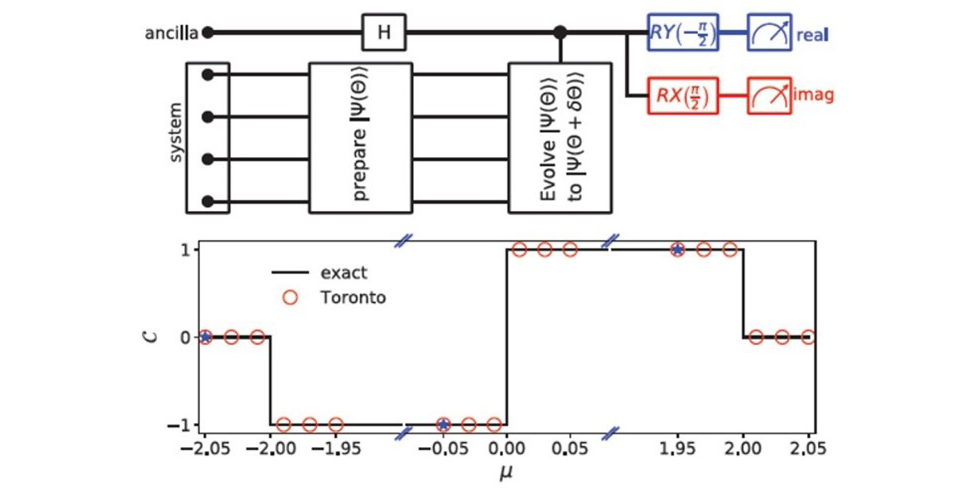
Featured image: A generic strategy allows accurate calculations of Chern numbers on IBM's quantum computers.
Popular summary
► BibTeX data
► References
[1] D. J. Thouless, M. Kohmoto, M. P. Nightingale, and M. den Nijs, Phys. Rev. Lett. 49, 405 (1982).
https://doi.org/10.1103/PhysRevLett.49.405
[2] Q. Niu, D. J. Thouless, and Y.-S. Wu, Phys. Rev. B 31, 3372 (1985).
https://doi.org/10.1103/PhysRevB.31.3372
[3] D. N. Sheng, L. Sheng, and Z. Y. Weng, Phys. Rev. B 73, 233406 (2006).
https://doi.org/10.1103/PhysRevB.73.233406
[4] H. Obuse, A. Furusaki, S. Ryu, and C. Mudry, Phys. Rev. B 76, 075301 (2007).
https://doi.org/10.1103/PhysRevB.76.075301
[5] J. Li, R.-L. Chu, J. K. Jain, and S.-Q. Shen, Phys. Rev. Lett. 102, 136806 (2009).
https://doi.org/10.1103/PhysRevLett.102.136806
[6] E. Prodan, J. Phys. A: Math. Theor. 44, 113001 (2011).
https://doi.org/10.1088/1751-8113/44/11/113001
[7] J. T. Chalker, M. Ortuno, and A. M. Somoza, Phys. Rev. B 83, 115317 (2011).
https://doi.org/10.1103/PhysRevB.83.115317
[8] J. Liu, A. C. Potter, K. T. Law, and P. A. Lee, Phys. Rev. Lett. 109, 267002 (2012).
https://doi.org/10.1103/PhysRevLett.109.267002
[9] A. M. Lobos, R. M. Lutchyn, and S. Das Sarma, Phys. Rev. Lett. 109, 146403 (2012).
https://doi.org/10.1103/PhysRevLett.109.146403
[10] E. J. Konig, P. M. Ostrovsky, I. V. Protopopov, I. V. Gornyi, I. S. Burmistrov, and A. D. Mirlin Phys. Rev. B 88, 035106 (2013).
https://doi.org/10.1103/PhysRevB.88.035106
[11] A. Altland, D. Bagrets, L. Fritz, A. Kamenev, and H. Schmiedt, Phys. Rev. Lett. 112, 206602 (2014).
https://doi.org/10.1103/PhysRevLett.112.206602
[12] I. Mondragon-Shem, T. L. Hughes, J. Song, and E. Prodan, Phys. Rev. Lett. 113, 046802 (2014).
https://doi.org/10.1103/PhysRevLett.113.046802
[13] J. Song, and E. Prodan, Phys. Rev. B 89, 224203 (2014).
https://doi.org/10.1103/PhysRevB.89.224203
[14] M. S. Foster, H.-Y. Xie, and Y.-Z. Chou, Phys. Rev. B 89, 155140 (2014).
https://doi.org/10.1103/PhysRevB.89.155140
[15] J. Wang, B. Lian, and S.-C. Zhang, Phys. Rev. B 89, 085106 (2014).
https://doi.org/10.1103/PhysRevB.89.085106
[16] C. Liu, W. Gao, B. Yang, and S. Zhang, Phys. Rev. Lett. 119, 183901 (2017).
https://doi.org/10.1103/PhysRevLett.119.183901
[17] E. J. Meier, F. A. An, A. Dauphin, M. Maffei, P. Massignan, T. L. Hughes, B. Gadway, Science 362, 929 (2018).
https://doi.org/10.1126/science.aat3406
[18] S. Stutzer, Y. Plotnik, Y. Lumer, P. Titum, N. Linder, M. Segev, M. C. Rechtsman, and A. Szameit, Nature 560, 461 (2018).
https://doi.org/10.1038/s41586-018-0418-2
[19] X. Xiao, arXiv:1802.02687 (2018).
https://doi.org/10.48550/arXiv.1802.02687
arXiv:1802.02687
[20] O. Shtanko, and R. Movassagh, Phys. Rev. Lett. 121, 126803 (2018).
https://doi.org/10.1103/PhysRevLett.121.126803
[21] T. Okugawa, P. Tang, A. Rubio, and D. M. Kennes, Phys. Rev. B 102, 201405(R) (2020).
https://doi.org/10.1103/PhysRevB.102.201405
[22] P. Roushan, C. Neill, Yu Chen, M. Kolodrubetz, C. Quintana, N. Leung, M. Fang, R. Barends, B. Campbell, Z. Chen, B. Chiaro, A. Dunsworth, E. Jeffrey, J. Kelly, A. Megrant, J. Mutus, P. J. J. O’Malley, D. Sank, A. Vainsencher, J. Wenner, T. White, A. Polkovnikov, A. N. Cleland and J. M. Martinis Nature 515, 241 (2014).
https://doi.org/10.1038/nature13891
[23] K. Choo, C. W. von Keyserlingk, N. Regnault, and T. Neupert, Phys. Rev. Lett. 121, 086808 (2018).
https://doi.org/10.1103/PhysRevLett.121.086808
[24] A. Smith, B. Jobst, A. G. Green, and F. Pollmann, Phys. Rev. Research 4, L022020 (2022).
https://doi.org/10.1103/PhysRevResearch.4.L022020
[25] D. Azses, R. Haenel, Y. Naveh, R. Raussendorf, E. Sela, and E. G. DallaTorre, Phys. Rev. Lett. 125, 120502 (2020).
https://doi.org/10.1103/PhysRevLett.125.120502
[26] F. Mei, Q. Guo, Y.-F. Yu, L. Xiao, S.-L. Zhu, and S. Jia, Phys. Rev. Lett. 125, 160503 (2020).
https://doi.org/10.1103/PhysRevLett.125.160503
[27] X. Xiao, J. K. Freericks, and A. F. Kemper, Quantum 5, 553 (2021).
https://doi.org/10.22331/q-2021-09-28-553
[28] E. Flurin, V. V. Ramasesh, S. Hacohen-Gourgy, L. S. Martin, N. Y. Yao, and I. Siddiqi, Phys. Rev. X 7, 031023 (2017).
https://doi.org/10.1103/PhysRevX.7.031023
[29] X. Zhan, L. Xiao, Z. Bian, K. Wang, X. Qiu, B. C. Sanders, W. Yi, and P. Xue, Phys. Rev. Lett. 119, 130501 (2017).
https://doi.org/10.1103/PhysRevLett.119.130501
[30] X.-Y. Xu, Q.-Q. Wang, W.-W. Pan, K. Sun, J.-S. Xu, G. Chen, J.-S. Tang, M. Gong, Y.-J. Han, C.-F. Li, and G.-C. Guo, Phys. Rev. Lett. 120, 260501 (2018).
https://doi.org/10.1103/PhysRevLett.120.260501
[31] A. Elben, J. Yu, G. Zhu, M. Hafezi, F. Pollmann, P. Zoller, and B. Vermersch, Sci. Adv. 6, eaaz3666 (2020).
https://doi.org/10.1126/sciadv.aaz3666
[32] J. Preskill, Quantum 2, 79 (2018).
https://doi.org/10.22331/q-2018-08-06-79
[33] A. Kandala, K. Temme, A. D. Corcoles, A. Mezzacapo, J. M. Chow, and J. M. Gambetta, Nature 567, 491 (2019).
https://doi.org/10.1038/s41586-019-1040-7
[34] K. E. Hamilton, and R. C. Pooser, Quantum Machine Intelligence 2, 10 (2020).
https://doi.org/10.1007/s42484-020-00021-x
[35] A. Cervera-Lierta, Quantum 2, 114 (2018).
https://doi.org/10.22331/q-2018-12-21-114
[36] K. Yeter-Aydeniz, R. C. Pooser, and G. Siopsis, npj Quantum Inf. 6, 63 (2020).
https://doi.org/10.1038/s41534-020-00290-1
[37] G. E. Volovik, JETP Lett. 70, 609 (1999).
https://doi.org/10.1134/1.568223
[38] N. Read, and D. Green, Phys. Rev. B 61, 10267 (2000).
https://doi.org/10.1103/PhysRevB.61.10267
[39] T. Fukui, Y. Hutsugai, and H. Suzuki, J. Phys. Soc. Jpn. 74, 1674 (2005).
https://doi.org/10.1143/JPSJ.74.1674
[40] P. J. J. O'malley, et al. Phys. Rev. X 6, 031007 (2016).
https://doi.org/10.1103/PhysRevX.6.031007
[41] A. Kandala, A. Mezzacapo, K. Temme, M. Takita, M. Brink, J. M. Chow, and J. M. Gambetta, Nature 549, 242 (2017).
https://doi.org/10.1038/nature23879
[42] C. Kokail, C. Maier, R. van Bijnen, T. Brydges, M. K. Joshi, P. Jurcevic, C. A. Muschik, P. Silvi, R. Blatt, C. F. Roos, and P. Zoller, Nature 569, 355 (2019).
https://doi.org/10.1038/s41586-019-1177-4
[43] X. Yaun, S. Endo, Q. Zhao, Y. Li and S. C. Benjamin, Quantum 3, 191 (2019).
https://doi.org/10.22331/q-2019-10-07-191
[44] H. R. Grimsley, S. E. Economou, E. Barnes, and N. J. Mayhall Nat. Commun. 10, 3007 (2019).
https://doi.org/10.1038/s41467-019-10988-2
[45] Y. Hatsugai, and M. Kohmoto, J. Phys. Soc. Jpn 61, 2056 (1992).
https://doi.org/10.1143/JPSJ.61.2056
[46] K. Kudo, H. Watanabe, T. Kariyado, and Y. Hatsugai, Phys. Rev. Lett. 122, 146601 (2019).
https://doi.org/10.1103/PhysRevLett.122.146601
[47] P. W. Philips, L. Yeo, and E. W. Huang Nat. Phys. 16, 1175 (2020).
https://doi.org/10.1038/s41567-020-0988-4
[48] X.-L. Qi, Y. S. Wu and S. C. Zhang, Phys. Rev. B 74, 085308 (2006).
https://doi.org/10.1103/PhysRevB.74.085308
[49] H.-Q. Wu, Y.-Y. He, C. Fang, Z. Y. Meng and Z.-Y. Lu, Phys. Rev. Lett. 117, 066403 (2016).
https://doi.org/10.1103/PhysRevLett.117.066403
[50] C.-E. Bardyn, L. Wawer, A. Altland, M. Fleischhauer, and S. Diehl, Phys. Rev. X 8, 011035 (2018).
https://doi.org/10.1103/PhysRevX.8.011035
[51] D. Aharonov, V. Jones, and Z. Landau, Algorithmica 55, 395 (2009).
https://doi.org/10.1007/s00453-008-9168-0
[52] B. Murta, G. Catarina, J. Fernandez-Rossier Phys. Rev. A 101, 020302 (2020).
https://doi.org/10.1103/PhysRevA.101.020302
[53] G. Aleksandrowicz, et al. Qiskit: An open-source framework for quantum computing. (2019).
https://doi.org/10.5281/ZENODO.2562111
[54] E. Knill, Nature 434, 39 (2005).
https://doi.org/10.1038/nature03350
[55] A. Cross, D. P. Divincenzo, and B. M. Terhal, Quantum Info. Comput. 9, 541 (2009).
https://doi.org/10.48550/arXiv.0711.1556
[56] J. Lee, W. J. Huggins, M. Head-Gordon and K. B. Whaley, J. Chem. Theory Comput. 15, 311 (2019).
https://doi.org/10.1021/acs.jctc.8b01004
[57] J. Chen, H.-P. Cheng and J. K. Freericks, J. Chem. Theory Comput. 17, 841 (2021).
https://doi.org/10.1021/acs.jctc.0c01052
[58] Y. Yao, F. Zhang, C.-Z. Wang, K.-M. Ho, and P. P. Orth Phys. Rev. Research 3, 013184 (2021).
https://doi.org/10.1103/PhysRevResearch.3.013184
[59] K. Mitarai and K. Fujii, Phys. Rev. Reseach 1, 013006 (2019).
https://doi.org/10.1103/PhysRevResearch.1.013006
[60] Z.-P. Cian, H. Dehghani, A. Elben, B. Vermersch, G. Zhu, M. Barkeshli, P. Zoller, and M. Hafezi, Phys. Rev. Lett. 126, 050501 (2021).
https://doi.org/10.1103/PhysRevLett.126.050501
[61] I. G. Ryabinkin, T.-C. Yen, S. N. Genin, and A. F. Izmaylov, J. Chem. Theory Comput. 14, 6317 (2018).
https://doi.org/10.1021/acs.jctc.8b00932
[62] M. Motta, C. Sun, A. T. Tan, M. J. O'Rourke, E. Ye, A. J. Minnich, F. G. Brandao, G. K.-L. Chan, Nat. Phys. 16, 205 (2020).
https://doi.org/10.1038/s41567-019-0704-4
[63] D. A. Fedorov, B. Peng, N. Govind, and Y. Alexeev, arXiv: 2103.08505 (2021).
https://doi.org/10.48550/arXiv.2103.08505
Cited by
[1] Emiel Koridon, Joana Fraxanet, Alexandre Dauphin, Lucas Visscher, Thomas E. O'Brien, and Stefano Polla, "A hybrid quantum algorithm to detect conical intersections", Quantum 8, 1259 (2024).
[2] Efekan Kökcü, Daan Camps, Lindsay Bassman, J. K. Freericks, Wibe A. de Jong, Roel Van Beeumen, and Alexander F. Kemper, "Algebraic compression of quantum circuits for Hamiltonian evolution", Physical Review A 105 3, 032420 (2022).
[3] Huai-Chun Chang and Hsiu-Chuan Hsu, "Digital quantum simulation of dynamical topological invariants on near-term quantum computers", Quantum Information Processing 21 1, 41 (2022).
The above citations are from Crossref's cited-by service (last updated successfully 2024-05-12 23:54:22) and SAO/NASA ADS (last updated successfully 2024-05-12 23:54:23). The list may be incomplete as not all publishers provide suitable and complete citation data.
This Paper is published in Quantum under the Creative Commons Attribution 4.0 International (CC BY 4.0) license. Copyright remains with the original copyright holders such as the authors or their institutions.