
Real time evolution with neural-network quantum states
Technische Universität München, Department of Informatics and Institute for Advanced Study, Boltzmannstraße 3, 85748 Garching, Germany
Technische Universität Dresden, Institute of Scientific Computing, Zellescher Weg 12-14, 01069 Dresden, Germany
| Published: | 2022-01-20, volume 6, page 627 |
| Eprint: | arXiv:1912.08831v4 |
| Doi: | https://doi.org/10.22331/q-2022-01-20-627 |
| Citation: | Quantum 6, 627 (2022). |
Find this paper interesting or want to discuss? Scite or leave a comment on SciRate.
Abstract
A promising application of neural-network quantum states is to describe the time dynamics of many-body quantum systems. To realize this idea, we employ neural-network quantum states to approximate the implicit midpoint rule method, which preserves the symplectic form of Hamiltonian dynamics. We ensure that our complex-valued neural networks are holomorphic functions, and exploit this property to efficiently compute gradients. Application to the transverse-field Ising model on a one- and two-dimensional lattice exhibits an accuracy comparable to the stochastic configuration method proposed in [Carleo and Troyer, Science 355, 602-606 (2017)], but does not require computing the (pseudo-)inverse of a matrix.
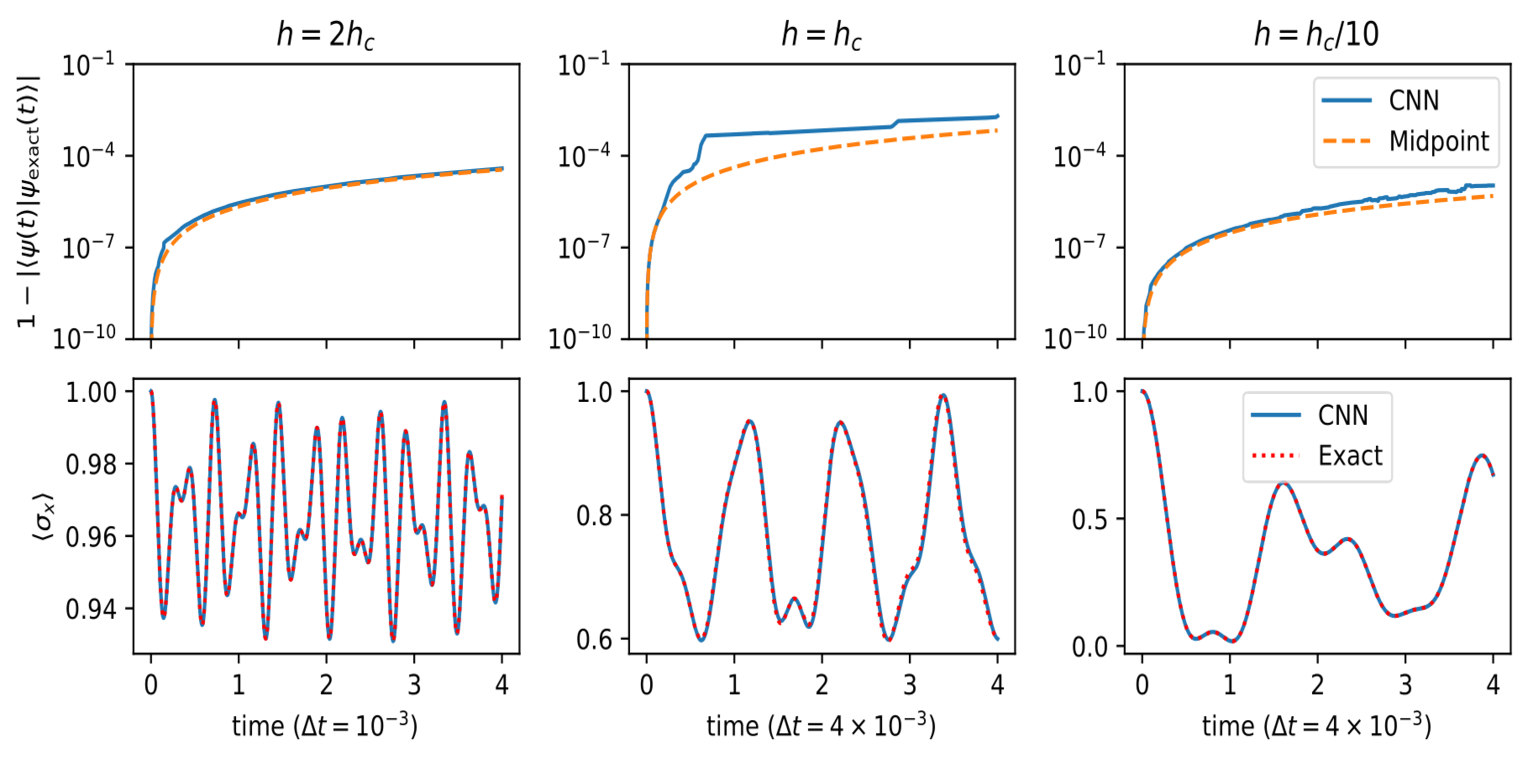
Featured image: Overlap error (top row) and transverse magnetization (bottom row) of the real time evolution governed by the Ising Hamiltonian on a 3 × 3 lattice after a quench of h. Each column corresponds to a different value of h after the quench, starting from “infinite” h.
Popular summary
In this work, we approach the problem using machine learning methods, as proposed in [Carleo and Troyer, Science 355, 602-606 (2017)]. The statevector is approximated by a neural network, and the time evolution of the system is realized by changes in the network parameters. Our main contribution is a translation of well-established numerical integration methods to the optimization of the network weights. We construct a cost function based on the implicit midpoint method as a concrete example, and minimize it with gradient descent. Compared with the previously proposed stochastic reconfiguration method, our approach does not require a possibly ill-conditioned matrix inversion.
The paper describes the mathematical details of the optimization and provides numerical examples of the time dynamics governed by the Ising model, on a 1D lattice with 20 sites and a small 2D lattice. We find the accuracies achieved by our method to be on par with stochastic reconfiguration. The remaining error in the simulations points towards limits of the expressibility of the neural network ansatze themselves, which could be improved in future works.
► BibTeX data
► References
[1] V. Alba and P. Calabrese. Entanglement and thermodynamics after a quantum quench in integrable systems. PNAS, 114: 7947–7951, 2017. 10.1073/pnas.1703516114.
https://doi.org/10.1073/pnas.1703516114
[2] H. W. J. Blöte and Y. Deng. Cluster Monte Carlo simulation of the transverse Ising model. Phys. Rev. E, 66: 066110, 2002. 10.1103/PhysRevE.66.066110.
https://doi.org/10.1103/PhysRevE.66.066110
[3] A. Borin and D. A. Abanin. Approximating power of machine-learning ansatz for quantum many-body states. Phys. Rev. B, 101, 2020. 10.1103/PhysRevB.101.195141.
https://doi.org/10.1103/PhysRevB.101.195141
[4] P. Calabrese and J. Cardy. Evolution of entanglement entropy in one-dimensional systems. J. Stat. Mech.: Theory Exp., 2005: P04010, 2005. 10.1088/1742-5468/2005/04/p04010.
https://doi.org/10.1088/1742-5468/2005/04/p04010
[5] G. Carleo and M. Troyer. Solving the quantum many-body problem with artificial neural networks. Science, 355: 602–606, 2017. 10.1126/science.aag2302.
https://doi.org/10.1126/science.aag2302
[6] G. Carleo, F. Becca, M. Schiró, and M. Fabrizio. Localization and glassy dynamics of many-body quantum systems. Sci. Rep., 2: 243, 2012. 10.1038/srep00243.
https://doi.org/10.1038/srep00243
[7] G. Carleo, F. Becca, L. Sanchez-Palencia, S. Sorella, and M. Fabrizio. Light-cone effect and supersonic correlations in one- and two-dimensional bosonic superfluids. Phys. Rev. A, 89: 031602, 2014. 10.1103/PhysRevA.89.031602.
https://doi.org/10.1103/PhysRevA.89.031602
[8] S. R. Clark. Unifying neural-network quantum states and correlator product states via tensor networks. J. Phys. A Math. Theor., 51: 135301, 2018. 10.1088/1751-8121/aaaaf2.
https://doi.org/10.1088/1751-8121/aaaaf2
[9] S. Czischek, M. Gärttner, and T. Gasenzer. Quenches near Ising quantum criticality as a challenge for artificial neural networks. Phys. Rev. B, 98: 024311, 2018. 10.1103/PhysRevB.98.024311.
https://doi.org/10.1103/PhysRevB.98.024311
[10] A. J. Daley, C. Kollath, U. Schollwöck, and G. Vidal. Time-dependent density-matrix renormalization-group using adaptive effective Hilbert spaces. J. Stat. Mech. Theory Exp., 2004: P04005, 2004. 10.1088/1742-5468/2004/04/p04005.
https://doi.org/10.1088/1742-5468/2004/04/p04005
[11] D. Deng, X. Li, and S. Das Sarma. Quantum entanglement in neural network states. Phys. Rev. X, 7: 021021, 2017. 10.1103/PhysRevX.7.021021.
https://doi.org/10.1103/PhysRevX.7.021021
[12] X. Gao and L.-M. Duan. Efficient representation of quantum many-body states with deep neural networks. Nat. Commun., 8: 662, 2017. 10.1038/s41467-017-00705-2.
https://doi.org/10.1038/s41467-017-00705-2
[13] I. Glasser, N. Pancotti, M. August, I. D. Rodriguez, and J. I. Cirac. Neural-network quantum states, string-bond states, and chiral topological states. Phys. Rev. X, 8: 011006, 2018. 10.1103/PhysRevX.8.011006.
https://doi.org/10.1103/PhysRevX.8.011006
[14] E. Hairer, C. Lubich, and G. Wanner. Geometric Numerical Integration. Structure-Preserving Algorithms for Ordinary Differential Equations. Springer-Verlag Berlin Heidelberg, 2006. 10.1007/3-540-30666-8.
https://doi.org/10.1007/3-540-30666-8
[15] A. Hirose. Complex-Valued Neural Networks. Springer-Verlag Berlin Heidelberg, 2012. 10.1007/978-3-642-27632-3.
https://doi.org/10.1007/978-3-642-27632-3
[16] M. Hochbruck and C. Lubich. Error analysis of Krylov methods in a nutshell. SIAM J. Sci. Comput., 19 (2): 695–701, 1998. 10.1137/S1064827595290450.
https://doi.org/10.1137/S1064827595290450
[17] R. Kaubruegger, L. Pastori, and J. C. Budich. Chiral topological phases from artificial neural networks. Phys. Rev. B, 97: 195136, 2018. 10.1103/PhysRevB.97.195136.
https://doi.org/10.1103/PhysRevB.97.195136
[18] D. P. Kingma and J. Ba. Adam: A method for stochastic optimization. In 3rd International Conference for Learning Representations, San Diego, 2015.
[19] Y. Levine, O. Sharir, N. Cohen, and A. Shashua. Quantum entanglement in deep learning architectures. Phys. Rev. Lett., 122: 065301, 2019. 10.1103/PhysRevLett.122.065301.
https://doi.org/10.1103/PhysRevLett.122.065301
[20] J. Liesen and P. Tichý. Convergence analysis of Krylov subspace methods. GAMM-Mitteilungen, 27: 153–173, 2004. 10.1002/gamm.201490008.
https://doi.org/10.1002/gamm.201490008
[21] Y. Nomura, A. S. Darmawan, Y. Yamaji, and M. Imada. Restricted Boltzmann machine learning for solving strongly correlated quantum systems. Phys. Rev. B, 96: 205152, 2017. 10.1103/PhysRevB.96.205152.
https://doi.org/10.1103/PhysRevB.96.205152
[22] L. Pastori, R. Kaubruegger, and J. C. Budich. Generalized transfer matrix states from artificial neural networks. Phys. Rev. B, 99: 165123, 2019. 10.1103/PhysRevB.99.165123.
https://doi.org/10.1103/PhysRevB.99.165123
[23] D. Poulin, A. Qarry, R. Somma, and F. Verstraete. Quantum simulation of time-dependent Hamiltonians and the convenient illusion of Hilbert space. Phys. Rev. Lett., 106: 170501, 2011. 10.1103/PhysRevLett.106.170501.
https://doi.org/10.1103/PhysRevLett.106.170501
[24] M. Schmitt and M. Heyl. Quantum dynamics in transverse-field Ising models from classical networks. SciPost Phys., 4: 013, 2018. 10.21468/SciPostPhys.4.2.013.
https://doi.org/10.21468/SciPostPhys.4.2.013
[25] M. Schmitt and M. Heyl. Quantum many-body dynamics in two dimensions with artificial neural networks. Phys. Rev. Lett., 125: 100503, 2020. 10.1103/PhysRevLett.125.100503.
https://doi.org/10.1103/PhysRevLett.125.100503
[26] U. Schollwöck. The density-matrix renormalization group. Rev. Mod. Phys., 77: 259–315, 2005. 10.1103/RevModPhys.77.259.
https://doi.org/10.1103/RevModPhys.77.259
[27] U. Schollwöck. The density-matrix renormalization group in the age of matrix product states. Ann. Phys., 326: 96–192, 2011. 10.1016/j.aop.2010.09.012.
https://doi.org/10.1016/j.aop.2010.09.012
[28] A. Shrestha and A. Mahmood. Review of deep learning algorithms and architectures. IEEE Access, 7: 53040–53065, 2019. 10.1109/ACCESS.2019.2912200.
https://doi.org/10.1109/ACCESS.2019.2912200
[29] S. Sorella. Generalized Lanczos algorithm for variational quantum Monte Carlo. Phys. Rev. B, 64: 024512, 2001. 10.1103/PhysRevB.64.024512.
https://doi.org/10.1103/PhysRevB.64.024512
[30] S. Suzuki, J. Inoue, and B. K. Chakrabarti. Quantum Ising Phases and Transitions in Transverse Ising Models. Springer, Berlin, Heidelberg, 2013. ISBN 978-3-642-33039-1. 10.1007/978-3-642-33039-1.
https://doi.org/10.1007/978-3-642-33039-1
[31] C. Trabelsi, O. Bilaniuk, Y. Zhang, D. Serdyuk, S. Subramanian, J. F. Santos, S. Mehri, N. Rostamzadeh, Y. Bengio, and C. J. Pal. Deep complex networks. In International Conference on Learning Representations, 2018. URL https://openreview.net/forum?id=H1T2hmZAb.
https://openreview.net/forum?id=H1T2hmZAb
[32] V. N. Vapnik. An overview of statistical learning theory. IEEE Trans. Neural Netw., 10: 988–999, 1999. 10.1109/72.788640.
https://doi.org/10.1109/72.788640
[33] G. Vidal. Efficient simulation of one-dimensional quantum many-body systems. Phys. Rev. Lett., 93: 040502, 2004. 10.1103/PhysRevLett.93.040502.
https://doi.org/10.1103/PhysRevLett.93.040502
[34] S. R. White and A. E. Feiguin. Real-time evolution using the density matrix renormalization group. Phys. Rev. Lett., 93: 076401, 2004. 10.1103/PhysRevLett.93.076401.
https://doi.org/10.1103/PhysRevLett.93.076401
Cited by
[1] Xiaogang Li, Kecheng Liu, and Qi-Ming Ding, "Simulating arbitrary non-Hermitian dynamics via a quantum circuit Monte Carlo method", Physical Review A 114 3, 032602 (2026).
[2] John M. Martyn, Khadijeh Najafi, and Di Luo, "Variational Neural-Network Ansatz for Continuum Quantum Field Theory", Physical Review Letters 131 8, 081601 (2023).
[3] Jannes Nys, Gabriel Pescia, Alessandro Sinibaldi, and Giuseppe Carleo, "Ab-initio variational wave functions for the time-dependent many-electron Schrödinger equation", Nature Communications 15 1, 9404 (2024).
[4] Vinit Singh, Amandeep Singh Bhatia, Mandeep Kaur Saggi, Manas Sajjan, and Sabre Kais, "Quantum machine learning for complex systems: paradigms, applications, and challenges", Academia Quantum 3 2(2026).
[5] Joseph Tindall, Antonio Francesco Mello, Matthew Fishman, E. Miles Stoudenmire, and Dries Sels, "Dynamics of disordered quantum systems with two- and three-dimensional tensor networks", Science 392 6800, 868 (2026).
[6] Markus Schmitt and Moritz Reh, "jVMC: Versatile and performant variational Monte Carlo leveraging automated differentiation and GPU acceleration", SciPost Physics Codebases 2 (2022).
[7] S. J. Thomson and J. Eisert, "Unravelling quantum dynamics using flow equations", Nature Physics 20 9, 1401 (2024).
[8] Liam Bernheimer, Hristiana Atanasova, and Guy Cohen, "Determinant- and derivative-free quantum Monte Carlo within the stochastic representation of wavefunctions", Reports on Progress in Physics 87 11, 118001 (2024).
[9] Jie Liu and Xin Wang, "Hamiltonian learning via inverse physics-informed neural networks", Physical Review Research 7 4, 043137 (2025).
[10] Zheyu Wu, Remmy Zen, Heitor P. Casagrande, Dario Poletti, and Stéphane Bressan, "Supervised training of neural-network quantum states for the next-nearest neighbor Ising model", Computer Physics Communications 300, 109169 (2024).
[11] Claudia Artiaco, Christoph Fleckenstein, David Aceituno Chávez, Thomas Klein Kvorning, and Jens H. Bardarson, "Efficient Large-Scale Many-Body Quantum Dynamics via Local-Information Time Evolution", PRX Quantum 5 2, 020352 (2024).
[12] Ryui Kaneko and Ippei Danshita, "Dynamics of correlation spreading in low-dimensional transverse-field Ising models", Physical Review A 108 2, 023301 (2023).
[13] Alessandro Sinibaldi, Douglas Hendry, Filippo Vicentini, and Giuseppe Carleo, "Time-Dependent Neural Galerkin Method for Quantum Dynamics", Physical Review Letters 136 12, 120402 (2026).
[14] Shaojun Gui, Tak-San Ho, and Herschel Rabitz, "Discrete real-time learning of quantum-state subspace evolution of many-body systems in the presence of time-dependent control fields", Physical Review A 110 5, 052412 (2024).
[15] Douglas Hendry, Alessandro Sinibaldi, and Giuseppe Carleo, "Grassmann variational Monte Carlo with neural wave functions", Physical Review B 114 13, 134404 (2026).
[16] Debanjan Konar, Dheeraj Peddireddy, Bijaya K. Panigrahi, and Vaneet Aggarwal, "Tensor ring optimized quantum-enhanced tensor neural networks", Quantum Machine Intelligence 7 1, 57 (2025).
[17] Damian Hofmann, Giammarco Fabiani, Johan Mentink, Giuseppe Carleo, and Michael Sentef, "Role of stochastic noise and generalization error in the time propagation of neural-network quantum states", SciPost Physics 12 5, 165 (2022).
[18] Wenxuan Zhang, Xiansong Xu, Zheyu Wu, Vinitha Balachandran, and Dario Poletti, "Ground state search by local and sequential updates of neural network quantum states", Physical Review B 107 16, 165149 (2023).
[19] Roger G. Melko and Juan Carrasquilla, "Language models for quantum simulation", Nature Computational Science 4 1, 11 (2024).
[20] Thomas Spriggs, Arash Ahmadi, Bokai Chen, and Eliska Greplova, "Quantum resources of quantum and classical variational methods", Machine Learning: Science and Technology 6 1, 015042 (2025).
[21] Vladimir Vargas-Calderón, Herbert Vinck-Posada, and Fabio A. González, "An empirical study of quantum dynamics as a ground state problem with neural quantum states", Quantum Information Processing 22 4, 165 (2023).
[22] Simon Elias Schrader, Håkon Emil Kristiansen, Thomas Bondo Pedersen, and Simen Kvaal, "Time evolution as an optimization problem: The hydrogen atom in strong laser fields in a basis of time-dependent Gaussian wave packets", The Journal of Chemical Physics 161 4, 044105 (2024).
[23] Di Luo, David D. Dai, and Liang Fu, "Pairing-based graph neural network for simulating quantum materials", Physical Review B 113 16, 165107 (2026).
[24] Filippo Vicentini, Damian Hofmann, Attila Szabó, Dian Wu, Christopher Roth, Clemens Giuliani, Gabriel Pescia, Jannes Nys, Vladimir Vargas-Calderón, Nikita Astrakhantsev, and Giuseppe Carleo, "NetKet 3: Machine Learning Toolbox for Many-Body Quantum Systems", SciPost Physics Codebases 7 (2022).
[25] Daming Li, "Variational Methods for Solving High-Dimensional Quantum Systems", Journal of Modern Physics 16 05, 686 (2025).
[26] Alexander Zaytsev, Darya Zaytseva, Sergey Zaytsev, Lorenzo Ugo Ancarani, Yury Popov, and Konstantin Kouzakov, "Parabolic wave packets for time propagation of atomic hydrogen in an electric field of short laser pulses", The European Physical Journal Plus 139 2, 199 (2024).
[27] Jannes Nys, Zakari Denis, and Giuseppe Carleo, "Real-time quantum dynamics of thermal states with neural thermofields", Physical Review B 109 23, 235120 (2024).
[28] Di Luo, Zhuo Chen, Kaiwen Hu, Zhizhen Zhao, Vera Mikyoung Hur, and Bryan K. Clark, "Gauge-invariant and anyonic-symmetric autoregressive neural network for quantum lattice models", Physical Review Research 5 1, 013216 (2023).
[29] Yantao Wu and Jannes Nys, "Real-Time Dynamics in Two Dimensions with Tensor Network States via Time-Dependent Variational Monte Carlo Method", PRX Quantum 7 3, 033035 (2026).
[30] Matija Medvidović, Alev Orfi, Juan Carrasquilla, and Dries Sels, "Adiabatic Transport of Neural Network Quantum States", PRX Intelligence 1 1, 013020 (2026).
[31] Mingshu Zhao and Zhanyuan Yan, "Interpretable neural network quantum states for solving the steady states of the nonlinear Schrödinger equation", Chaos: An Interdisciplinary Journal of Nonlinear Science 35 11, 113122 (2025).
[32] Bizi Huang, Weizhong Fu, and Ji Chen, "Stochastic representation of time-evolving neural network-based wavefunctions", The Journal of Chemical Physics 163 24, 244107 (2025).
[33] Wenxuan Zhang, Bo Xing, Xiansong Xu, and Dario Poletti, "Paths towards time evolution with larger neural-network quantum states", Computer Physics Communications 312, 109577 (2025).
[34] Zhou-Quan Wan, Roeland Wiersema, and Shiwei Zhang, "Removing Nodal and Support-Mismatch Pathologies in Variational Monte Carlo via Blurred Sampling", Physical Review X 16 3, 031059 (2026).
[35] Kaelan Donatella, Zakari Denis, Alexandre Le Boité, and Cristiano Ciuti, "Dynamics with autoregressive neural quantum states: Application to critical quench dynamics", Physical Review A 108 2, 022210 (2023).
[36] Wladislaw Krinitsin, Niklas Tausendpfund, Markus Heyl, Matteo Rizzi, and Markus Schmitt, "Time evolution of the quantum Ising model in two dimensions using tree tensor networks", Physical Review B 112 13, 134310 (2025).
[37] Tim S Hindges, Wenhao He, and Ju Li, "Recent advances in electronic structure learning", Modelling and Simulation in Materials Science and Engineering 34 5, 053001 (2026).
[38] Eimantas Ledinauskas and Egidijus Anisimovas, "Scalable imaginary time evolution with neural network quantum states", SciPost Physics 15 6, 229 (2023).
[39] Tanja Đurić, Jia Hui Chung, Bo Yang, and Pinaki Sengupta, "Spin- 1/2 Kagome Heisenberg Antiferromagnet: Machine Learning Discovery of the Spinon Pair-Density-Wave Ground State", Physical Review X 15 1, 011047 (2025).
[40] Pascal M. Vecsei, Christian Flindt, and Jose L. Lado, "Lee-Yang theory of quantum phase transitions with neural network quantum states", Physical Review Research 5 3, 033116 (2023).
[41] Jan-Niklas Herre, Qiyu Liu, Roman Rausch, Christoph Karrasch, and Dante M. Kennes, "Investigating Stark many-body localization with continuous unitary transformation flows", Physical Review Research 7 3, 033047 (2025).
[42] Matija Medvidović and Javier Robledo Moreno, "Neural-network quantum states for many-body physics", The European Physical Journal Plus 139 7, 631 (2024).
[43] Yaofeng Chen and Li You, "Optimal Control of Unknown Collective Spin Systems via a Neural Network Surrogate", Chinese Physics Letters 42 10, 100601 (2025).
[44] Aaron Sander, Lukas Burgholzer, and Robert Wille, 2023 IEEE International Conference on Quantum Computing and Engineering (QCE) 283 (2023) ISBN:979-8-3503-4323-6.
[45] Luca Gravina, Vincenzo Savona, and Filippo Vicentini, "Neural Projected Quantum Dynamics: a systematic study", Quantum 9, 1803 (2025).
[46] Hannah Lange, Anka Van de Walle, Atiye Abedinnia, and Annabelle Bohrdt, "From architectures to applications: a review of neural quantum states", Quantum Science and Technology 9 4, 040501 (2024).
[47] Andrew D. King, Alberto Nocera, Marek M. Rams, Jacek Dziarmaga, Roeland Wiersema, William Bernoudy, Jack Raymond, Nitin Kaushal, Niclas Heinsdorf, Richard Harris, Kelly Boothby, Fabio Altomare, Mohsen Asad, Andrew J. Berkley, Martin Boschnak, Kevin Chern, Holly Christiani, Samantha Cibere, Jake Connor, Martin H. Dehn, Rahul Deshpande, Sara Ejtemaee, Pau Farre, Kelsey Hamer, Emile Hoskinson, Shuiyuan Huang, Mark W. Johnson, Samuel Kortas, Eric Ladizinsky, Trevor Lanting, Tony Lai, Ryan Li, Allison J. R. MacDonald, Gaelen Marsden, Catherine C. McGeoch, Reza Molavi, Travis Oh, Richard Neufeld, Mana Norouzpour, Joel Pasvolsky, Patrick Poitras, Gabriel Poulin-Lamarre, Thomas Prescott, Mauricio Reis, Chris Rich, Mohammad Samani, Benjamin Sheldan, Anatoly Smirnov, Edward Sterpka, Berta Trullas Clavera, Nicholas Tsai, Mark Volkmann, Alexander M. Whiticar, Jed D. Whittaker, Warren Wilkinson, Jason Yao, T. J. Yi, Anders W. Sandvik, Gonzalo Alvarez, Roger G. Melko, Juan Carrasquilla, Marcel Franz, and Mohammad H. Amin, "Beyond-classical computation in quantum simulation", Science 388 6743, 199 (2025).
[48] Victor Wei, W. A. Coish, Pooya Ronagh, and Christine A. Muschik, "Neural-shadow quantum state tomography", Physical Review Research 6 2, 023250 (2024).
[49] Saeed S. Jahromi and Román Orús, "Variational tensor neural networks for deep learning", Scientific Reports 14 1, 19017 (2024).
[50] Ilaria Gianani and Claudia Benedetti, "Multiparameter estimation of continuous-time quantum walk Hamiltonians through machine learning", AVS Quantum Science 5 1, 014405 (2023).
[51] Kévin Hémery, Khaldoon Ghanem, Eleanor Crane, Sara L. Campbell, Joan M. Dreiling, Caroline Figgatt, Cameron Foltz, John P. Gaebler, Jacob Johansen, Michael Mills, Steven A. Moses, Juan M. Pino, Anthony Ransford, Mary Rowe, Peter Siegfried, Russell P. Stutz, Henrik Dreyer, Alexander Schuckert, and Ramil Nigmatullin, "Measuring the Loschmidt Amplitude for Finite-Energy Properties of the Fermi-Hubbard Model on an Ion-Trap Quantum Computer", PRX Quantum 5 3, 030323 (2024).
[52] Agnes Valenti, Guliuxin Jin, Julian Léonard, Sebastian D. Huber, and Eliska Greplova, "Scalable Hamiltonian learning for large-scale out-of-equilibrium quantum dynamics", Physical Review A 105 2, 023302 (2022).
[53] Kevin Slagle, "Quantum Gauge Networks: A New Kind of Tensor Network", Quantum 7, 1113 (2023).
[54] Raffaele Salioni, Rocco Martinazzo, Davide Emilio Galli, and Christian Apostoli, "Adaptive quantum dynamics with the time-dependent variational Monte Carlo method", Physical Review B 113 1, 014408 (2026).
[55] Han-Qing Shi and Hai-Qing Zhang, "Learning topological defects formation with neural networks in a quantum phase transition", Communications in Theoretical Physics 76 5, 055101 (2024).
[56] Moritz Reh, Markus Schmitt, and Martin Gärttner, "Optimizing design choices for neural quantum states", Physical Review B 107 19, 195115 (2023).
[57] Kevin Slagle and John Preskill, "Emergent quantum mechanics at the boundary of a local classical lattice model", Physical Review A 108 1, 012217 (2023).
[58] Naeimeh Mohseni, Thomas Fösel, Lingzhen Guo, Carlos Navarrete-Benlloch, and Florian Marquardt, "Deep Learning of Quantum Many-Body Dynamics via Random Driving", Quantum 6, 714 (2022).
[59] Shaojun Gui, Tak-San Ho, and Herschel Rabitz, "Control simulations of many-body quantum systems by a synergism of discrete real-time learning and optimal control theory", The Journal of Chemical Physics 163 10, 104108 (2025).
[60] Anka Van de Walle, Markus Schmitt, and Annabelle Bohrdt, "Many-body dynamics with explicitly time-dependent neural quantum states", Machine Learning: Science and Technology 6 4, 045011 (2025).
[61] Tianchen Zhao, Chuhao Sun, Asaf Cohen, James Stokes, and Shravan Veerapaneni, "Quantum-inspired variational algorithms for partial differential equations: application to financial derivative pricing", Quantitative Finance 24 1, 1 (2024).
[62] Yantao Wu and Wen-Yuan Liu, "Accurate Gauge-Invariant Tensor-Network Simulations for Abelian Lattice Gauge Theory in (2+1)D : Ground-State and Real-Time Dynamics", Physical Review Letters 135 13, 130401 (2025).
[63] Ruiyang Zhou and Abolfazl Bayat, 2025 7th International Conference on Intelligent Autonomous Systems (ICoIAS) 7 (2025) ISBN:979-8-3315-9013-0.
[64] Alessandro Sinibaldi, Clemens Giuliani, Giuseppe Carleo, and Filippo Vicentini, "Unbiasing time-dependent Variational Monte Carlo by projected quantum evolution", Quantum 7, 1131 (2023).
[65] Markus Schmitt and Markus Heyl, "Quantum Many-Body Dynamics in Two Dimensions with Artificial Neural Networks", Physical Review Letters 125 10, 100503 (2020).
[66] Anna Dawid, Julian Arnold, Borja Requena, Alexander Gresch, Marcin Płodzień, Kaelan Donatella, Kim A. Nicoli, Paolo Stornati, Rouven Koch, Miriam Büttner, Robert Okuła, Gorka Muñoz-Gil, Rodrigo A. Vargas-Hernández, Alba Cervera-Lierta, Juan Carrasquilla, Vedran Dunjko, Marylou Gabrié, Patrick Huembeli, Evert van Nieuwenburg, Filippo Vicentini, Lei Wang, Sebastian J. Wetzel, Giuseppe Carleo, Eliška Greplová, Roman Krems, Florian Marquardt, Michał Tomza, Maciej Lewenstein, and Alexandre Dauphin, "Modern applications of machine learning in quantum sciences", arXiv:2204.04198, (2022).
[67] Di Luo, Zhuo Chen, Juan Carrasquilla, and Bryan K. Clark, "Autoregressive Neural Network for Simulating Open Quantum Systems via a Probabilistic Formulation", Physical Review Letters 128 9, 090501 (2022).
[68] Benedikt Kloss, David Reichman, and Yevgeny Bar Lev, "Studying dynamics in two-dimensional quantum lattices using tree tensor network states", SciPost Physics 9 5, 070 (2020).
[69] Sheng-Hsuan Lin and Frank Pollmann, "Scaling of Neural-Network Quantum States for Time Evolution", Physica Status Solidi B Basic Research 259 5, 2100172 (2022).
[70] Di Luo and James Halverson, "Infinite neural network quantum states: entanglement and training dynamics", Machine Learning: Science and Technology 4 2, 025038 (2023).
[71] Christopher Orthodoxou, Amelle Zaïr, and George H. Booth, "High harmonic generation in two-dimensional Mott insulators", npj Quantum Materials 6 1, 76 (2021).
[72] Zhuo Chen, Di Luo, Kaiwen Hu, and Bryan K. Clark, "Simulating 2+1D Lattice Quantum Electrodynamics at Finite Density with Neural Flow Wavefunctions", arXiv:2212.06835, (2022).
[73] Chee Kong Lee, Pranay Patil, Shengyu Zhang, and Chang Yu Hsieh, "Neural-network variational quantum algorithm for simulating many-body dynamics", Physical Review Research 3 2, 023095 (2021).
[74] David R. Vivas, Javier Madroñero, Victor Bucheli, Luis O. Gómez, and John H. Reina, "Neural-Network Quantum States: A Systematic Review", arXiv:2204.12966, (2022).
[75] Benedikt Fauseweh and Jian-Xin Zhu, "Laser pulse driven control of charge and spin order in the two-dimensional Kondo lattice", Physical Review B 102 16, 165128 (2020).
[76] Roberto Verdel, Markus Schmitt, Yi-Ping Huang, Petr Karpov, and Markus Heyl, "Variational classical networks for dynamics in interacting quantum matter", Physical Review B 103 16, 165103 (2021).
[77] Di Luo, Aidan P. Reddy, Trithep Devakul, and Liang Fu, "Artificial intelligence for artificial materials: moiré atom", arXiv:2303.08162, (2023).
[78] Chu Guo and Dario Poletti, "Scheme for automatic differentiation of complex loss functions with applications in quantum physics", Physical Review E 103 1, 013309 (2021).
[79] I. Meyerov, A. Liniov, M. Ivanchenko, and S. Denisov, "Simulating quantum dynamics: Evolution of algorithms in the HPC context", arXiv:2005.04681, (2020).
[80] Stefano De Nicola, "Importance sampling scheme for the stochastic simulation of quantum spin dynamics", SciPost Physics 11 3, 048 (2021).
[81] Awwab A. Azam, Lexu Zhao, and Jiabin Yu, "Reduced Density Matrices Through Machine Learning", arXiv:2511.07367, (2025).
[82] Kevin Slagle, "Testing Quantum Mechanics using Noisy Quantum Computers", arXiv:2108.02201, (2021).
[83] Hrvoje Vrcan and Johan H. Mentink, "Instability of explicit time integration for strongly quenched dynamics with neural quantum states", arXiv:2507.17421, (2025).
[84] Rouven Koch and Jose L. Lado, "Neural network enhanced hybrid quantum many-body dynamical distributions", Physical Review Research 3 3, 033102 (2021).
[85] Eddy de Leon and Caroline Lasser, "Residual-Based Time Discretization on Nonlinear Approximation Manifolds: Analysis and Gaussian Applications", arXiv:2607.15086, (2026).
[86] Markus Schmitt and Moritz Reh, "jVMC: Versatile and performant variational Monte Carlo leveraging automated differentiation and GPU acceleration", arXiv:2108.03409, (2021).
[87] Tak Hur, "Stochastic Reconfiguration as Statistical Filtering for Overparameterized Neural Quantum States", arXiv:2609.23334, (2026).
The above citations are from Crossref's cited-by service (last updated successfully 2026-10-27 19:24:15) and SAO/NASA ADS (last updated successfully 2026-10-27 19:24:16). The list may be incomplete as not all publishers provide suitable and complete citation data.
This Paper is published in Quantum under the Creative Commons Attribution 4.0 International (CC BY 4.0) license. Copyright remains with the original copyright holders such as the authors or their institutions.