
No-free-information principle in general probabilistic theories
1QTF Centre of Excellence, Department of Physics and Astronomy, University of Turku, Turku 20014, Finland
2Mathematical Institute, Slovak Academy of Sciences, Štefánikova 49, Bratislava, Slovakia
| Published: | 2019-07-08, volume 3, page 157 |
| Eprint: | arXiv:1808.07376v3 |
| Doi: | https://doi.org/10.22331/q-2019-07-08-157 |
| Citation: | Quantum 3, 157 (2019). |
Find this paper interesting or want to discuss? Scite or leave a comment on SciRate.
Abstract
In quantum theory, the no-information-without-disturbance and no-free-information theorems express that those observables that do not disturb the measurement of another observable and those that can be measured jointly with any other observable must be trivial, i.e., coin tossing observables. We show that in the framework of general probabilistic theories these statements do not hold in general and continue to completely specify these two classes of observables. In this way, we obtain characterizations of the probabilistic theories where these statements hold. As a particular class of state spaces we consider the polygon state spaces, in which we demonstrate our results and show that while the no-information-without-disturbance principle always holds, the validity of the no-free-information principle depends on the parity of the number of vertices of the polygons.

Popular summary
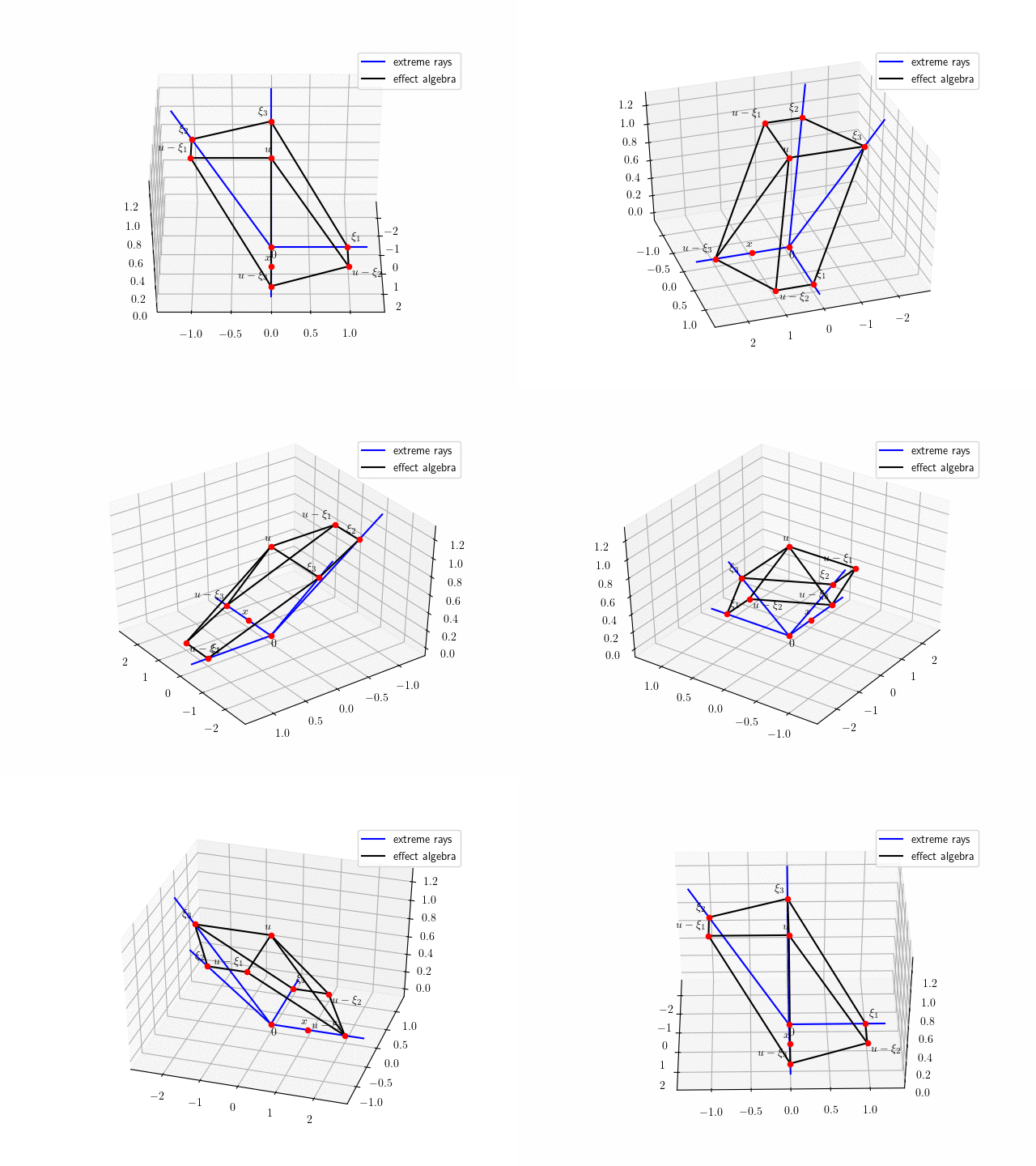
By noting that in quantum theory these principles hold, we formalized this problem in a more general class of theories, namely within the framework of general probabilistic theories (GPTs). These theories form a wide class of operational theories where many of the key features of quantum theory can be formulated more generally. By including both quantum and classical theory, as well as countless toy theories, the study of GPTs allows us to compare these theories based on their respective features and quantify their properties.
In the presented manuscript, we have mathematically characterized the principles in question within the GPT framework, tying our work with previously known results. We show that all three principles are strictly different, which means that there are operationally valid theories (even non-classical theories) where one can obtain non-trivial information about a system without disturbing it and where one can always choose to get some fixed non-trivial information when performing any other measurement. We have presented several examples of theories to demonstrate our claims.
► BibTeX data
► References
[1] H. Barnum, C. M. Caves, C. A. Fuchs, R. Jozsa, and B. Schumacher. Noncommuting mixed states cannot be broadcast. Phys. Rev. Lett., 76: 2818–2821, 1996. 10.1103/PhysRevLett.76.2818.
https://doi.org/10.1103/PhysRevLett.76.2818
[2] P. Busch. ``No Information Without Disturbance": Quantum Limitations of Measurement. In J. Christian and W. Myrvold, editors, Quantum Reality, Relativistic Causality, and Closing the Epistemic Circle. Springer-Verlag, 2009. 10.1007/978-1-4020-9107-0_13.
https://doi.org/10.1007/978-1-4020-9107-0_13
[3] T. Heinosaari and M. Ziman. The Mathematical Language of Quantum Theory. From Uncertainty to Entanglement. Cambridge University Press, 2012. 10.1017/CBO9781139031103.
https://doi.org/10.1017/CBO9781139031103
[4] H. Barnum, J. Barrett, M. Leifer, and A. Wilce. Cloning and Broadcasting in Generic Probabilistic Theories. 2006. URL http://arxiv.org/abs/quant-ph/0611295.
arXiv:quant-ph/0611295
[5] H. Barnum, J. Barrett, M. Leifer, and A. Wilce. Generalized No-broadcasting theorem. Phys. Rev. Lett., 99: 240501, 2007. 10.1103/PhysRevLett.99.240501.
https://doi.org/10.1103/PhysRevLett.99.240501
[6] G. Chiribella, G. M. D'Ariano, and P. Perinotti. Probabilistic theories with purification. Phys. Rev. A, 81: 062348, 2010. 10.1103/PhysRevA.81.062348.
https://doi.org/10.1103/PhysRevA.81.062348
[7] H. Barnum and A. Wilce. Information processing in convex operational theories. Electron. Notes Theor. Comput. Sci., 270: 3–15, 2011. 10.1016/j.entcs.2011.01.002.
https://doi.org/10.1016/j.entcs.2011.01.002
[8] C. Pfister and S. Wehner. An information-theoretic principle implies that any discrete physical theory is classical. Nat. Commun., 4: 1851, 2013. 10.1038/ncomms2821.
https://doi.org/10.1038/ncomms2821
[9] G. C. Wick, A. S. Wightman, and E. P. Wigner. The intrinsic parity of elementary particles. Phys. Rev., 88: 101–105, 1952. 10.1103/PhysRev.88.101.
https://doi.org/10.1103/PhysRev.88.101
[10] G. Kimura, K. Nuida, and H. Imai. Distinguishability measures and entropies for general probabilistic theories. Rep. Math. Phys., 66: 175 – 206, 2010. 10.1016/S0034-4877(10)00025-X.
https://doi.org/10.1016/S0034-4877(10)00025-X
[11] A. J. Short and S. Wehner. Entropy in general physical theories. New J. Phys., 12: 033023, 2010. 10.1088/1367-2630/12/3/033023.
https://doi.org/10.1088/1367-2630/12/3/033023
[12] I. Namioka and R. Phelps. Tensor products of compact convex sets. Pacific J. Math., 31: 469–480, 1969. 10.2140/pjm.1969.31.469.
https://doi.org/10.2140/pjm.1969.31.469
[13] S. N. Filippov, T. Heinosaari, and L. Leppäjärvi. Necessary condition for incompatibility of observables in general probabilistic theories. Phys. Rev. A, 95: 032127, 2017. 10.1103/PhysRevA.95.032127.
https://doi.org/10.1103/PhysRevA.95.032127
[14] T. Heinosaari and T. Miyadera. Incompatibility of quantum channels. J. Phys. A. Math. Gen., 50: 135302, 2017. 10.1088/1751-8121/aa5f6b.
https://doi.org/10.1088/1751-8121/aa5f6b
[15] J. Barrett, N. Linden, S. Massar, S. Pironio, S. Popescu, and D. Roberts. Nonlocal correlations as an information-theoretic resource. Phys. Rev. A, 71: 022101, 2005. 10.1103/PhysRevA.71.022101.
https://doi.org/10.1103/PhysRevA.71.022101
[16] L. Guerini, J. Bavaresco, M. T. Cunha, and A. Acín. Operational framework for quantum measurement simulability. J. Math. Phys., 58: 092102, 2017. 10.1063/1.4994303.
https://doi.org/10.1063/1.4994303
[17] M. Oszmaniec, L. Guerini, P. Wittek, and A. Acín. Simulating Positive-Operator-Valued Measures with Projective Measurements. Phys. Rev. Lett., 119: 190501, 2017. 10.1103/PhysRevLett.119.190501.
https://doi.org/10.1103/PhysRevLett.119.190501
[18] S. N. Filippov, T. Heinosaari, and L. Leppäjärvi. Simulability of observables in general probabilistic theories. Phys. Rev. A, 97: 062102, 2018. 10.1103/PhysRevA.97.062102.
https://doi.org/10.1103/PhysRevA.97.062102
[19] M. Oszmaniec, F. B. Maciejewski, and Z. Puchała. All quantum measurements can be simulated using projective measurements and postselection. 2018. URL http://arxiv.org/abs/1807.08449.
arXiv:1807.08449
[20] M. Plávala. All measurements in a probabilistic theory are compatible if and only if the state space is a simplex. Phys. Rev. A, 94: 042108, 2016. 10.1103/PhysRevA.94.042108.
https://doi.org/10.1103/PhysRevA.94.042108
[21] P. Janotta, C. Gogolin, J. Barrett, and N. Brunner. Limits on nonlocal correlations from the structure of the local state space. New J. Phys., 13: 063024, 2011. 10.1088/1367-2630/13/6/063024.
https://doi.org/10.1088/1367-2630/13/6/063024
[22] R. T. Rockafellar. Convex Analysis. Princeton Landmarks in Mathematics and Physics. Princeton University Press, 1997.
Cited by
[1] Thomas D. Galley, Flaminia Giacomini, and John H. Selby, "A no-go theorem on the nature of the gravitational field beyond quantum theory", Quantum 6, 779 (2022).
[2] Teiko Heinosaari, Anna Jenčová, and Martin Plávala, "Dispensing of quantum information beyond no-broadcasting theorem—is it possible to broadcast anything genuinely quantum?", Journal of Physics A: Mathematical and Theoretical 56 13, 135301 (2023).
[3] Pauli Jokinen, Mirjam Weilenmann, Martin Plávala, Juha-Pekka Pellonpää, Jukka Kiukas, and Roope Uola, "No-Broadcasting Characterizes Operational Contextuality", Physical Review Letters 133 24, 240201 (2024).
[4] Davide Rolino, Marco Erba, Alessandro Tosini, and Paolo Perinotti, "Minimal operational theories: classical theories with quantum features", New Journal of Physics 27 2, 023004 (2025).
[5] Thomas D. Galley, Flaminia Giacomini, and John H. Selby, "Any consistent coupling between classical gravity and quantum matter is fundamentally irreversible", Quantum 7, 1142 (2023).
[6] Thomas D. Galley and Lluis Masanes, "How dynamics constrains probabilities in general probabilistic theories", Quantum 5, 457 (2021).
[7] Giacomo Mauro D'Ariano, Paolo Perinotti, and Alessandro Tosini, "Information and disturbance in operational probabilistic theories", Quantum 4, 363 (2020).
[8] Tim Achenbach, Andreas Bluhm, Leevi Leppäjärvi, Ion Nechita, and Martin Plávala, "Factorization of multimeters: a unified view on nonclassical quantum phenomena", Letters in Mathematical Physics 116 3, 56 (2026).
[9] Teiko Heinosaari and Leevi Leppäjärvi, "Random access test as an identifier of nonclassicality* ", Journal of Physics A: Mathematical and Theoretical 55 17, 174003 (2022).
[10] John H. Selby, David Schmid, Elie Wolfe, Ana Belén Sainz, Ravi Kunjwal, and Robert W. Spekkens, "Accessible fragments of generalized probabilistic theories, cone equivalence, and applications to witnessing nonclassicality", Physical Review A 107 6, 062203 (2023).
[11] Ludovico Lami, Daniel Goldwater, and Gerardo Adesso, "A post-quantum associative memory", Journal of Physics A: Mathematical and Theoretical 56 45, 455304 (2023).
[12] Abraham Westerbaan, Bas Westerbaan, and John van de Wetering, "The three types of normal sequential effect algebras", Quantum 4, 378 (2020).
[13] Paulo J Cavalcanti, John H Selby, Jamie Sikora, and Ana Belén Sainz, "Decomposing all multipartite non-signalling channels via quasiprobabilistic mixtures of local channels in generalised probabilistic theories", Journal of Physics A: Mathematical and Theoretical 55 40, 404001 (2022).
[14] Martin Plávala and Matthias Kleinmann, "Generalized dynamical theories in phase space and the hydrogen atom", Physical Review A 108 5, 052212 (2023).
[15] Marco Erba, Paolo Perinotti, Davide Rolino, and Alessandro Tosini, "Measurement incompatibility is strictly stronger than disturbance", Physical Review A 109 2, 022239 (2024).
[16] Teiko Heinosaari, Leevi Leppäjärvi, and Martin Plávala, "Encoding and decoding of information in general probabilistic theories", International Journal of Quantum Information 22 05, 2440007 (2024).
[17] Sergey N. Filippov, Stan Gudder, Teiko Heinosaari, and Leevi Leppäjärvi, "Operational Restrictions in General Probabilistic Theories", Foundations of Physics 50 8, 850 (2020).
[18] Martin Plávala, "General probabilistic theories: An introduction", Physics Reports 1033, 1 (2023).
[19] Kim Vallée and Damian Markham, "Formalizing contextuality in sequential scenarios", arXiv:2509.14125, (2025).
The above citations are from Crossref's cited-by service (last updated successfully 2026-07-15 07:40:14) and SAO/NASA ADS (last updated successfully 2026-07-14 18:50:48). The list may be incomplete as not all publishers provide suitable and complete citation data.
Could not fetch ADS cited-by data during last attempt 2026-07-15 07:40:14: Cannot retrieve data from ADS due to rate limitations.
This Paper is published in Quantum under the Creative Commons Attribution 4.0 International (CC BY 4.0) license. Copyright remains with the original copyright holders such as the authors or their institutions.
Pingback: Perspective in Quantum Views by Marius Krumm "What can we learn from trivial measurements?"