
Post-selection games
1Departamento de Física Teórica, Atómica y Óptica, Universidad de Valladolid, 47011 Valladolid, Spain
2Laboratory for Disruptive Interdisciplinary Science (LaDIS), Universidad de Valladolid, 47011 Valladolid, Spain.
| Published: | 2026-11-05, volume 10, page 2259 |
| Editor: | Ravi Kunjwal |
| Eprint: | arXiv:2601.18861v3 |
| Doi: | https://doi.org/10.22331/q-2026-11-05-2259 |
| Citation: | Quantum 10, 2259 (2026). |
Find this paper interesting or want to discuss? Scite or leave a comment on SciRate.
Abstract
In this paper, we introduce post-selection games, a generalization of nonlocal games where each round can be not only won or lost by the players, but also discarded by the referee. Such games naturally formalize possibilistic proofs of nonlocality, such as Hardy's paradox. We develop algorithms for computing the local and Tsirelson bounds of post-selection games. Furthermore, we show that they have an unbounded advantage in statistical power over traditional nonlocal games, making them ideally suited for analysing Bell tests with low detection efficiency.
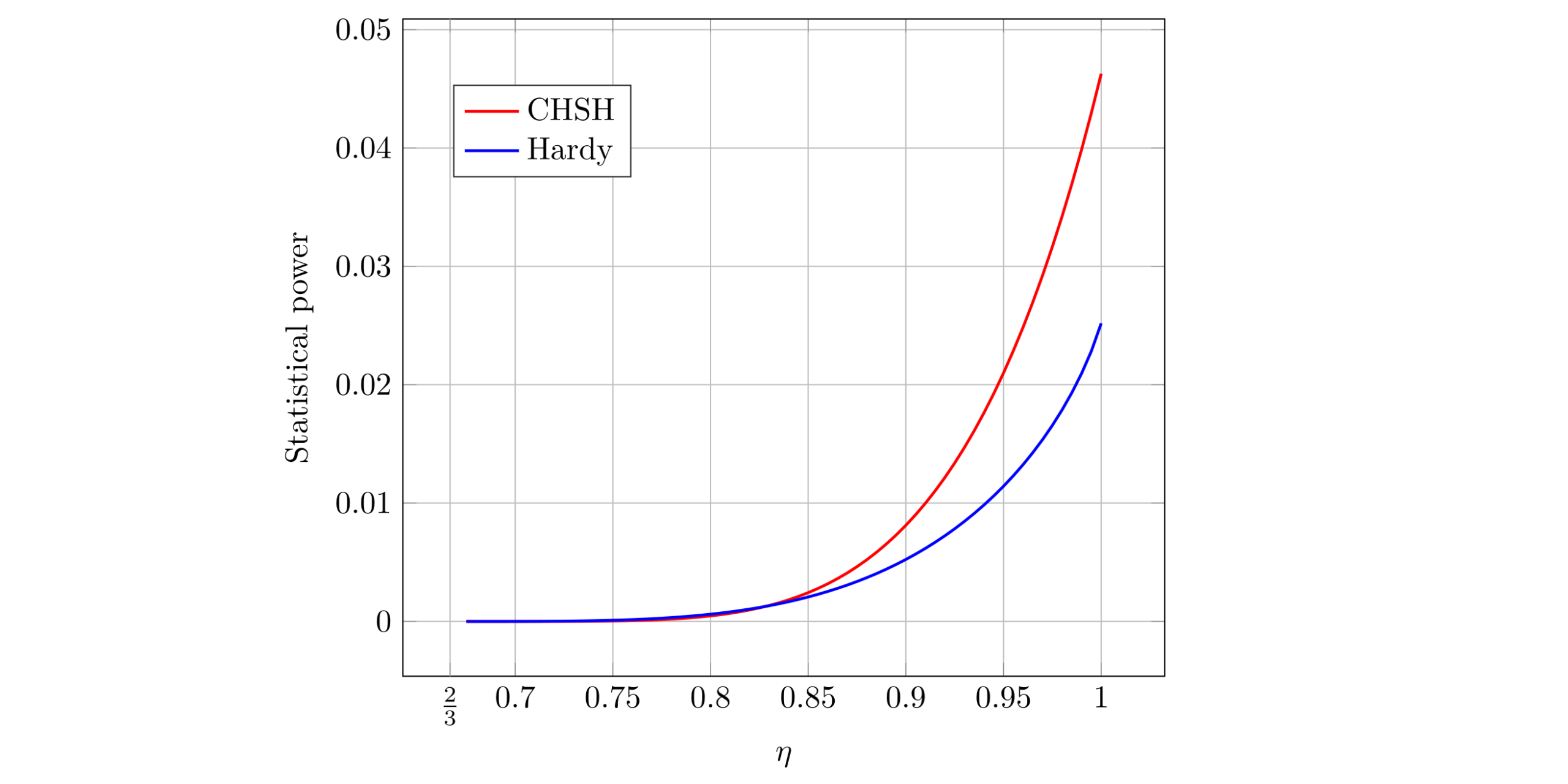
Featured image: Statistical power of the CHSH nonlocal game and the Hardy post-selection game as a function of detection efficiency.
Popular summary
Experimental demonstrations of nonlocality are challenging because of its high sensitivity to noise, that tends to drown out the quantum signal. The noise is not uniform, though, as some answers are more affected than others. In order to go around that, we generalize nonlocal games to post-selection games, where the referee can not only accept or reject the answers, but also entirely discard a round. The players can then use this freedom to make the noisier answers be discarded. As the resulting data is much cleaner, we need much less of it to have conclusive statistics.
► BibTeX data
► References
[1] J. S. Bell ``On the Einstein-Podolsky-Rosen paradox'' Physics 1, 195-200 (1964).
https://doi.org/10.1103/PhysicsPhysiqueFizika.1.195
[2] John F. Clauser, Michael A. Horne, Abner Shimony, and Richard A. Holt, ``Proposed experiment to test local hidden-variable theories'' Physical Review Letters 23, 880–884 (1969).
https://doi.org/10.1103/PhysRevLett.23.880
[3] N. Brunner, D. Cavalcanti, S. Pironio, V. Scarani, and S. Wehner, ``Bell nonlocality'' Reviews of Modern Physics 86, 419–478 (2014).
https://doi.org/10.1103/RevModPhys.86.419
arXiv:1303.2849
[4] Richard D. Gill ``Statistics, Causality and Bell’s Theorem'' Statistical Science 29, 512–528 (2014).
https://doi.org/10.1214/14-sts490
arXiv:1207.5103
[5] Daniel M. Greenberger, Michael A. Horne, Abner Shimony, and Anton Zeilinger, ``Bell’s theorem without inequalities'' American Journal of Physics 58, 1131–1143 (1990).
https://doi.org/10.1119/1.16243
[6] N. David Mermin ``Quantum mysteries revisited'' American Journal of Physics 58, 731–734 (1990).
https://doi.org/10.1119/1.16503
[7] Lucien Hardy ``Quantum mechanics, local realistic theories, and Lorentz-invariant realistic theories'' Physical Review Letters 68, 2981–2984 (1992).
https://doi.org/10.1103/PhysRevLett.68.2981
[8] Lucien Hardy ``Nonlocality for two particles without inequalities for almost all entangled states'' Physical Review Letters 71, 1665–1668 (1993).
https://doi.org/10.1103/PhysRevLett.71.1665
[9] Gilles Brassard, Anne Broadbent, and Alain Tapp, ``Quantum Pseudo-Telepathy'' Foundations of Physics 35, 1877–1907 (2005).
https://doi.org/10.1007/s10701-005-7353-4
[10] Shane Mansfieldand Tobias Fritz ``Hardy’s Non-locality Paradox and Possibilistic Conditions for Non-locality'' Foundations of Physics 42, 709–719 (2012).
https://doi.org/10.1007/s10701-012-9640-1
arXiv:1105.1819
[11] Danilo Boschi, S Branca, Francesco De Martini, and Lucien Hardy, ``Ladder proof of nonlocality without inequalities: Theoretical and experimental results'' Physical Review Letters 79, 2755 (1997).
https://doi.org/10.1103/PhysRevLett.79.2755
[12] Si-Ran Zhao, Shuai Zhao, Hai-Hao Dong, Wen-Zhao Liu, Jing-Ling Chen, Kai Chen, Qiang Zhang, and Jian-Wei Pan, ``Loophole-Free Test of Local Realism via Hardy's Violation'' Physical Review Letters 133, 060201 (2024).
https://doi.org/10.1103/PhysRevLett.133.060201
arXiv:2401.03505
[13] Alessandro Fedrizzi, Marcelo P. Almeida, Matthew A. Broome, Andrew G. White, and Marco Barbieri, ``Hardy's Paradox and Violation of a State-Independent Bell Inequality in Time'' Physical Review Letters 106, 200402 (2011).
https://doi.org/10.1103/PhysRevLett.106.200402
arXiv:1011.1304
[14] John F Clauserand Michael A Horne ``Experimental consequences of objective local theories'' Physical Review D 10, 526 (1974).
https://doi.org/10.1103/PhysRevD.10.526
[15] Philippe H Eberhard ``Background level and counter efficiencies required for a loophole-free Einstein-Podolsky-Rosen experiment'' Physical Review A 47, R747 (1993).
https://doi.org/10.1103/PhysRevA.47.R747
[16] Richard Cleve, Peter Høyer, Ben Toner, and John Watrous, ``Consequences and limits of nonlocal strategies'' Proceedings. 19th IEEE Annual Conference on Computational Complexity, 2004. 236–249 (2004).
https://doi.org/10.1109/CCC.2004.1313847
[17] Wim van Dam, Richard D. Gill, and Peter D. Grünwald, ``The statistical strength of nonlocality proofs'' IEEE Transactions on Information Theory 51, 2812–2835 (2005).
https://doi.org/10.1109/TIT.2005.851738
[18] Mateus Araújo, Flavien Hirsch, and Marco Túlio Quintino, ``Bell nonlocality with a single shot'' Quantum 4, 353 (2020).
https://doi.org/10.22331/q-2020-10-28-353
arXiv:2005.13418
[19] B. S. Tsirelson ``Some results and problems on quantum Bell-type inequalities'' Hadronic Journal Supplement 8, 329–345 (1993).
[20] Valerio Scarani ``Bell nonlocality'' Oxford University Press (2019) DOI:10.1093/oso/9780198788416.001.0001.
https://doi.org/10.1093/oso/9780198788416.001.0001
[21] B. S. Cirel'son ``Quantum generalizations of Bell's inequality'' Letters in Mathematical Physics 4, 93–100 (1980).
https://doi.org/10.1007/BF00417500
[22] Boris Tsirelson ``Quantum information processing - Lecture notes'' (1997).
https://www.webcitation.org/5fl2WZOMI
[23] Koon Tong Goh, Jedrzej Kaniewski, Elie Wolfe, Tamás Vértesi, Xingyao Wu, Yu Cai, Yeong-Cherng Liang, and Valerio Scarani, ``Geometry of the set of quantum correlations'' Physical Review A 97, 022104 (2018).
https://doi.org/10.1103/PhysRevA.97.022104
arXiv:1710.05892
[24] N. David Mermin ``Quantum mysteries refined'' American Journal of Physics 62, 880–887 (1994).
https://doi.org/10.1119/1.17733
[25] Rafael Rabelo, Law Yun Zhi, and Valerio Scarani, ``Device-Independent Bounds for Hardy’s Experiment'' Physical Review Letters 109, 180401 (2012).
https://doi.org/10.1103/physrevlett.109.180401
arXiv:1205.3280
[26] Jan-Åke Larsson ``Loopholes in Bell inequality tests of local realism'' Journal of Physics A: Mathematical and Theoretical 47, 424003 (2014).
https://doi.org/10.1088/1751-8113/47/42/424003
arXiv:1407.0363
[27] Mirjam Weilenmann, Costantino Budroni, and Miguel Navascues, ``Memory attacks in network nonlocality and self-testing'' Quantum 9, 1735 (2025).
https://doi.org/10.22331/q-2025-05-06-1735
arXiv:2402.12318
[28] Stephen Boydand Lieven Vandenberghe ``Convex Optimization'' Cambridge University Press (2004).
http://www.stanford.edu/~boyd/cvxbook/
[29] Miguel Navascués, Stefano Pironio, and Antonio Acín, ``A convergent hierarchy of semidefinite programs characterizing the set of quantum correlations'' New J. Phys. 10, 073013 (2008).
https://doi.org/10.1088/1367-2630/10/7/073013
arXiv:0803.4290
[30] Adán Cabello ````All versus Nothing'' Inseparability for Two Observers'' Physical Review Letters 87, 010403 (2001).
https://doi.org/10.1103/PhysRevLett.87.010403
[31] P. K. Aravind ``A simple demonstration of Bell's theorem involving two observers and no probabilities or inequalities'' American Journal of Physics 72, 1303 (2004).
https://doi.org/10.1119/1.1773173
[32] B. Hensen, H. Bernien, A. E. Dréau, A. Reiserer, N. Kalb, M. S. Blok, J. Ruitenberg, R. F. L. Vermeulen, R. N. Schouten, C. Abellán, W. Amaya, V. Pruneri, M. W. Mitchell, M. Markham, D. J. Twitchen, D. Elkouss, S. Wehner, T. H. Taminiau, and R. Hanson, ``Loophole-free Bell inequality violation using electron spins separated by 1.3 kilometres'' Nature 526, 682–686 (2015).
https://doi.org/10.1038/nature15759
arXiv:1508.05949
[33] Marissa Giustina, Marijn A. M. Versteegh, Sören Wengerowsky, Johannes Handsteiner, Armin Hochrainer, Kevin Phelan, Fabian Steinlechner, Johannes Kofler, Jan-Åke Larsson, Carlos Abellán, and et al., ``Significant-Loophole-Free Test of Bell’s Theorem with Entangled Photons'' Physical Review Letters 115, 250401 (2015).
https://doi.org/10.1103/physrevlett.115.250401
arXiv:1511.03190
[34] Lynden K. Shalm, Evan Meyer-Scott, Bradley G. Christensen, Peter Bierhorst, Michael A. Wayne, Martin J. Stevens, Thomas Gerrits, Scott Glancy, Deny R. Hamel, Michael S. Allman, Kevin J. Coakley, Shellee D. Dyer, Carson Hodge, Adriana E. Lita, Varun B. Verma, Camilla Lambrocco, Edward Tortorici, Alan L. Migdall, Yanbao Zhang, Daniel R. Kumor, William H. Farr, Francesco Marsili, Matthew D. Shaw, Jeffrey A. Stern, Carlos Abellán, Waldimar Amaya, Valerio Pruneri, Thomas Jennewein, Morgan W. Mitchell, Paul G. Kwiat, Joshua C. Bienfang, Richard P. Mirin, Emanuel Knill, and Sae Woo Nam, ``Strong Loophole-Free Test of Local Realism'' Physical Review Letters 115, 250402 (2015).
https://doi.org/10.1103/physrevlett.115.250402
arXiv:1511.03189
[35] Ll. Masanes ``Extremal quantum correlations for $N$ parties with two dichotomic observables per site'' (2005).
[36] Cyril Branciard ``Detection loophole in Bell experiments: How postselection modifies the requirements to observe nonlocality'' Physical Review A 83, 032123 (2011).
https://doi.org/10.1103/PhysRevA.83.032123
arXiv:1010.1178
[37] Nicolas Gigena, Ekta Panwar, Giovanni Scala, Mateus Araújo, Máté Farkas, and Anubhav Chaturvedi, ``Self-testing tilted strategies for maximal loophole-free nonlocality'' npj Quantum Information 11, 82 (2025).
https://doi.org/10.1038/s41534-025-01029-6
arXiv:2405.08743
[38] Won Young Hwang, In Gyu Koh, and Yeong Deok Han, ``The detection loophole in Hardy's nonlocality theorem and minimum detection efficiency'' Physics Letters A 212, 309–314 (1996).
https://doi.org/10.1016/0375-9601(96)00072-2
[39] Mateus Araújo, Peter Brown, Sébastien Designolle, Carlos de Gois, Ye-Chao Liu, Lucas Porto, and Marco Túlio Quintino, ``Ket.jl: a Julia toolbox for quantum information, nonlocality, and entanglement'' (2026) DOI:10.5281/zenodo.14674642.
https://doi.org/10.5281/zenodo.14674642
https://github.com/dev-ket/Ket.jl
[40] Patrick Kofod Mogensenand Asbjørn Nilsen Riseth ``Optim: A mathematical optimization package for Julia'' Journal of Open Source Software 3, 615 (2018).
https://doi.org/10.21105/joss.00615
[41] Adán Cabello ``Bell's theorem with and without inequalities for the three-qubit Greenberger-Horne-Zeilinger and W states'' Physical Review A 65, 032108 (2002).
https://doi.org/10.1103/PhysRevA.65.032108
[42] Lin-Mei Liangand Cheng-Zu Li ``Bell's theorem without inequalities for one class of two-qubit mixed states'' Physics Letters A 318, 300–302 (2003).
https://doi.org/10.1016/j.physleta.2003.09.038
[43] Lin-Mei Liangand Cheng-Zu Li ``Nonlocality without inequalities for two-qubit mixed states based on Cabello's nonlocality'' Physics Letters A 335, 371–373 (2005).
https://doi.org/10.1016/j.physleta.2004.12.046
[44] Jing-Ling Chen, Adán Cabello, Zhen-Peng Xu, Hong-Yi Su, Chunfeng Wu, and Leong Chuan Kwek, ``Hardy's paradox for high-dimensional systems'' Physical Review A 88, 062116 (2013).
https://doi.org/10.1103/PhysRevA.88.062116
arXiv:1308.4468
[45] José Luis Cereceda ``Cabello's nonlocality for generalized three-qubit GHZ states'' Quantum Studies: Mathematics and Foundations 4, 205–215 (2017).
https://doi.org/10.1007/s40509-016-0093-7
arXiv:1609.04763
[46] Hui-Xian Meng, Jie Zhou, Zhen-Peng Xu, Hong-Yi Su, Ting Gao, Feng-Li Yan, and Jing-Ling Chen, ``Hardy's paradox for multisetting high-dimensional systems'' Physical Review A 98, 062103 (2018).
https://doi.org/10.1103/PhysRevA.98.062103
arXiv:1805.04651
[47] Kai-Siang Chen, Shiladitya Mal, Gelo Noel M. Tabia, and Yeong-Cherng Liang, ``Hardy-type paradoxes for an arbitrary symmetric bipartite Bell scenario'' Physical Review A 109, 042206 (2024).
https://doi.org/10.1103/PhysRevA.109.042206
arXiv:2311.02045
Cited by
Could not fetch Crossref cited-by data during last attempt 2026-11-05 12:42:53: Could not fetch cited-by data for 10.22331/q-2026-11-05-2259 from Crossref. This is normal if the DOI was registered recently. On SAO/NASA ADS no data on citing works was found (last attempt 2026-11-05 12:42:53).
This Paper is published in Quantum under the Creative Commons Attribution 4.0 International (CC BY 4.0) license. Copyright remains with the original copyright holders such as the authors or their institutions.