
Prog-QAOA: Framework for resource-efficient quantum optimization through classical programs
1Wigner Research Centre for Physics, Budapest, Hungary
2Eötvös University, Budapest, Hungary
3Institute of Theoretical and Applied Informatics, Polish Academy of Sciences
4Algorithmiq Ltd, Kanavakatu 3C 00160 Helsinki, Finland
5QTF Centre of Excellence, Department of Physics, University of Helsinki, Helsinki, Finland
| Published: | 2025-03-20, volume 9, page 1663 |
| Editor: | Marco Cerezo |
| Eprint: | arXiv:2209.03386v5 |
| Doi: | https://doi.org/10.22331/q-2025-03-20-1663 |
| Citation: | Quantum 9, 1663 (2025). |
Find this paper interesting or want to discuss? Scite or leave a comment on SciRate.
Abstract
Current state-of-the-art quantum optimization algorithms require representing the original problem as a binary optimization problem, which is then converted into an equivalent cost Hamiltonian suitable for the quantum device. Implementing each term of the cost Hamiltonian separately often results in high redundancy, significantly increasing the resources required. Instead, we propose to design classical programs for computing the objective function and certifying the constraints, and later compile them to quantum circuits, eliminating the reliance on the binary optimization problem representation. This results in a new variant of the Quantum Approximate Optimization Algorithm (QAOA), which we name the Program-based QAOA (Prog-QAOA). We exploit this idea for optimization tasks like the Travelling Salesman Problem and Max-$K$-Cut and obtain circuits that are near-optimal with respect to all relevant cost measures, e.g., number of qubits, gates, and circuit depth. While we demonstrate the power of Prog-QAOA only for a particular set of paradigmatic problems, our approach is conveniently applicable to generic optimization problems.
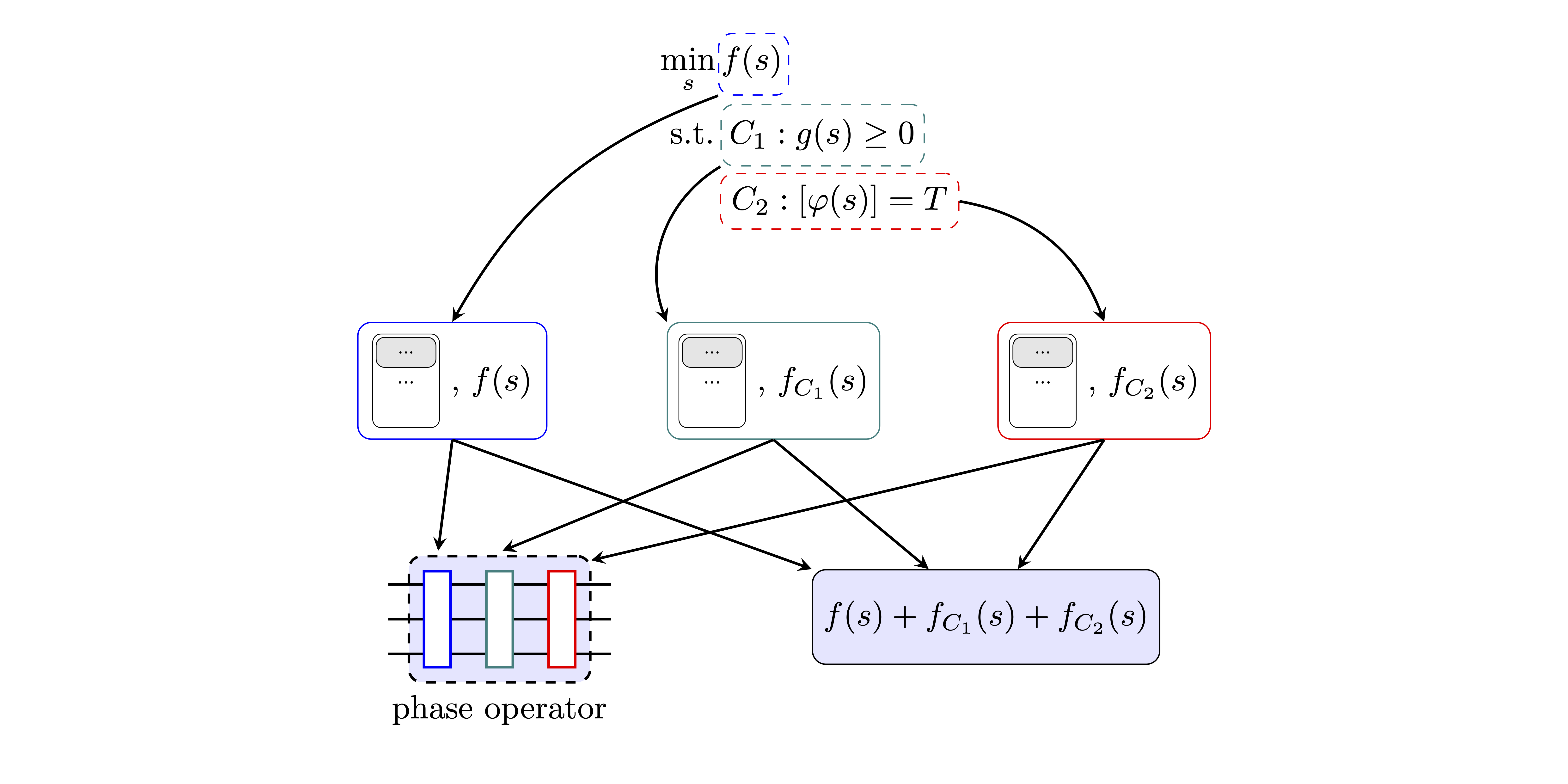
Featured image: A high-level diagram of Prog-QAOA
► BibTeX data
► References
[1] Tameem Albash and Daniel A Lidar. Adiabatic quantum computation. Reviews of Modern Physics, 90 (1): 015002, 2018. 10.1103/RevModPhys.90.015002.
https://doi.org/10.1103/RevModPhys.90.015002
[2] Vikraman Arvind and Gaurav Rattan. The complexity of geometric graph isomorphism. In Electron. Colloquium Comput. Complex., volume 21, page 70, 2014. https://api.semanticscholar.org/CorpusID:31522403.
https://api.semanticscholar.org/CorpusID:31522403
[3] László Babai. Graph isomorphism in quasipolynomial time. In Proceedings of the forty-eighth annual ACM symposium on Theory of Computing, pages 684–697, 2016. 10.1145/2897518.2897542.
https://doi.org/10.1145/2897518.2897542
[4] Adriano Barenco, Charles H Bennett, Richard Cleve, David P DiVincenzo, Norman Margolus, Peter Shor, Tycho Sleator, John A Smolin, and Harald Weinfurter. Elementary gates for quantum computation. Physical Review A, 52 (5): 3457, 1995. 10.1103/PhysRevA.52.3457.
https://doi.org/10.1103/PhysRevA.52.3457
[5] Andreas Bärtschi and Stephan Eidenbenz. Deterministic preparation of Dicke states. In International Symposium on Fundamentals of Computation Theory, pages 126–139. Springer, 2019. 10.1007/978-3-030-25027-0_9.
https://doi.org/10.1007/978-3-030-25027-0_9
[6] Andreas Bärtschi and Stephan Eidenbenz. Grover mixers for QAOA: Shifting complexity from mixer design to state preparation. In 2020 IEEE International Conference on Quantum Computing and Engineering (QCE), pages 72–82. IEEE, 2020. 10.1109/QCE49297.2020.00020.
https://doi.org/10.1109/QCE49297.2020.00020
[7] Jacob Biamonte, Peter Wittek, Nicola Pancotti, Patrick Rebentrost, Nathan Wiebe, and Seth Lloyd. Quantum machine learning. Nature, 549 (7671): 195–202, 2017. 10.1038/nature23474.
https://doi.org/10.1038/nature23474
[8] Max Born and Vladimir Fock. Beweis des adiabatensatzes. Zeitschrift für Physik, 51 (3): 165–180, 1928. 10.1007/BF01343193.
https://doi.org/10.1007/BF01343193
[9] Ludmila Botelho, Adam Glos, Akash Kundu, Jarosław Adam Miszczak, Özlem Salehi, and Zoltán Zimborás. Error mitigation for variational quantum algorithms through mid-circuit measurements. Physical Review A, 105 (2): 022441, 2022. 10.1103/PhysRevA.105.022441.
https://doi.org/10.1103/PhysRevA.105.022441
[10] Sami Boulebnane and Ashley Montanaro. Solving boolean satisfiability problems with the quantum approximate optimization algorithm. PRX Quantum, 5 (3): 030348, 2024. 10.1103/PRXQuantum.5.030348.
https://doi.org/10.1103/PRXQuantum.5.030348
[11] Sami Boulebnane, Xavier Lucas, Agnes Meyder, Stanislaw Adaszewski, and Ashley Montanaro. Peptide conformational sampling using the quantum approximate optimization algorithm. npj Quantum Information, 9 (1): 70, 2023. 10.1038/s41534-023-00733-5.
https://doi.org/10.1038/s41534-023-00733-5
[12] Cristian S Calude, Michael J Dinneen, and Richard Hua. QUBO formulations for the graph isomorphism problem and related problems. Theoretical Computer Science, 701: 54–69, 2017. 10.1016/j.tcs.2017.04.016.
https://doi.org/10.1016/j.tcs.2017.04.016
[13] Colin Campbell and Edward Dahl. QAOA of the highest order. In 2022 IEEE 19th International Conference on Software Architecture Companion (ICSA-C), pages 141–146. IEEE, 2022. 10.1109/ICSA-C54293.2022.00035.
https://doi.org/10.1109/ICSA-C54293.2022.00035
[14] Turbasu Chatterjee, Shah Ishmam Mohtashim, and Akash Kundu. On the variational perspectives to the graph isomorphism problem. arXiv preprint arXiv:2111.09821, 2021. 10.48550/arXiv.2111.09821.
https://doi.org/10.48550/arXiv.2111.09821
arXiv:2111.09821
[15] Adenilton J Da Silva and Daniel K Park. Linear-depth quantum circuits for multiqubit controlled gates. Physical Review A, 106 (4): 042602, 2022. 10.1103/PhysRevA.106.042602.
https://doi.org/10.1103/PhysRevA.106.042602
[16] DaftWullie, 2022. https://quantumcomputing.stackexchange.com/questions/11734.
https://quantumcomputing.stackexchange.com/questions/11734
[17] Pierre Dupuy de la Grand'rive and Jean-Francois Hullo. Knapsack problem variants of QAOA for battery revenue optimisation. arXiv preprint arXiv:1908.02210, 2019. 10.48550/arXiv.1908.02210.
https://doi.org/10.48550/arXiv.1908.02210
arXiv:1908.02210
[18] Sepehr Ebadi, Alexander Keesling, Madelyn Cain, Tout T Wang, Harry Levine, Dolev Bluvstein, Giulia Semeghini, Ahmed Omran, J-G Liu, Rhine Samajdar, et al. Quantum optimization of maximum independent set using Rydberg atom arrays. Science, 376 (6598): 1209–1215, 2022. 10.1126/science.abo6587.
https://doi.org/10.1126/science.abo6587
[19] Kilian Ender, Anette Messinger, Michael Fellner, Clemens Dlaska, and Wolfgang Lechner. Modular parity quantum approximate optimization. PRX Quantum, 3 (3): 030304, 2022. 10.1103/PRXQuantum.3.030304.
https://doi.org/10.1103/PRXQuantum.3.030304
[20] Edward Farhi and Aram W Harrow. Quantum supremacy through the quantum approximate optimization algorithm. arXiv preprint arXiv:1602.07674, 2016. 10.48550/arXiv.1602.07674.
https://doi.org/10.48550/arXiv.1602.07674
arXiv:1602.07674
[21] Edward Farhi, Jeffrey Goldstone, and Sam Gutmann. A quantum approximate optimization algorithm. arXiv preprint arXiv:1411.4028, 2014. 10.48550/arXiv.1411.4028.
https://doi.org/10.48550/arXiv.1411.4028
arXiv:1411.4028
[22] Franz G Fuchs, Herman Øie Kolden, Niels Henrik Aase, and Giorgio Sartor. Efficient encoding of the weighted MAX-$k$-CUT on a quantum computer using QAOA. SN Computer Science, 2 (2): 1–14, 2021. 10.1007/s42979-020-00437-z.
https://doi.org/10.1007/s42979-020-00437-z
[23] Austin Gilliam, Stefan Woerner, and Constantin Gonciulea. Grover adaptive search for constrained polynomial binary optimization. Quantum, 5: 428, 2021. 10.22331/q-2021-04-08-428.
https://doi.org/10.22331/q-2021-04-08-428
[24] Adam Glos, Aleksandra Krawiec, and Zoltán Zimborás. Space-efficient binary optimization for variational quantum computing. npj Quantum Information, 8 (1): 1–8, 2022. 10.1038/s41534-022-00546-y.
https://doi.org/10.1038/s41534-022-00546-y
[25] Saul Gonzalez-Bermejo, Guillermo Alonso-Linaje, and Parfait Atchade-Adelomou. GPS: A new TSP formulation for its generalizations type QUBO. Mathematics, 10 (3): 416, 2022. 10.3390/math10030416.
https://doi.org/10.3390/math10030416
[26] Lov K Grover. A fast quantum mechanical algorithm for database search. In Proceedings of the Twenty-Eighth Annual ACM symposium on Theory of Computing, pages 212–219, 1996. 10.1145/237814.237866.
https://doi.org/10.1145/237814.237866
[27] Stuart Hadfield, Zhihui Wang, Bryan O’Gorman, Eleanor G Rieffel, Davide Venturelli, and Rupak Biswas. From the quantum approximate optimization algorithm to a quantum alternating operator ansatz. Algorithms, 12 (2): 34, 2019. 10.3390/a12020034.
https://doi.org/10.3390/a12020034
[28] Yong He, Ming-Xing Luo, E Zhang, Hong-Ke Wang, and Xiao-Feng Wang. Decompositions of $n$-qubit Toffoli gates with linear circuit complexity. International Journal of Theoretical Physics, 56 (7): 2350–2361, 2017. 10.1007/s10773-017-3389-4.
https://doi.org/10.1007/s10773-017-3389-4
[29] Andrew Lucas. Ising formulations of many NP problems. Frontiers in Physics, 2: 5, 2014. 10.3389/fphy.2014.00005.
https://doi.org/10.3389/fphy.2014.00005
[30] Samuel Marsh and Jingbo B Wang. Combinatorial optimization via highly efficient quantum walks. Physical Review Research, 2 (2): 023302, 2020. 10.1103/PhysRevResearch.2.023302.
https://doi.org/10.1103/PhysRevResearch.2.023302
[31] Sam McArdle, Xiao Yuan, and Simon Benjamin. Error-mitigated digital quantum simulation. Physical Review Letters, 122 (18): 180501, 2019. 10.1103/PhysRevLett.122.180501.
https://doi.org/10.1103/PhysRevLett.122.180501
[32] Clair E Miller, Albert W Tucker, and Richard A Zemlin. Integer programming formulation of Traveling Salesman Problems. Journal of the ACM (JACM), 7 (4): 326–329, 1960. 10.1145/321043.321046.
https://doi.org/10.1145/321043.321046
[33] D Michael Miller, Robert Wille, and Gerhard W Dueck. Synthesizing reversible circuits for irreversible functions. In 2009 12th Euromicro Conference on Digital System Design, Architectures, Methods and Tools, pages 749–756. IEEE, 2009. 10.1109/DSD.2009.186.
https://doi.org/10.1109/DSD.2009.186
[34] S. A. Moses et al. A race-track trapped-ion quantum processor. Phys. Rev. X, 13: 041052, Dec 2023. 10.1103/PhysRevX.13.041052.
https://doi.org/10.1103/PhysRevX.13.041052
[35] Bryan O'Gorman, William J Huggins, Eleanor G Rieffel, and K Birgitta Whaley. Generalized swap networks for near-term quantum computing. arXiv preprint arXiv:1905.05118, 2019. 10.48550/arXiv.1905.05118.
https://doi.org/10.48550/arXiv.1905.05118
arXiv:1905.05118
[36] Francisco Orts, Gloria Ortega, Elías F Combarro, Ignacio F Rúa, Antonio M Puertas, and Ester M Garzón. Efficient design of a quantum absolute-value circuit using Clifford+T gates. The Journal of Supercomputing, pages 1–15, 2023. 10.1007/s11227-023-05162-x.
https://doi.org/10.1007/s11227-023-05162-x
[37] Alberto Peruzzo, Jarrod McClean, Peter Shadbolt, Man-Hong Yung, Xiao-Qi Zhou, Peter J Love, Alán Aspuru-Guzik, and Jeremy L O’Brien. A variational eigenvalue solver on a photonic quantum processor. Nature Communications, 5 (1): 1–7, 2014. 10.1038/ncomms5213.
https://doi.org/10.1038/ncomms5213
[38] John Preskill. Quantum computing in the NISQ era and beyond. Quantum, 2: 79, 2018. 10.22331/q-2018-08-06-79.
https://doi.org/10.22331/q-2018-08-06-79
[39] Rasmus V Rasmussen and Michael A Trick. Round robin scheduling – a survey. European Journal of Operational Research, 188 (3): 617–636, 2008. 10.1016/j.ejor.2007.05.046.
https://doi.org/10.1016/j.ejor.2007.05.046
[40] Lidia Ruiz-Perez and Juan Carlos Garcia-Escartin. Quantum arithmetic with the Quantum Fourier Transform. Quantum Information Processing, 16: 1–14, 2017. 10.1007/s11128-017-1603-1.
https://doi.org/10.1007/s11128-017-1603-1
[41] Reem Saadeh and Mohammad Qatawneh. Performance evaluation of parallel bubble sort algorithm on supercomputer IMAN1. International Journal of Computer Science & Information Technology (IJCSIT) Vol, 11, 2019. 10.2139/ssrn.3423841.
https://doi.org/10.2139/ssrn.3423841
[42] Mehdi Saeedi and Igor L Markov. Synthesis and optimization of reversible circuits—a survey. ACM Computing Surveys (CSUR), 45 (2): 1–34, 2013. 10.1145/2431211.2431220.
https://doi.org/10.1145/2431211.2431220
[43] Mehdi Saeedi and Massoud Pedram. Linear-depth quantum circuits for $n$-qubit Toffoli gates with no ancilla. Physical Review A, 87 (6): 062318, 2013. 10.1103/PhysRevA.87.062318.
https://doi.org/10.1103/PhysRevA.87.062318
[44] Özlem Salehi, Adam Glos, and Jarosław Adam Miszczak. Unconstrained binary models of the Travelling Salesman Problem variants for quantum optimization. Quantum Information Processing, 21 (2): 1–30, 2022. 10.1007/s11128-021-03405-5.
https://doi.org/10.1007/s11128-021-03405-5
[45] Nicolas PD Sawaya, Tim Menke, Thi Ha Kyaw, Sonika Johri, Alán Aspuru-Guzik, and Gian Giacomo Guerreschi. Resource-efficient digital quantum simulation of $d$-level systems for photonic, vibrational, and spin-$s$ Hamiltonians. npj Quantum Information, 6 (1): 1–13, 2020. 10.1038/s41534-020-0278-0.
https://doi.org/10.1038/s41534-020-0278-0
[46] Nicolas PD Sawaya, Albert T Schmitz, and Stuart Hadfield. Encoding trade-offs and design toolkits in quantum algorithms for discrete optimization: coloring, routing, scheduling, and other problems. Quantum, 7: 1111, 2023. 10.22331/q-2023-09-14-1111.
https://doi.org/10.22331/q-2023-09-14-1111
[47] Jacob T Seeley, Martin J Richard, and Peter J Love. The Bravyi-Kitaev transformation for quantum computation of electronic structure. The Journal of Chemical Physics, 137 (22): 224109, 2012. 10.1063/1.4768229.
https://doi.org/10.1063/1.4768229
[48] Ruslan Shaydulin, Changhao Li, Shouvanik Chakrabarti, Matthew DeCross, Dylan Herman, Niraj Kumar, Jeffrey Larson, Danylo Lykov, Pierre Minssen, Yue Sun, et al. Evidence of scaling advantage for the quantum approximate optimization algorithm on a classically intractable problem. Science Advances, 10 (22): eadm6761, 2024. 10.1126/sciadv.adm6761.
https://doi.org/10.1126/sciadv.adm6761
[49] Peter W Shor. Polynomial-time algorithms for prime factorization and discrete logarithms on a quantum computer. SIAM Review, 41 (2): 303–332, 1999. 10.1137/S0036144598347011.
https://doi.org/10.1137/S0036144598347011
[50] Ryan Sweke, Frederik Wilde, Johannes Meyer, Maria Schuld, Paul K Fährmann, Barthélémy Meynard-Piganeau, and Jens Eisert. Stochastic gradient descent for hybrid quantum-classical optimization. Quantum, 4: 314, 2020. 10.22331/q-2020-08-31-314.
https://doi.org/10.22331/q-2020-08-31-314
[51] Zsolt Tabi, Kareem H El-Safty, Zsófia Kallus, Péter Hága, Tamás Kozsik, Adam Glos, and Zoltán Zimborás. Quantum optimization for the graph coloring problem with space-efficient embedding. In 2020 IEEE International Conference on Quantum Computing and Engineering (QCE), pages 56–62. IEEE, 2020. 10.1109/QCE49297.2020.00018.
https://doi.org/10.1109/QCE49297.2020.00018
[52] Samson Wang, Enrico Fontana, Marco Cerezo, Kunal Sharma, Akira Sone, Lukasz Cincio, and Patrick J Coles. Noise-induced barren plateaus in variational quantum algorithms. Nature Communications, 12 (1): 1–11, 2021. 10.1038/s41467-021-27045-6.
https://doi.org/10.1038/s41467-021-27045-6
[53] Zhihui Wang, Nicholas C Rubin, Jason M Dominy, and Eleanor G Rieffel. XY mixers: Analytical and numerical results for the quantum alternating operator ansatz. Physical Review A, 101 (1): 012320, 2020. 10.1103/PhysRevA.101.012320.
https://doi.org/10.1103/PhysRevA.101.012320
[54] Xiao Yuan, Suguru Endo, Qi Zhao, Ying Li, and Simon C Benjamin. Theory of variational quantum simulation. Quantum, 3: 191, 2019. 10.22331/q-2019-10-07-191.
https://doi.org/10.22331/q-2019-10-07-191
[55] You Zhou and Qing Liu. Performance analysis of multi-shot shadow estimation. Quantum, 7: 1044, 2023. 10.22331/q-2023-06-29-1044.
https://doi.org/10.22331/q-2023-06-29-1044
[56] Kenneth M Zick, Omar Shehab, and Matthew French. Experimental quantum annealing: case study involving the graph isomorphism problem. Scientific Reports, 5 (1): 11168, 2015. 10.1038/srep11168.
https://doi.org/10.1038/srep11168
Cited by
[1] Josh Cudby, James Bonfield, Chenxi Zhou, Richard Durbin, and Sergii Strelchuk, "Pangenome-guided sequence assembly via binary optimisation", (2025).
[2] Anita Weidinger, Glen Bigan Mbeng, Michael Fellner, Davit Khachatryan, and Wolfgang Lechner, "Performance of parity QAOA for the signed Max-Cut problem", New Journal of Physics 28 3, 034514 (2026).
[3] Saba Arife Bozpolat and Özlem Salehi Köken, "Kuantum Yaklaşık Optimizasyon Algoritması İçin Hamilton İşlemcisi İnşası Yöntemlerinin Karşılaştırmalı Analizi", International Journal of Advances in Engineering and Pure Sciences 38 1, 91 (2026).
[4] Seyed Ehsan Ghasempouri, Gerhard W. Dueck, and Stijn De Baerdemacker, "Max-Cut graph-driven quantum circuit design for geometrically frustrated planar spin systems with spin-glass-like energy landscapes", Physical Review Research 8 4, 043084 (2026).
[5] Bence Bakó, Dániel T R Nagy, Péter Hága, Zsófia Kallus, and Zoltán Zimborás, "Problem-informed graphical quantum generative learning", Quantum Science and Technology 11 3, 035012 (2026).
[6] Jatin Yadav and Vaishali Ganganwar, 2026 International Conference on Emerging Smart Computing and Informatics (ESCI) 1 (2026) ISBN:979-8-3315-8949-3.
[7] Carla Piazza, Riccardo Romanello, and Beniamino Todone, 2026 IEEE International Conference on Quantum Software (QSW) 57 (2026) ISBN:979-8-3195-1200-0.
[8] Alexander Engelsberger, Magdalena Pšeničkova, and Thomas Villmann, "Prototype-Based Classifiers and Vector Quantization on a Quantum Computer—Implementing Integer Arithmetic Oracles for Nearest Prototype Search", Entropy 28 2, 229 (2026).
[9] Don Roosan and Rubayat Khan, Quantum Informatics for Novel Therapeutics 107 (2026) ISBN:978-3-032-19535-7.
[10] Elijah Pelofske, Andreas Bärtschi, and Stephan Eidenbenz, "Short-depth QAOA circuits and quantum annealing on higher-order ising models", npj Quantum Information 10 1, 30 (2024).
[11] Zewen Zhang, Roger Paredes, Bhuvanesh Sundar, David Quiroga, Anastasios Kyrillidis, Leonardo Duenas-Osorio, Guido Pagano, and Kaden R. A. Hazzard, "Grover-QAOA for 3-SAT: quadratic speedup, fair-sampling, and parameter clustering", Quantum Science and Technology 10 1, 015022 (2025).
[12] Márton Karácsony, László Oroszlány, and Zoltan Zimboras, "Efficient qudit based scheme for photonic quantum computing", SciPost Physics Core 7 2, 032 (2024).
[13] Nicolas PD Sawaya, Albert T. Schmitz, and Stuart Hadfield, "Encoding trade-offs and design toolkits in quantum algorithms for discrete optimization: coloring, routing, scheduling, and other problems", Quantum 7, 1111 (2023).
[14] Anita Weidinger, Glen Bigan Mbeng, and Wolfgang Lechner, "Error mitigation for quantum approximate optimization", Physical Review A 108 3, 032408 (2023).
[15] Akash Kundu, "Reinforcement learning-assisted quantum architecture search for variational quantum algorithms", arXiv:2402.13754, (2024).
[16] Ankit Khandelwal, Handy Kurniawan, Shraddha Aangiras, Özlem Salehi, and Adam Glos, "Classification and transformations of quantum circuit decompositions for permutation operations", Quantum Information Processing 23 9, 322 (2024).
[17] Wenyang Qian, Robert A. M. Basili, Mary Mehrnoosh Eshaghian-Wilner, Ashfaq Khokhar, Glenn Luecke, and James P. Vary, "Comparative Study of Variations in Quantum Approximate Optimization Algorithms for the Traveling Salesman Problem", Entropy 25 8, 1238 (2023).
[18] Anita Weidinger, Glen Bigan Mbeng, Michael Fellner, Davit Khachatryan, and Wolfgang Lechner, "Performance of Parity QAOA for the Signed Max-Cut Problem", arXiv:2409.14786, (2024).
[19] Igor Gaidai and Rebekah Herrman, "Decomposition of sparse amplitude permutation gates with application to preparation of sparse clustered quantum states", Quantum Information Processing 25 1, 31 (2026).
[20] Jonas Nüßlein, Daniëlle Schuman, David Bucher, Naeimeh Mohseni, Kumar Ghosh, Corey O'Meara, Giorgio Cortiana, and Claudia Linnhoff-Popien, "Towards Less Greedy Quantum Coalition Structure Generation in Induced Subgraph Games", arXiv:2408.04366, (2024).
[21] Aritra Sarkar, "Automated Quantum Software Engineering: why? what? how?", arXiv:2212.00619, (2022).
[22] Mingyou Wu and Hanwu Chen, "Adiabatic-Passage-Based Parameter Setting for Quantum Approximate Optimization Algorithm", arXiv:2312.00077, (2023).
[23] Aliya Khadieva, "Quantum hashing algorithm implementation", arXiv:2407.10136, (2024).
[24] Aliya Khadieva, Özlem Salehi, and Abuzer Yakaryılmaz, "A Representative Framework for Implementing Quantum Finite Automata on Real Devices", arXiv:2406.11360, (2024).
[25] Josh Cudby, James Bonfield, Chenxi Zhou, Richard Durbin, and Sergii Strelchuk, "Pangenome-guided sequence assembly via binary optimisation", arXiv:2508.08200, (2025).
[26] Akash Kundu, Ludmila Botelho, and Adam Glos, "Hamiltonian-oriented homotopy quantum approximate optimization algorithm", Physical Review A 109 2, 022611 (2024).
[27] Elisabeth Wybo and Jernej Rudi Finžgar, "Quantum-informed surrogate sampling for combinatorial optimization", arXiv:2607.22372, (2026).
[28] Daniel Goldsmith, Xing Liang, Dimitrios Makris, and Hongwei Wu, "Solving larger Travelling Salesman Problem networks with a penalty-free Variational Quantum Algorithm", arXiv:2512.06523, (2025).
[29] András Czégel, Dávid Sipos, and Boglárka G. -Tóth, "A quantum-classical hybrid branch & bound algorithm", arXiv:2511.19501, (2025).
[30] Omer Gurevich, Maor Matityahu, Tal Mor, and Aryeh Lev Zabokritskiy, "Correcting Connectivity in Arc-Based QUBO Models for Fixed-Fleet Vehicle Routing", arXiv:2608.26894, (2026).
[31] Owen Friedewald, Ali Shiri Sichani, and Chi-Ren Shyu, "Exact Diagonal Completion on Reachable Subspaces: Application to QAOA Placement", arXiv:2609.38734, (2026).
[32] V. S. Yarmus and Kh. P. Gnatenko, "Solving the MAX-$k$-CUT problem for hypergraphs with quantum computing", arXiv:2610.41678.
The above citations are from Crossref's cited-by service (last updated successfully 2026-11-07 15:50:28) and SAO/NASA ADS (last updated successfully 2026-11-07 15:50:34). The list may be incomplete as not all publishers provide suitable and complete citation data.
This Paper is published in Quantum under the Creative Commons Attribution 4.0 International (CC BY 4.0) license. Copyright remains with the original copyright holders such as the authors or their institutions.