
Unitary causal decompositions: a characterisation via lattice theory
1Department of Computer Science, University of Oxford, Oxford, United Kingdom
2Perimeter Institute for Theoretical Physics, Waterloo, Ontario, Canada
3Quantinuum, London, United Kingdom
| Published: | 2026-09-30, volume 10, page 2218 |
| Editor: | Andrea Di Biagio |
| Eprint: | arXiv:2508.11762v2 |
| Doi: | https://doi.org/10.22331/q-2026-09-30-2218 |
| Citation: | Quantum 10, 2218 (2026). |
Find this paper interesting or want to discuss? Scite or leave a comment on SciRate.
Abstract
If a unitary transformation has a circuit representation with no directed path from input $a$ to output $b$, then $a$ does not influence $b$ through the overall unitary. Conversely, if a unitary satisfies a number of no-influence conditions, it is natural to wonder whether a circuit decomposition exists in which all of them are represented by absences of paths. Such decompositions are known as causal decompositions; determining their existence in general is a central open problem in the study of causal structure in quantum theory. We present progress towards a general solution by considering the special case of unitary causal decompositions, i.e. decompositions in terms of unitary circuits in the traditional quantum circuit formalism that do not require the generalisation to 'extended' or 'routed' quantum circuits prompted by earlier research on this topic. We identify a combinatorial condition that characterises precisely those sets of no-influence constraints $G$ for which any unitary transformation satisfying $G$ admits a unitary causal decomposition representing the constraints. Our approach is systematic, grounded in lattice theory and finite-dimensional operator algebra, and offers hope for extensions to more general (e.g. routed unitary) causal decompositions in the future.
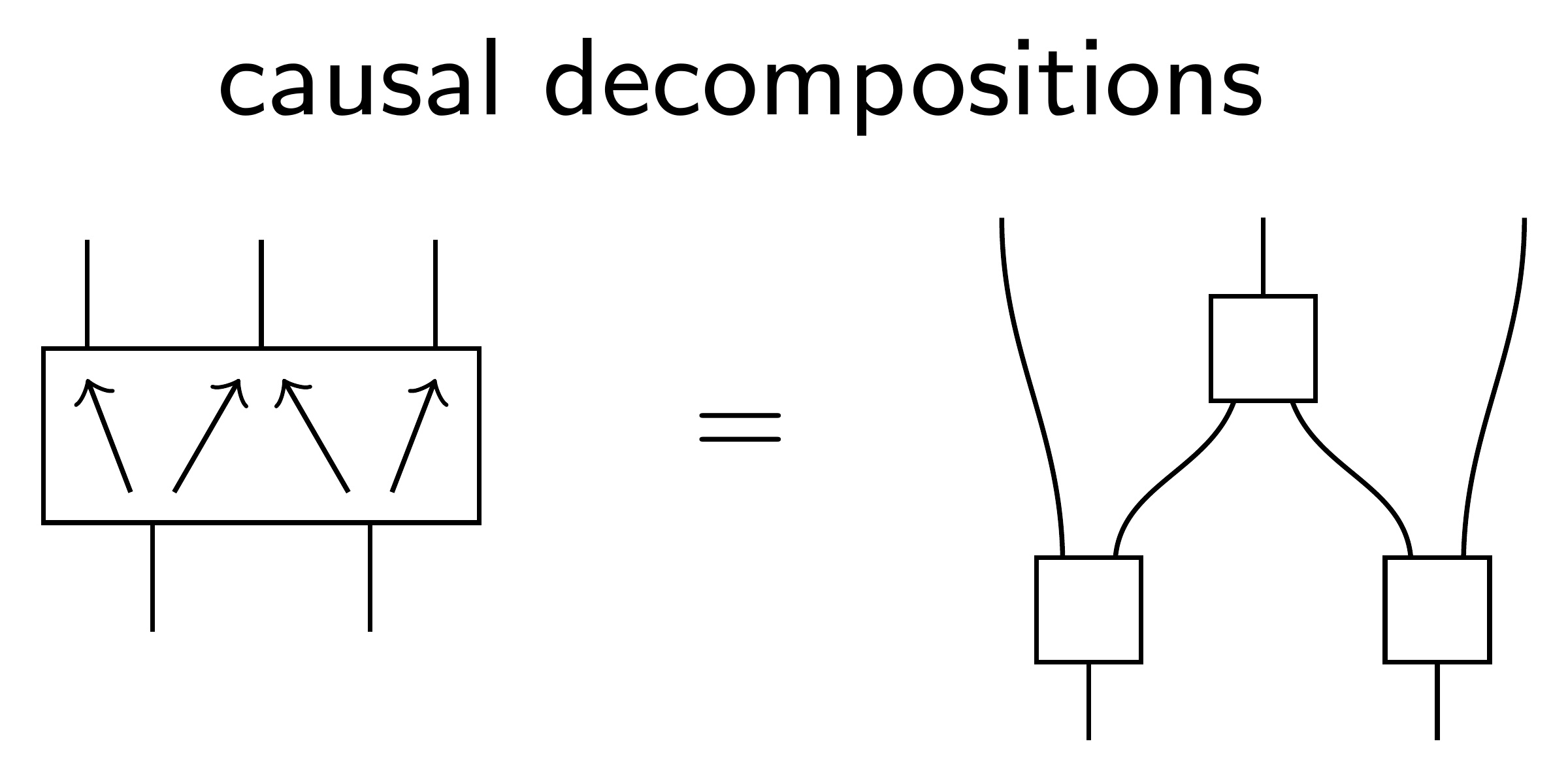
Featured image: Any two-input, three-output unitary whose causal dependency relations are as indicated on the left can be decomposed into a circuit as on the right, making the absence of influence from left to right and from right to left immediately apparent by the absence of paths through the circuit. We characterise to what other causal structures this can be generalised within the traditional unitary circuit formalism.
Popular summary
► BibTeX data
► References
[1] Christopher J Woodand Robert W Spekkens ``The Lesson of Causal Discovery Algorithms for Quantum Correlations: Causal Explanations of Bell-inequality Violations Require Fine-Tuning'' New Journal of Physics 17, 033002 (2015).
https://doi.org/10.1088/1367-2630/17/3/033002
[2] John-Mark A. Allen, Jonathan Barrett, Dominic C. Horsman, Ciarán M. Lee, and Robert W. Spekkens, ``Quantum Common Causes and Quantum Causal Models'' Physical Review X 7, 031021 (2017).
https://doi.org/10.1103/PhysRevX.7.031021
arXiv:1609.09487
[3] Jonathan Barrett, Robin Lorenz, and Ognyan Oreshkov, ``Quantum Causal Models'' (2019).
https://doi.org/10.48550/arXiv.1906.10726
arXiv:1906.10726
[4] Fabio Costaand Sally Shrapnel ``Quantum Causal Modelling'' New Journal of Physics 18, 063032 (2016).
https://doi.org/10.1088/1367-2630/18/6/063032
arXiv:1512.07106
[5] Joe Henson, Raymond Lal, and Matthew F Pusey, ``Theory-Independent Limits on Correlations from Generalized Bayesian Networks'' New Journal of Physics 16, 113043 (2014).
https://doi.org/10.1088/1367-2630/16/11/113043
arXiv:1405.2572
[6] David Beckman, Daniel Gottesman, M. A. Nielsen, and John Preskill, ``Causal and Localizable Quantum Operations'' Physical Review A 64, 21 (2001).
https://doi.org/10.1103/PhysRevA.64.052309
[7] T. Eggeling, D. Schlingemann, and R. F. Werner, ``Semicausal Operations Are Semilocalizable'' Europhysics Letters 57, 782–788 (2002).
https://doi.org/10.1209/epl/i2002-00579-4
[8] Benjamin Schumacherand Michael D. Westmoreland ``Locality and Information Transfer in Quantum Operations'' Quantum Information Processing 4, 13–34 (2005).
https://doi.org/10.1007/s11128-004-3193-y
[9] Pablo Arrighi, Vincent Nesme, and Reinhard Werner, ``Unitarity plus Causality Implies Localizability'' Journal of Computer and System Sciences 77, 372–378 (2011).
https://doi.org/10.1016/j.jcss.2010.05.004
arXiv:0711.3975
https://linkinghub.elsevier.com/retrieve/pii/S0022000010000589
[10] B. Schumacherand R. F. Werner ``Reversible Quantum Cellular Automata'' (2004).
https://doi.org/10.48550/arXiv.quant-ph/0405174
http://arxiv.org/abs/quant-ph/0405174
[11] Pablo Arrighi, Renan Fargetton, Vincent Nesme, and Eric Thierry, ``Applying Causality Principles to the Axiomatization of Probabilistic Cellular Automata'' Springer Berlin Heidelberg (2011).
https://doi.org/10.1007/978-3-642-21875-0_1
arXiv:1102.0860
[12] Asif Shakeeland Peter J. Love ``When Is a Quantum Cellular Automaton (QCA) a Quantum Lattice Gas Automaton (QLGA)?'' Journal of Mathematical Physics 54, 092203 (2013).
https://doi.org/10.1063/1.4821640
arXiv:1209.5367
https://pubs.aip.org/jmp/article/54/9/092203/233213/When-is-a-quantum-cellular-automaton-QCA-a-quantum
[13] Robin Lorenzand Jonathan Barrett ``Causal and Compositional Structure of Unitary Transformations'' Quantum 5, 1–46 (2021).
https://doi.org/10.22331/Q-2021-07-28-511
arXiv:2001.07774
[14] Augustin Vanrietvelde, Octave Mestoudjian, and Pablo Arrighi, ``Causal Decompositions of 1D Quantum Cellular Automata'' (2025).
https://doi.org/10.48550/arXiv.2506.22219
arXiv:2506.22219
[15] ``Causal and Compositional Structure in Quantum Theory'' thesis (2025).
https://doi.org/10.5287/ORA-VQ7OPD7AP
https://ora.ox.ac.uk/objects/uuid:09e2b66c-6877-4c3c-8972-e22756daf846
[16] Augustin Vanrietvelde, Hlér Kristjánsson, and Jonathan Barrett, ``Routed Quantum Circuits'' Quantum 5, 1–35 (2021).
https://doi.org/10.22331/Q-2021-07-13-503
arXiv:2011.08120
[17] ``An Order-Theoretic Circuit Syntax and Characterisation of the Concept Lattice'' (2025).
https://doi.org/10.48550/arXiv.2507.05428
arXiv:2507.05428
[18] Jonathan Barrett, Robin Lorenz, and Ognyan Oreshkov, ``Cyclic Quantum Causal Models'' Nature Communications 12, 1–15 (2021).
https://doi.org/10.1038/s41467-020-20456-x
arXiv:2002.12157
[19] Nick Ormrod, Augustin Vanrietvelde, and Jonathan Barrett, ``Causal Structure in the Presence of Sectorial Constraints, with Application to the Quantum Switch'' Quantum 7, 1028 (2023).
https://doi.org/10.22331/q-2023-06-01-1028
https://quantum-journal.org/papers/q-2023-06-01-1028/
[20] Augustin Vanrietvelde, Nick Ormrod, Hlér Kristjánsson, and Jonathan Barrett, ``Consistent Circuits for Indefinite Causal Order'' Quantum 9, 1923 (2025).
https://doi.org/10.22331/q-2025-12-02-1923
arXiv:2206.10042
[21] Judea Pearl ``Causality: Models, Reasoning, and Inference'' Cambridge University Press (2009).
https://doi.org/10.1017/CBO9780511803161
https://www.cambridge.org/core/product/identifier/9780511803161/type/book
[22] Tobias Fritz ``Beyond Bell’s Theorem II: Scenarios with Arbitrary Causal Structure'' Communications in Mathematical Physics 341, 391–434 (2016).
https://doi.org/10.1007/s00220-015-2495-5
arXiv:1404.4812
[23] Rafael Chaves, Christian Majenz, and David Gross, ``Information-Theoretic Implications of Quantum Causal Structures'' Nature Communications 6, 5766 (2015).
https://doi.org/10.1038/ncomms6766
https://www.nature.com/articles/ncomms6766
[24] Tein van der Lugt ``Causally faithful circuits for relativistic realisability, or: What can you do in a spacetime?'' (2024) PIRSA:24090098.
https://doi.org/10.48660/24090098
https://pirsa.org/24090098
[25] Augustin Vanrietvelde, Octave Mestoudjian, and Pablo Arrighi, ``Partitions in Quantum Theory'' (2025).
https://doi.org/10.48550/arXiv.2506.22218
arXiv:2506.22218
[26] Garrett Birkhoff ``Lattice Theory'' American Mathematical Society (1967).
https://doi.org/10.1090/coll/025
[27] Bernhard Ganterand Rudolf Wille ``Formal Concept Analysis: Mathematical Foundations'' Springer Nature Switzerland (2024).
https://doi.org/10.1007/978-3-031-63422-2
[28] Matt Wilsonand Augustin Vanrietvelde ``Composable Constraints'' (2021).
https://doi.org/10.48550/arXiv.2112.06818
arXiv:2112.06818
[29] Robin Lorenz ``Quantum Causal Structure'' thesis (Trinity Term 2020).
https://doi.org/10.5287/ora-2nedjjdex
https://ora.ox.ac.uk/objects/uuid:20c76feb-0e89-40b5-a303-09ba9feb5f37
[30] Nick Ormrodand Jonathan Barrett ``Quantum Influences and Event Relativity'' (2024).
https://doi.org/10.48550/arXiv.2401.18005
arXiv:2401.18005
[31] Nick van der Ormrod, Yìlè Yīng, and Jarosław K. Korbicz, ``Decoherence without the State: A Causal Quantum Darwinist Approach'' (2026).
https://doi.org/10.48550/arXiv.2605.07090
arXiv:2605.07090
[32] Augustin Vanrietvelde ``Routed Quantum Circuits: An Extended Framework for Coherent Control and Indefinite Causal Order'' thesis (2022).
https://www.cs.ox.ac.uk/people/aleks.kissinger/theses/vanrietvelde-thesis.pdf
[33] Augustin Vanrietveldeand Giulio Chiribella ``Universal Control of Quantum Processes Using Sector-Preserving Channels'' Quantum Information and Computation 21, 1320–1352 (2021).
https://doi.org/10.26421/QIC21.15-16-5
arXiv:2106.12463
[34] Thomas S Richardsonand James M Robins ``Single World Intervention Graphs (SWIGs): A Unification of the Counterfactual and Graphical Approaches to Causality'' Center for Statistics and the Social Sciences, University of Washington (2013).
https://csss.uw.edu/research/working-papers/single-world-intervention-graphs-swigs-unification-counterfactual-and
[35] Elie Wolfe, Alejandro Pozas-Kerstjens, Matan Grinberg, Denis Rosset, Antonio Acín, and Miguel Navascués, ``Quantum Inflation: A General Approach to Quantum Causal Compatibility'' Physical Review X 11, 021043 (2021).
https://doi.org/10.1103/PhysRevX.11.021043
arXiv:1909.10519
[36] Carl A. Millerand Yusuf Alnawakhtha ``Impossibility of Perfect Cheating for Single-Qubit Position Verification'' Physical Review A 114 (2026).
https://doi.org/10.1103/4pcn-d1yj
arXiv:2406.20022
[37] Harry Buhrman, Nishanth Chandran, Serge Fehr, Ran Gelles, Vipul Goyal, Rafail Ostrovsky, and Christian Schaffner, ``Position-Based Quantum Cryptography: Impossibility and Constructions'' SIAM Journal on Computing 43, 150–178 (2014).
https://doi.org/10.1137/130913687
arXiv:1009.2490
[38] Daniel Centenoand Elie Wolfe ``Distinguishing Quantum Causal Scenarios with Indistinguishable Classical Analogs: The Significance of Intermediate Latents'' Physical Review A 112, 042206 (2025).
https://doi.org/10.1103/f7dh-5xht
arXiv:2412.10238
[39] Douglas R. Farenick ``Algebras of Linear Transformations'' Springer New York (2001).
https://doi.org/10.1007/978-1-4613-0097-7
[40] Nick Ormrod ``A Causal Derivation of the Algebraic Approach to Quantum Systems'' (2025).
https://doi.org/10.48550/arXiv.2508.01111
arXiv:2508.01111
[41] Aleks Kissinger, Matty Hoban, and Bob Coecke, ``Equivalence of Relativistic Causal Structure and Process Terminality'' (2017).
https://doi.org/10.48550/arXiv.1708.04118
arXiv:1708.04118
Cited by
[1] Daniel Centeno and Elie Wolfe, "Distinguishing quantum causal scenarios with indistinguishable classical analogs: The significance of intermediate latents", Physical Review A 112 4, 042206 (2025).
The above citations are from SAO/NASA ADS (last updated successfully 2026-10-12 20:24:17). The list may be incomplete as not all publishers provide suitable and complete citation data.
On Crossref's cited-by service no data on citing works was found (last attempt 2026-10-12 20:24:16).
This Paper is published in Quantum under the Creative Commons Attribution 4.0 International (CC BY 4.0) license. Copyright remains with the original copyright holders such as the authors or their institutions.